As of 2026-09-25 00:34 UTC. World leaders adopted a United Nations declaration on sea-level rise on September 24, bringing coastal protection, access to finance and the survival of states into one political agreement. For low-lying countries, the significance extends beyond keeping seawater out: the text also addresses what happens to sovereignty and maritime zones as coastlines change.[1][2]
The immediate question is how governments turn that agreement into funded work. The declaration calls for more accessible finance and stronger infrastructure planning, but specifies no new dedicated fund, project allocations or construction deadlines. Its adoption gives governments a shared agenda; delivery still needs budgets, institutions and decisions about particular places.[2]
What the agreement changes
Three parts of the record matter most:
- The September 24 outcome: paragraphs 10–13 call for more support, simpler access to finance and predictable disbursement, alongside ecosystem restoration and sea-level projections built into infrastructure design and maintenance. These are agreed objectives; the document supplies no project-by-project spending schedule.[1][2]
- The legal direction: paragraphs 20–21 support maintaining maritime zones established consistently with the UN Convention on the Law of the Sea, and a presumption favouring continued statehood. Those provisions strengthen political recognition of continuity, while retaining references to international law. They should not be presented as settling every future dispute.[2]
- The physical baseline: WMO's March 2026 climate summary reports that global mean sea level remained near record highs in 2025. Its estimated annual rise was 4.75 millimetres during 2012–2025, compared with 2.65 millimetres during 1993–2011. Those are observed global averages over different periods, not a forecast for any individual island.[4]
The last distinction matters for spending. WMO's scientific review explains that ocean dynamics, ice loss and local land movement produce different relative sea-level changes around the world. A port, clinic or water system needs a local assessment; multiplying the global rate by its expected lifetime cannot substitute for one.[5]
A pledge, a policy and a built coastline
Britain's September 24 statement illustrates why the different forms of support need separate accounting. It cited a £330 million pledge to the Global Environment Facility's ninth replenishment. That is broader environmental funding, including emissions and biodiversity work, rather than a sum assigned entirely to sea-level adaptation. The statement also described continued recognition of statehood as its starting point, with circumstances and affected people's wishes considered in each case.[3]
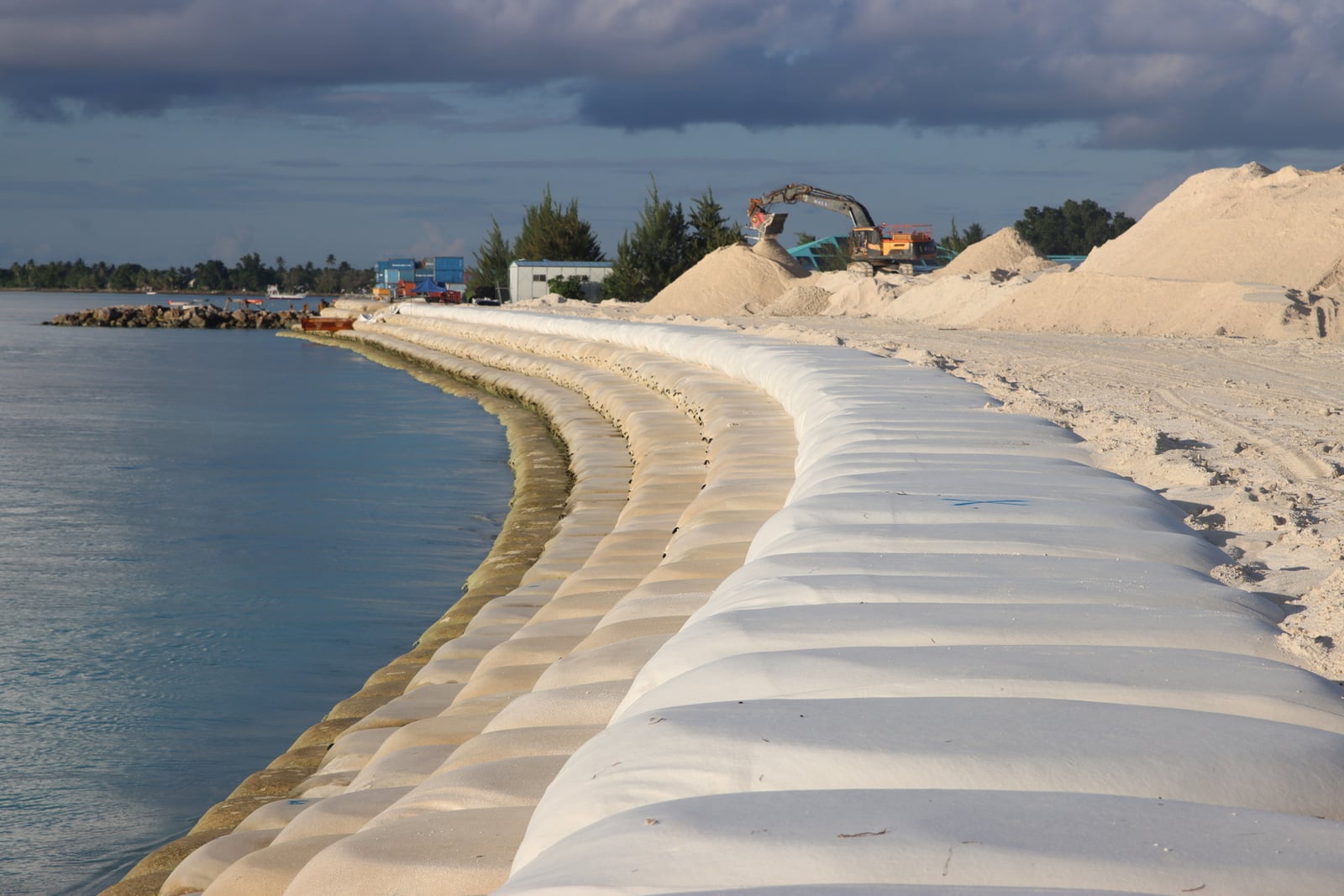
Tuvalu supplies a more tangible reference point. In October 2025, the UN country team reported completion of eight hectares of reclaimed land under a US$17.5 million project funded by Australia, New Zealand and the United States. Its account describes community participation throughout the work and plans to use the new space for housing, livelihoods and public facilities, guided by the Funafuti Kaupule's Development Control Plan.[6]
That project predates this week's declaration. Its value as a comparison is the visible chain from named funders to a defined site and completed physical work. A reclaimed plot also leaves subsequent choices about housing, services and maintenance. Coastal resilience requires institutions to keep making those choices after the opening ceremony.
What to watch over the next month
For coastal authorities, the useful follow-up is evidence that the declaration changes a funding application, a planning requirement or a project. For donors and newsrooms, the task is to distinguish an announced contribution from approved spending and money actually disbursed. The following are monitoring horizons, not deadlines imposed by the agreement:
- Next 24 hours: check the adopted wording and national statements before attributing a pledge or recognition policy to all participating governments.
- Next seven days: look for named implementing agencies, funding conditions and procedures that make applications easier for vulnerable countries.
- Next 30 days: look for approved allocations, procurement steps or revised coastal plans connecting the diplomatic commitments to specific communities.
Three conditional paths follow. Base: ministries work through existing funds and planning systems; the signal is documented follow-up without a new financing mechanism. Upside: a fund simplifies access or a government announces an allocation with a recipient and delivery schedule. Downside: announcements repeat support while identifiable projects encounter documented funding or implementation delays. These are analytical scenarios, not predictions; a month without a new announcement alone would not prove failure.
The practical checklist is short: record the funder, recipient, amount, approval status and delivery date; keep older projects separate from new commitments; and check whether local communities help determine the use of protected land. Revise this assessment if an implementing decision establishes a dedicated fund or binding delivery timetable. The declaration has made the shared objectives clearer. The next evidence must show where they change conditions on the coast.
Sources
- UN News, “LIVE: World leaders approve new declaration to tackle rising sea levels” (September 24, 2026) — adoption reporting and link to the agreed text.
- UN General Assembly, final declaration text circulated August 20, 2026 and linked in the September 24 adoption report — especially paragraphs 10–13, 20–21 and 24.
- UK Foreign, Commonwealth & Development Office, statement at the high-level meeting on sea-level rise (September 24, 2026) — national recognition policy and the scope of the GEF pledge.
- World Meteorological Organization, “State of the Climate 2025” summary (March 2026) — observed global sea-level rates and their comparison periods.
- Tim Naish, Edward Hanna and Amy Lovecroft, WMO Bulletin, “Future Sea-level Rise Is Certain, but the Amount and Speed Are Uncertain” (October 15, 2025) — regional variation and local planning limits.
- Avneel Abhishay Chand, UN country team for the Pacific, “From Ocean to Land: Tuvalu Reclaims Its Future Against Rising Seas” (October 14, 2025) — completed reclamation, funders, community participation and intended land use.
- UNDP, photograph of coastal protection works in Tuvalu, published with its October 2025 project-completion announcement — original photographic asset.