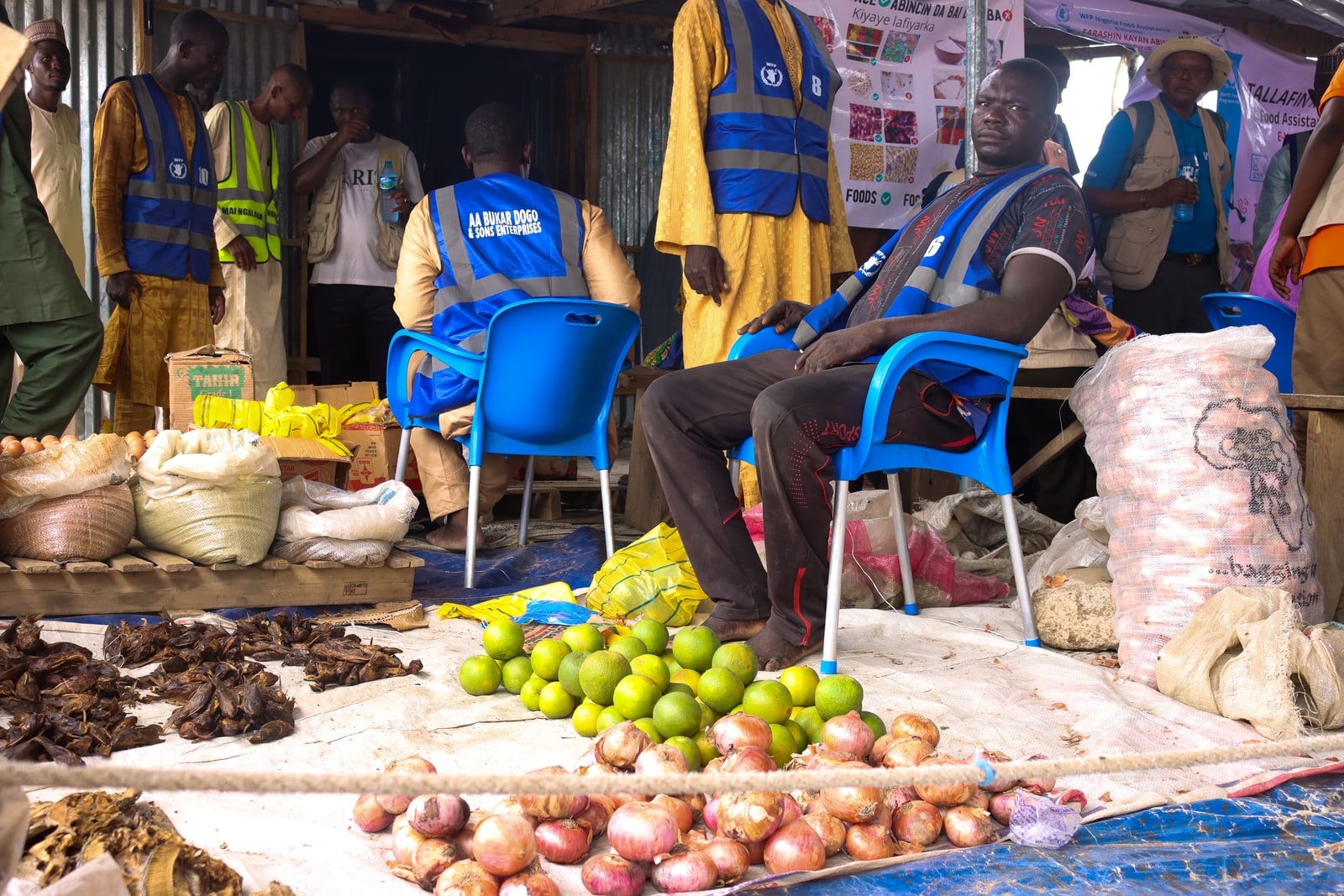
As of 2026-09-26 11:35 UTC, a September 1 OCHA field report describes monthly food vouchers reaching more than 117,000 people in Ngala, in Nigeria's Borno State. Families can redeem them at 39 accredited shops. This is an account of an operating programme, with a practical question at its centre: how much choice can assistance restore to a household displaced by conflict?[1]
The answer begins at the shop counter, but extends to the road bringing food into town. A digital entitlement helps a family buy a meal only when the retailer has something suitable to sell. Understanding that connection explains both the appeal of vouchers and the conditions that can weaken them.
What changes when assistance becomes a purchase?
The World Food Programme distinguishes vouchers used with selected retailers from unrestricted cash, which lets recipients choose where and how to spend. Both increase household control, but a voucher operates within a defined network. It should not be described as money that works everywhere.[2]
WFP's broader case for cash assistance starts with a particular problem: markets function, yet people lack purchasing power. Transfers can help households meet different needs at different times. With unrestricted money, those needs may include transport, rent or medical expenses alongside food. That flexibility matters when a family's most urgent expense changes from one week to the next.[3]
In Ngala, OCHA reports that regular purchases are also helping traders bring more goods into town. Its interviews describe families selecting food and retailers expanding their businesses. Those accounts show how the programme operates; they do not establish a measured, town-wide improvement in nutrition or employment.[1]
Three records help keep the evidence in proportion:
| Record | What it supports | Limit |
|---|---|---|
| OCHA, September 1 | Local programme scale and participant experiences.[1] | Field reporting, without a comparison group. |
| WFP, July 2 | Conflict, access constraints and funding shortages across northern Nigeria.[5] | Regional context from July, rather than a September Ngala assessment. |
| WFP operational guidance, accessed September 26 | How market conditions shape assistance choices.[2][4] | General practice, rather than a local impact evaluation. |
Why does an electronic voucher still need a supply chain?
A shop has to replace the food it sells. WFP works with wholesalers and retailers on inventories, transport, storage and purchasing. It assesses financial and technological capacity, too, and asks whether suppliers can keep meeting demand for nutritious food throughout the year.[2]
That turns a seemingly simple payment into a relationship between household demand and merchant supply. More customers can give a trader a reason to replenish stock. The replenishment still has to be possible. A successful transaction today says little about whether the same food will be on the shelf next week.
The distinction becomes especially important in an insecure setting. In its July warning, WFP described attacks and illegal checkpoints disrupting cargo movements in northern Nigeria. It also reported that funding constraints limited its assistance in three northeastern states to about 740,000 people, against 6.2 million experiencing food insecurity.[5] These figures describe a wider response under strain. They cannot be used to calculate the coverage rate of Ngala's voucher scheme.
What should count as success?
Counting people reached answers a delivery question. Assessing what they could actually obtain requires looking at prices, availability and the reliability of supply. WFP's market-analysis framework combines precisely those elements with wider factors such as inflation, exchange rates and government policy.[4]
Consider a simple illustration, rather than a reported Ngala result: if a household's allowance stays fixed while the price of its usual food basket rises, the allowance buys less. If the price stays unchanged but the preferred foods disappear, meaningful choice has also narrowed. A payment record alone would miss both developments.
There is a wider economic question, too. WFP argues that spending transfers locally can support businesses and jobs, extending benefits beyond direct recipients.[3] That is a plausible mechanism for recovery, but increased sales at participating shops are only one part of the picture. Evidence of lasting improvement would also need to show dependable access for households and a market that can keep supplying them.
What would strengthen or weaken the outlook?
The following are conditional reading scenarios, rather than forecasts:
- Base case: continued assistance and regular replenishment sustain household purchases. Evidence would be repeated successful redemptions alongside food availability.
- Upside: more dependable supplies and steadier prices widen what families can obtain. Confirm this through market monitoring and household reports, rather than retailer sales alone.
- Downside: interrupted funding, restricted access or rising basket costs reduce the practical value of the entitlement. Any of these would challenge the assumption that reliable assistance is continuing.
For donors, programme observers and readers following the response, the next checks are concrete:
- Next 24 hours: distinguish the September field account from a new programme launch or an independent impact evaluation.
- Next seven days: look for local evidence on food prices, stock availability and households' ability to redeem assistance.
- Next 30 days: check for updated funding and continuity information. WFP's July appeal provides historical context, not a current balance sheet.[5]
Revise the assessment if newer evidence shows missed transfers, persistent stock shortages or materially reduced purchasing power. The measure that matters is the food a family can reliably take home.
Sources
- David Jumbo, “Nigeria: E-vouchers help families buy food and keep local markets open,” OCHA, September 1, 2026; reporting and photograph.
- World Food Programme, “Supply chain for cash transfers,” accessed September 26, 2026; retailer arrangements, assessments and replenishment.
- World Food Programme, “Cash transfers,” accessed September 26, 2026; purchasing power, household flexibility and local spending.
- World Food Programme, “Market analysis,” accessed September 26, 2026; prices, availability, supply chains and economic context.
- World Food Programme, “Conflict and shrinking humanitarian assistance drives northern Nigeria hunger crisis to levels not seen in nearly a decade,” July 2, 2026; access and funding context.