As of 2026-08-25 19:35 UTC, the United Nations Secretary-General and the president of the International Committee of the Red Cross have renewed their call for legally binding rules on autonomous weapons. Their statement points to the Seventh Review Conference of the Convention on Certain Conventional Weapons, or CCW, in November as the clearest place for states to launch negotiations.[1]
That is urgent language, but the sharper news is procedural. In October 2023, the same two institutions called on leaders to launch and conclude negotiations by 2026.[5] At Tuesday's Geneva briefing, a UN disarmament official said the international community had not begun to negotiate an instrument.[2]
The year is not over, and no deadline in the 2023 appeal had legal force. But the achievable outcome has plainly narrowed. The live 2026 test is no longer whether states can finish a treaty from a standing start. It is whether they can turn years of expert drafting into a mandate to negotiate one.
That makes the two decisive LAWS stages unusually legible. The expert group returns from 31 August to 4 September. A CCW preparatory committee meets from 7 to 9 September, and the review conference follows from 16 to 20 November.[4] The expert group can improve and transmit a text; the review conference can decide whether that text becomes the basis of a negotiation or another object of discussion.
How the deadline was rewritten
| Record | What is established | Confidence and boundary |
|---|---|---|
| 5 October 2023 — joint appeal | The UN Secretary-General and ICRC president asked states to negotiate specific prohibitions and restrictions and conclude the work by 2026.[5] | High. This was a political and humanitarian appeal, not a binding timetable. |
| 1 December 2025 — General Assembly vote | Resolution 80/57 was adopted 164–6–7 and called on CCW parties to work toward completing elements for an instrument “with a view to future negotiations.”[6] | High. The vote demonstrates breadth of support for more work; it did not open treaty negotiations. |
| 2–6 March 2026 — expert session | The CCW group examined a five-part rolling text covering scope, existing law, prohibitions, control measures, reviews and accountability.[3] | High for the negotiating record. It is a chair's working text accompanied by recorded disagreements, not agreed treaty language. |
| 25 August 2026 — renewed appeal | The UN and ICRC urged negotiations to begin and identified November's review conference as the clearest route to a mandate.[1][2] | High for the request and calendar. No cited source reports that states have accepted the request. |
The distinction between a text, a mandate and an instrument is the center of this story. Collapsing those stages would make the diplomacy look further advanced than it is.
The draft is no longer empty
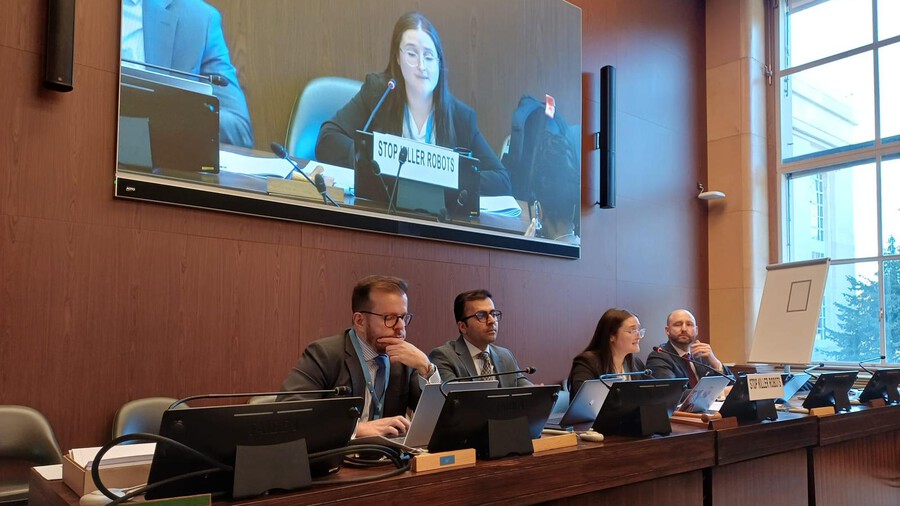
The process does have more than speeches to show for a decade of meetings. The March session brought together 85 High Contracting Parties, two signatory states, five observer states, international organizations, the ICRC, academics and civil-society groups. Delegations worked directly from a rolling text rather than beginning with general statements.[3]
Its proposed scope is functional. A lethal autonomous weapon system is characterized in the draft as a combination of weapons and technological components able to identify, select and engage a target without a human operator intervening in those tasks. The chair also removed explicit references to artificial intelligence from one set of safeguards so that non-AI systems would not fall through a drafting loophole.[3] That matters: the object of regulation is a weapon's behavior and the human role around it, not whether a manufacturer markets the software as “AI.”
The proposed rules also have visible shape. The text would bar systems that are inherently indiscriminate, cause superfluous injury or unnecessary suffering, or otherwise cannot be used in compliance with international humanitarian law. For other systems, it sketches controls involving target types, duration, geographic scope, number of engagements, deactivation, testing, legal review, training and a responsible human chain of command.[3]
This resembles the two-tier structure the UN and ICRC have advocated since 2023: prohibit the unacceptable systems and restrict the rest.[5] It is materially more specific than a generic promise to keep a “human in the loop.” It asks where the weapon may operate, for how long, against what kind of target, with what predictable effects and under whose responsibility.
Yet the March record also exposes the unresolved core. Many delegations treated “context-appropriate human judgement and control” as the text's added value. Others considered the phrase vague or objected that it could be read as a new legal standard rather than a way to apply existing law. Delegates disagreed over how control should vary across a weapon's life cycle and whether language might imply continuous human control at every stage.[3]
Those are not cosmetic edits. A rule that merely invokes human control without specifying what an operator must know, decide or be able to stop can coexist with radically different weapons. A rule that is too rigid about real-time intervention can exclude defensive or communications-denied uses before their risks are assessed. The drafting challenge is to preserve a human decision that is informed and attributable without pretending every operational context is identical.
Broad support has not supplied legal form
The General Assembly vote helps locate the political gap. Resolution 80/57 won 164 votes in favor, with six against and seven abstentions. But its operative language asked CCW parties to work toward completing a set of elements with a view to future negotiations.[6] That phrasing recognized progress while keeping negotiation itself in the future.
The renewed appeal tries to close that gap. It does not ask the August–September expert session to produce a finished convention in five days. It asks states to preserve the drafting work and use the November review conference to launch a legally binding process.[1][2]
Why is that decision difficult if so many General Assembly members supported the resolution? The two forums do different work under different procedures. The Assembly can register a large majority. The CCW develops weapons rules through consensus-based diplomacy, where a small number of states can prevent a collective move. An Arms Control Association analysis identifies that consensus rule, divergent security priorities and objections from states developing autonomous systems as central reasons the expert process has not moved into negotiation.[8]
That analysis is an assessment, not an official prediction of November's outcome. It does explain why counting supportive states is insufficient. A majority can establish political weight; it cannot, by itself, produce a CCW mandate.
What the August–September session can still change
The second 2026 expert session is the last scheduled five-day block before the review conference.[4] Its most valuable result would not be a triumphant headline. It would be a final report that makes the November choice hard to evade.
Four features would show that the groundwork is ready:
- A functional scope. The rules should follow target identification, selection and engagement, including systems whose critical functions are distributed across components, rather than depend on an “AI” label.
- A clear two-tier structure. The report should distinguish systems or uses to prohibit from the controls required for all others, without implying that existing international humanitarian law has been suspended while new rules are negotiated.
- Operational human judgement. The text should connect control to concrete measures—mission limits, understood capabilities, testing, intervention or deactivation, command responsibility and review—rather than leave the phrase as an ethical slogan.
- A negotiating recommendation. The report should tell the review conference what legal process to open, on what basis and with what objective. Perfect treaty clauses are not a prerequisite for a mandate; agreement that the clauses should now be negotiated is.
The fourth feature is decisive. The first three can improve voluntary practice even without a treaty. They can also become a comfortable holding pattern in which delegations refine safeguards indefinitely while avoiding a decision about legal form.
The handoff before November
In the next 24 hours, the renewed appeal is a position, not a rule change. Governments may endorse it, reject it or stay silent. News coverage should distinguish support for “human control” in principle from support for opening a binding negotiation. Those positions are not interchangeable.
Over the next seven days, the expert group will reconvene in Geneva.[4] Watch the documents, not only national statements: a revised rolling text, a draft final report and any agreed description of outstanding issues will show whether March's conceptual disputes are narrowing. A collection of speeches without shared language would be a weaker signal.
Over the next 30 days, the session should have left a public record. The useful questions will be whether states agreed on the elements, whether the final report recommends negotiations, and whether delegations begin naming the November mandate they would accept. Absence of a recommendation would not prove that a treaty is impossible; it would show that the expert track has not delivered the bridge the renewed appeal requested.
What November can actually decide
These are conditional monitoring paths, not probability forecasts.
| Path | Observable language or decision | Meaning |
|---|---|---|
| Base — text without a mandate | The expert group records convergence, but the review outcome asks states to “continue” or “further consider” the work without opening negotiations. | Safeguards advance while legal form remains hedged—the most direct continuation of today's gap. |
| Upside — negotiations open | The review conference adopts a mandate with a legal objective, scope and timetable based on the two-tier structure. | The text becomes the starting point for an instrument or protocol; another declaration of urgency would not meet this trigger. |
| Downside — the handoff fails | The expert group cannot agree on a recommendation, or the review conference omits a pathway to binding rules. | States may turn to national policies, General Assembly work or a process outside the CCW, but that would be a new phase rather than completion of the 2023 timetable. |
Before calling it a treaty
- CCW delegations: publish whether they support a binding negotiating mandate, the systems or uses they would prohibit, and how they would turn human judgement into testable operational limits.
- UN and ICRC officials: keep the three stages explicit—draft elements, authority to negotiate, completed instrument—and publish the evidence behind claims of convergence.
- Newsrooms and watchdogs: do not describe the rolling text as a treaty or the General Assembly vote as a negotiating mandate; compare the final September report with the March disagreements.[3][6]
- Developers and procuring authorities: do not treat diplomatic delay as an absence of current law. The draft itself reaffirms that international humanitarian law already applies, while proposed specific rules remain unsettled.[3]
- Update condition: revise this analysis if the expert group publishes a materially different final text, a state coalition opens a separate negotiation, or the CCW schedule changes.
- Invalidate the central procedural claim if an official record shows that a legally binding negotiation had already begun by the cutoff. Invalidate the November-decision thesis if the CCW creates a negotiating mandate before the review conference or formally removes that decision from its agenda.
The renewed appeal is therefore less a second alarm than an admission about sequence. States have accumulated enough language to see the outline of rules, but not enough agreement to give those rules a negotiating home. In 2023, the demand was a completed instrument by 2026. On 25 August 2026, the immediate question is more basic: will November allow the negotiation to start?
Sources
- International Committee of the Red Cross and United Nations, “Renewed call from UN Secretary-General and ICRC President to adopt rules on autonomous weapon systems” (25 August 2026) — current appeal and November decision point.
- United Nations Office at Geneva, “UN Geneva Press Briefing — 25 August 2026” — launch transcript, clarification that negotiations have not begun, and explanation of the proposed mandate.
- UN CCW Group of Governmental Experts, Chairperson's Summary of the First 2026 Session, CCW/GGE.1/2026/WP.2 — rolling-text provisions, participation record, areas of support and unresolved drafting questions.
- UN Meeting of the High Contracting Parties to the CCW, Final Report, CCW/MSP/2025/8 (27 November 2025) — official dates for the two 2026 expert sessions, preparatory committee and Seventh Review Conference.
- International Committee of the Red Cross and United Nations, “Joint call … to establish new prohibitions and restrictions on Autonomous Weapon Systems” (5 October 2023) — original two-tier proposal and call to conclude negotiations by 2026.
- United Nations Digital Library, “Lethal autonomous weapons systems,” General Assembly resolution A/RES/80/57 (adopted 1 December 2025) — official text and 164–6–7 vote record.
- Universitat Autònoma de Barcelona Faculty of Law, “The Faculty of Law participates in the CCW GGE sessions in Geneva” (16 March 2026) — first-session context and source page for the cover photograph.
- Alexander Kmentt, “Geopolitics and the Regulation of Autonomous Weapons Systems,” Arms Control Today (January/February 2025) — independent analysis of the CCW's consensus constraint and the gap between expert discussion and negotiation.