As of 2026-08-27 02:40 UTC, Australia’s federal, state and territory leaders had agreed that the Commonwealth would legislate nationally consistent standards for large AI data centres. The standards are meant to cover energy, water and land use, complement state planning systems, and become law in early 2027.[1]
That agreement is real. A finished energy rule is not yet public.
Before the meeting, the Commonwealth had promised legal obligations requiring large data centres to underwrite new power supply, pay their share of connection costs, reduce demand when the grid needs support and use water efficiently.[2] After the meeting, the communiqué committed governments to mandatory standards but did not repeat those tests. Prime Minister Anthony Albanese instead described a “flexible” national position that recognises Queensland and the Northern Territory as different, and said draft legislation was expected by the end of 2026.[1][3]
ABC reported that Queensland would be able to use gas or coal for data centres and that further design work remained. Queensland Premier David Crisafulli linked that flexibility to his state’s public ownership of generation, transmission and distribution; the Northern Territory had also opposed a renewables-only condition.[3][4] The supported conclusion is therefore narrower than either “national rules settled” or “renewables abandoned”: leaders settled who will legislate and what subjects the law will cover, while the common energy test, state-specific routes and enforcement machinery remain unwritten in the cited public record.
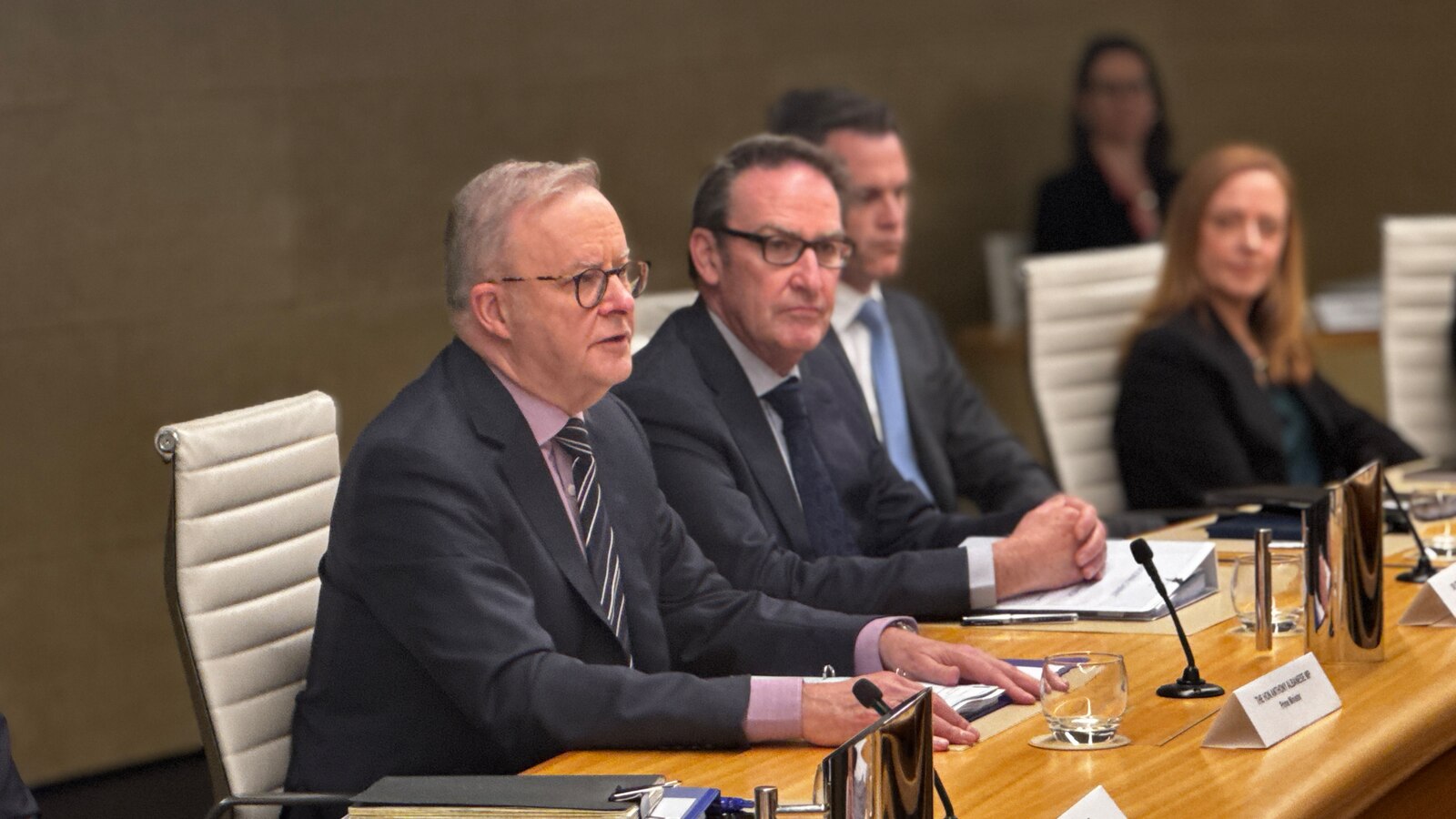
Image context: the cover photograph shows Albanese at the August 26 National Cabinet meeting. It documents the decision-making setting; it does not depict a data centre, power plant or completed law.[4]
What the meeting fixed—and what it left open
| Question | Verified position at the cutoff | Confidence boundary |
|---|---|---|
| Will there be a federal framework? | National Cabinet backed Commonwealth legislation for nationally consistent, mandatory standards on energy, water and land use.[1] | No bill, regulation or exposure draft is linked in the communiqué. |
| When is the next legal milestone? | Albanese said a draft was expected by the end of 2026 and legislation in early 2027.[3] | An announced timetable is not enactment, commencement or a compliance date. |
| Must every facility use only renewables? | The post-meeting position accommodates different state circumstances; ABC reports Queensland can use gas or coal, and the NT sought similar flexibility.[3][4] | The public record does not yet define the exception, its duration or the test for “surplus” power. |
| Do the July cost protections survive? | The July framework promised new supply, full connection-cost allocation and demand flexibility.[2] | The August communiqué does not say which July details will appear unchanged in the bill.[1] |
| How large is the forecast load? | AEMO forecasts National Electricity Market data-centre consumption rising from about 5 TWh in 2025–26 to 34 TWh in 2035–36, from roughly 3% to 13% of grid-supplied electricity.[5] | It is a system forecast that models project attrition and gradual ramp-up, not a guarantee that every proposal will connect.[5] |
| What applies today? | Existing laws still apply, alongside government expectations used to prioritise Commonwealth assessments for new or expanded projects.[6] | Those expectations expressly do not alter legal obligations; they are not the promised 2027 statute.[6] |
The policy moved from expectations toward law
Australia already had a five-part policy for developers before National Cabinet met. Published in March, the Data Centre Expectations ask new and expanded projects to support national interests, add clean generation or storage, cover network costs, manage peak demand, minimise water use, report water efficiency and invest in Australian skills and research.[6]
The document has leverage but a clear legal limit. The Commonwealth says energy-intensive proposals that do not align with it will not be prioritised in federal regulatory assessments. It also says the expectations work alongside existing laws and do not change anyone’s obligation to comply with them.[6] In other words, they can shape the federal queue; they are not a self-executing national permit code.
The July announcement promised to cross that boundary. It converted several expectations into proposed legal obligations and put National Cabinet on the August calendar.[2] The August outcome then supplied intergovernmental consent for federal legislation, using the Commonwealth’s corporations power, while allowing different jurisdictional circumstances to be reflected.[1][3]
This sequence matters because “nationally consistent” can describe more than one design. It can mean one performance test with several approved ways to meet it. It can also mean a common legislative shell that leaves the decisive energy choice to each jurisdiction. Only the draft can show which version governments have chosen.
Two power paths need one auditable test
The central drafting problem is not simply whether a megawatt-hour is labelled renewable, gas or coal. It is whether a new, very large load pays for the capacity and network work it causes, adds supply that would not otherwise exist, responds when the system is tight, and can prove that households and other businesses are not carrying its costs.
Queensland’s public ownership can change how those choices are coordinated. It does not, by itself, answer how “surplus” will be measured, who bears the opportunity cost of using it, or what happens when a data centre’s demand persists after surplus conditions end. Those are analytical questions raised by the announced flexibility, not facts the current sources resolve.[3][4]
AEMO’s forecast shows why the accounting cannot be postponed. The operator projects a nearly sevenfold increase in annual data-centre electricity consumption across the National Electricity Market over ten years. Its method already discounts projects that may fall out of the connection pipeline and allows connected facilities to ramp gradually.[5] The forecast is therefore more disciplined than adding every announced gigawatt, but it remains conditional on investment and delivery across the electricity system.
One private-sector signal illustrates the distinction. Internal New South Wales government emails reviewed by ABC recorded Anthropic’s interest in discussing up to 5 GW of AI training capacity in the state. ABC also reported that this was initial interest, carried no stated timetable and had not become a public commitment by the company.[7] Five gigawatts of connection capacity and 34 terawatt-hours of annual consumption are different measures; treating the first as a built project or directly adding it to the second would overstate what is known.
Water and land standards are also placeholders
Energy dominated the political dispute, but the communiqué gives water and land use equal billing.[1] The existing expectations offer a preview: early consultation with utilities, communities and First Nations peoples; efficient cooling; non-potable or circular water where possible; infrastructure-cost allocation; drought resilience; and ongoing usage reporting.[6]
None of those phrases yet supplies a national threshold. The draft still needs to define “large,” decide whether existing projects and pre-law approvals are grandfathered, name the regulator, specify disclosure frequency, and explain how federal compliance will complement rather than duplicate state planning approval. It also needs to say whether a dry inland site and a water-secure coastal site face the same numeric test or the same decision method.
That is not evidence that the standards will be weak. It is the uncertainty boundary at the cutoff: subject areas and legislative intent are public; metrics, exceptions, verification and remedies are not.
The next evidence, by horizon
Next 24 hours: the meeting itself does not switch on a new permit condition. The most useful immediate evidence would be a published clarification from the Commonwealth, Queensland or the NT defining the claimed flexibility—especially whether it changes only the generation mix or also the July promises on additional supply, network costs and demand response.[1][2][3]
Next seven days: network operators, water utilities, developers and host communities should look for a consultation route and a definition of the facilities in scope. A credible process would identify who can test cost and resource claims, not merely invite broad views on AI opportunity.
Next 30 days: watch for a principles paper, exposure-draft timetable or state implementation note. No such document by late September would not, on its own, break the official schedule; Albanese set the draft target at the end of 2026.[3] It would, however, leave projects and communities working from the non-binding expectations for longer.
By the announced legislative window: the decisive record is the bill and its supporting instruments. The key comparison is with July: new-power additionality, connection costs, demand flexibility, water efficiency, siting and community input.[2] A slogan about national consistency cannot substitute for those operative clauses.
Three ways flexibility can reach the statute
Base path — one performance floor, different compliance routes. The Commonwealth defines common outcomes for additional supply, consumer-cost protection, water and reporting, while Queensland and the NT can meet the energy standard through jurisdiction-specific mixes. Trigger: the draft publishes one measurable floor and explicit alternative compliance methods.
Upside path — the July protections become auditable obligations. The law preserves new-supply and connection-cost requirements, adds independent verification, sets a water-reporting method and limits grandfathering. Trigger: an exposure draft assigns metrics, data duties, a regulator and consequences for non-compliance.
Downside path — national branding masks state-by-state substance. The federal framework covers process, but the hardest questions about additional power, fossil generation, cost allocation or legacy approvals are broadly deferred or exempted. Trigger: the draft lacks a common additionality and cost test, or lets projects avoid it through approval timing without a narrow transition rule.
These are conditional paths, not probability estimates. The public documents do not yet support odds.
The accountability checklist
- The Commonwealth: publish the size threshold, baseline date, additional-power test, connection-cost rule, demand-response duty, water metric, grandfathering rule, verifier and regulator.
- States and territories: state which parts of their generation and planning systems constitute alternative compliance, and publish how local communities can test land, noise and water claims.
- Networks and water utilities: separate requested capacity from contracted, connected and operating load; identify who funds each upgrade without exposing commercially sensitive system-security data.
- Developers: show that a proposal is more than a queue position by naming its schedule, supply arrangement, network contribution, flexible-load capability, water source and reporting plan.
- Journalists and analysts: keep gigawatts of possible connection capacity separate from terawatt-hours of forecast annual use, and keep a political agreement separate from enacted law.[5][7]
Invalidate this report’s central assessment that the compact precedes its operative energy rule if a binding, detailed instrument already in force at the cutoff is produced, or if the governments publish a dated draft that resolves the additionality, cost and exception tests. The broader event would remain: National Cabinet backed federal legislation. What would change is the status of the rule from promised to inspectable.
Until then, Australia has moved one step beyond voluntary expectations and one step short of an enforceable national standard. The compact’s credibility will turn on whether two power paths are judged by one transparent test.
Sources
- Prime Minister of Australia, “Meeting of National Cabinet” communiqué (August 26, 2026) — official agreement on mandatory energy, water and land-use standards, federal legislation and timing.
- Prime Minister of Australia, “AI in Australia’s interests” (July 15, 2026) — original proposed legal obligations for new power, connection costs, demand flexibility, water and siting.
- Prime Minister of Australia, “Press conference — Sydney” transcript (August 26, 2026) — post-meeting account of jurisdictional flexibility, Commonwealth power and the end-2026 draft target.
- Holly Tregenza and Clare Armstrong, ABC News, “Queensland allowed to use coal, gas for data centres despite renewable push” (August 26, 2026) — current outcome reporting, state positions and source page for Nick Dole’s National Cabinet photograph.
- Australian Energy Market Operator, “Reliability can be maintained with timely investment as demand grows” (August 25, 2026) — official 2026 ESOO data-centre consumption forecast and methodology boundary.
- Australian Department of Industry, Science and Resources, “Expectations of data centres and AI infrastructure developers” (March 2026) — current energy, water, community, skills and assessment-priority baseline.
- Cam Wilson, ABC News, “AI giant Anthropic wanted ‘massive’ data centre capacity in NSW, emails reveal” (August 26, 2026) — reported 5 GW expression of interest, present-capacity context and explicit project-status limits.