The name arrived as a reprimand. In 1969, critic Vladimir Jovičić described a “Black Wave” in Yugoslav cinema: films he thought were morbidly preoccupied with the underside of human experience. The phrase was not a manifesto signed by filmmakers. It was a hostile attempt to gather their troubling images under one dark weather system.[1][3]
The insult survived its intended use. Today, Yugoslav Black Wave is the most convenient name for a burst of formally adventurous cinema made largely during the 1960s and early 1970s by directors including Dušan Makavejev, Aleksandar Petrović, Živojin Pavlović, Želimir Žilnik, Karpo Godina, and others. Yet convenience has a cost. Treat the Wave as a house style and its films start to look like coordinated dissidence: one bloc of brave artists, one oppressive state, one recognizable aesthetic. The history is more entangled. These filmmakers shared an appetite for contradiction, not a single method. Their cinema was enabled by socialist cultural infrastructure, sharpened by disappointment with socialist reality, and later restricted by institutions that had helped make experimentation possible.[3][6]
Before it was black, it was new
The less dramatic name was New Yugoslav Film. Its conditions developed after Yugoslavia's 1948 break with Stalin and through the decentralization of film production in the early 1960s. Film clubs established across the federation gave young amateurs somewhere to encounter modern cinema, handle equipment, test short forms, and argue about what a socialist image could be. Several future Black Wave directors passed through that culture before moving into professional production.[3]
This origin complicates any tidy story of underground artists creating entirely outside the system. The opening came from within a society attempting its own route between centralized planning and a market economy, between revolutionary legitimacy and greater exposure to the West. The resulting films did not merely import Italian neorealism or the French New Wave, though both mattered. They used Yugoslavia's specific promises as material. If the official public image celebrated modernization, collective purpose, and the heroic memory of the Partisan struggle, these filmmakers asked what remained outside the crop: underemployment, homelessness, stalled mobility, compromised desire, war memory, and people whom progress had not carried with it.[1][3][5]
That question traveled across a federation of six republics, which is another reason not to shrink the Wave into a Belgrade-only school. MoMA's 2023 retrospective assembled work with the cooperation of archives in Belgrade, Zagreb, Ljubljana, Sarajevo, and Skopje. The curatorial map makes a historical point: “Yugoslav” names a field of connected production cultures whose differences did not disappear just because later criticism placed them under one label.[1]
A mood mistaken for a method
What made the films look related was often what they refused. The confident hero who embodies history's correct direction gives way to drifters, witnesses, opportunists, workers, lovers, and failed revolutionaries who cannot make the world resolve around them. A national success story becomes a set of unfinished encounters. Dark humor is crucial here. It keeps disappointment from settling into solemn defeat, making doctrine collide with appetite, boredom, vanity, sex, and the stubborn comedy of material life.[1][3]
Formally, however, the films pull apart. Arsenal's history of New Yugoslav Film distinguishes the comparatively linear realism of Petrović and Pavlović from Žilnik's volatile mixture of agitprop and documentary, and from the archival collage practiced by Makavejev and Lazar Stojanović.[3] One director follows a body through actual fields and job lines; another invites nonactors to replay their own precarious lives; another cuts official imagery against erotic or vernacular material until neither retains authority. “Black” cannot describe a lighting plan, a genre, or even a common politics. It describes the alarm produced when radically different forms kept finding cracks in the approved picture.
Greg de Cuir Jr.'s expanded study calls the period “polemical cinema,” a better phrase for its energy than stylistic unity. Polemic is relational: an image pushes against another image, a lived condition tests an announced principle, a spectator is denied the comfort of a final synthesis. The movement's coherence lies in that friction between social claim and visible remainder.[6]
The antihero enters the landscape
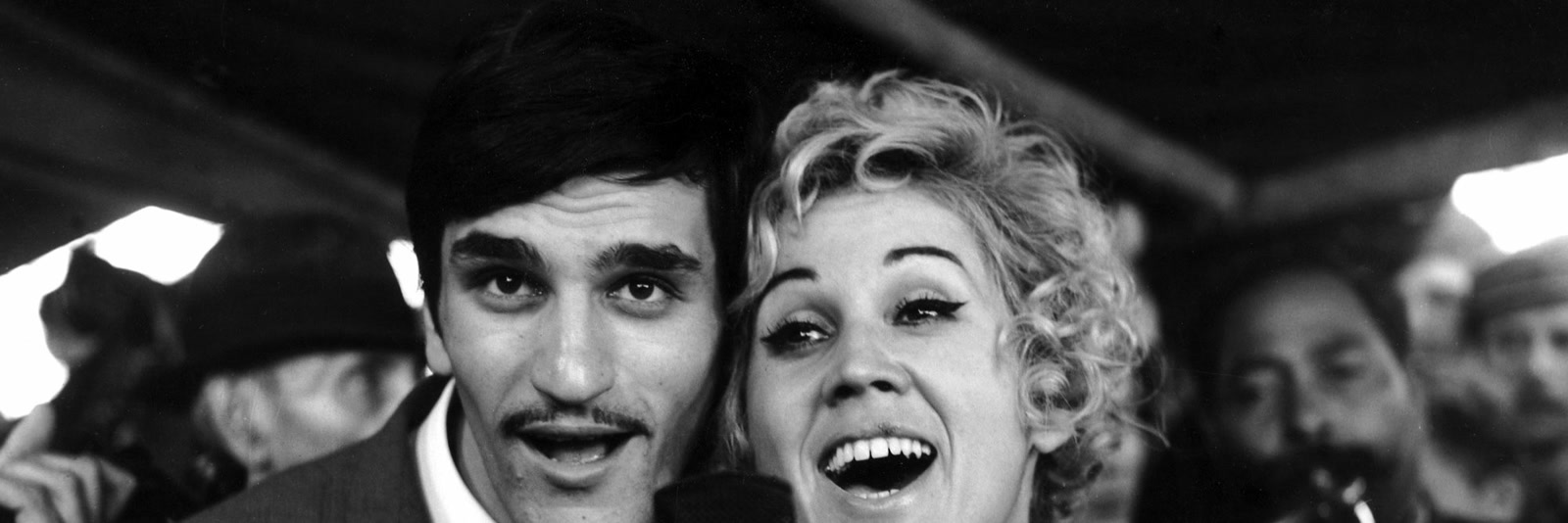
Pavlović's When I Am Dead and Pale (1967) makes the shift brutally legible. Its protagonist, Jimmy Barka, is a chain-smoking seasonal worker and would-be singer whose charm repeatedly outruns his ability. He moves between the countryside and Belgrade, between manual labor and fantasies of performance, never acquiring the purposeful trajectory expected of a model cinematic worker. MoMA describes the film as a portrait of a charismatic vagabond among people at society's margins; Film Comment emphasizes how his wandering passes through unemployment, changing popular culture, and women whose work and economic circumstances are more clearly grounded than his ambitions.[2][5]
Jimmy is not an antihero because he secretly possesses superior insight. He is vain, funny, careless, seductive, and unequipped for the world he wants to enter. Pavlović's achievement is to let those defects remain social without turning the character into a diagram. The landscapes around him do not simply prove that the national project has failed. They show uneven development as lived tempo: waiting, hustling, temporary work, a song pitched to the wrong room. Compassion and criticism occupy the same frame.[2][5]
That is why the archival still used for this article matters. A single frame from When I Am Dead and Pale cannot illustrate the entire Black Wave, and it should not pretend to. It does something better: it returns the intimidating label to one film, one performance, and one precarious life. The movement becomes credible again when its abstraction is made answerable to particular bodies.
Collage and docufiction refuse the last word
Other filmmakers broke certainty by breaking the frame itself. Makavejev and Stojanović combined found or archival footage with newly shot material, making montage a contest between public memory and unruly experience.[3] Their films do not supply one voice that explains every fragment. The cut becomes political because it makes incompatible kinds of evidence coexist. Official history, private desire, scientific language, spectacle, and ordinary gesture can interrupt one another before any of them hardens into truth.
Žilnik approached the same problem through encounter. His early work used nonactors and moved between documentary and fiction, often building films with unemployed people, neglected children, homeless residents, and others pushed outside the state's self-image. Harvard Film Archive describes his method as letting protagonists play themselves; the phrase sounds simple, but it changes the film's authority. A person is not merely observed as evidence of a social problem. They participate in the act that frames, stages, and argues about their condition.[4]
These practices also expose a limit within the movement. Making marginality visible does not automatically make representation innocent. Žilnik's Black Film turned its camera back on the inadequacy of abstract humanism and on the filmmaker's own claim to social courage.[4] That self-implication is among the Wave's most durable lessons. A radical subject does not guarantee a radical relation between camera and subject; the method itself must remain available for criticism.
Pressure came through the same doors as possibility
The suppression of Black Wave cinema resists the clean drama of a single censor flipping a switch. Arsenal notes that Yugoslavia did not operate one simple official-censorship mechanism, even as films were shelved and directors were prevented from working. MoMA describes many titles as banned or censored while also noting that festival attention abroad created a degree of latitude unusual elsewhere in the Eastern Bloc. Following the political crackdown around the 1968 protests, Žilnik and others found their ability to make films narrowed; exile became one route out.[1][3][4]
Those accounts are not mutually exclusive. They reveal a dispersed system of pressure: production could be decentralized and artistically fertile, then circulation or future work could close when a film's contradictions became politically costly. International prizes might protect a reputation without keeping a director employed at home. The same institutional ecology could generate an opening and later police its consequences.
That tension is more revealing than a romance of forbidden art. Black Wave did not emerge because culture and politics were separate. It emerged because they were inseparable—because arguments about labor, antifascism, sexuality, modernization, and collective life were also arguments about who could make images, which images could travel, and how long an experiment would be tolerated.
From slur to retrieval tool
After Yugoslavia dissolved amid the wars of the 1990s, many of these films fell out of distribution. The archives that preserved them now belong to different states; the name of the movement refers to a country that no longer exists. MoMA's 15-film program in 2023 therefore did more than revive a style. It temporarily reassembled a broken circulation network, bringing prints and restorations from several successor-state institutions into one conversation.[1]
This is the final reversal of “Black Wave.” A label coined to discredit became a handle for finding, preserving, and programming films. That afterlife is valuable, but only if the handle does not become a lid. Pavlović's compassionate realism is not Žilnik's participatory provocation; Žilnik is not Makavejev's collision machine; one republic's film culture cannot stand for the federation.
The canon is most alive when its name remains visibly unstable. Yugoslav Black Wave matters not because its filmmakers agreed on how cinema should look, but because they kept testing public ideals against bodies, rooms, jobs, memories, and cuts that would not behave. The accusation was darkness. The achievement was refusing to brighten contradiction into a lie.
Sources
- The Museum of Modern Art, “Black Wave to White Ray: Yugoslav Film of the 1960s” (2023) — the label's hostile origin, major filmmakers, censorship, international circulation, and the multi-archive retrospective.
- The Museum of Modern Art, “Kad budem mrtav i beo (When I Am Dead and Pale)” — film credits, synopsis, reception context, and the Yugoslav Cinematheque still used as the article image.
- Arsenal Institute for Film and Video Art, “Black Waves, Red Horizons — New Yugoslav Film” (2015) — production decentralization, film-club culture, political context, formal heterogeneity, and institutional suppression.
- Harvard Film Archive, “Želimir Žilnik and the Black Wave” (2017) — Žilnik's biography, nonactor docufiction method, marginal subjects, 1968-era pressure, and exile.
- Manuela Lazić, “Review: Black Wave to White Ray — Yugoslav Films of the 1960s,” Film Comment (2023) — movement context and close discussion of When I Am Dead and Pale, Strange Girl, and Monday or Tuesday.
- Greg de Cuir Jr., Yugoslav Black Wave: Polemical Cinema from 1963–72 in the Socialist Federal Republic of Yugoslavia (Amsterdam University Press, expanded edition, 2025; Google Books catalog record) — scholarly history of the industry, filmmakers, political thought, and aesthetics.