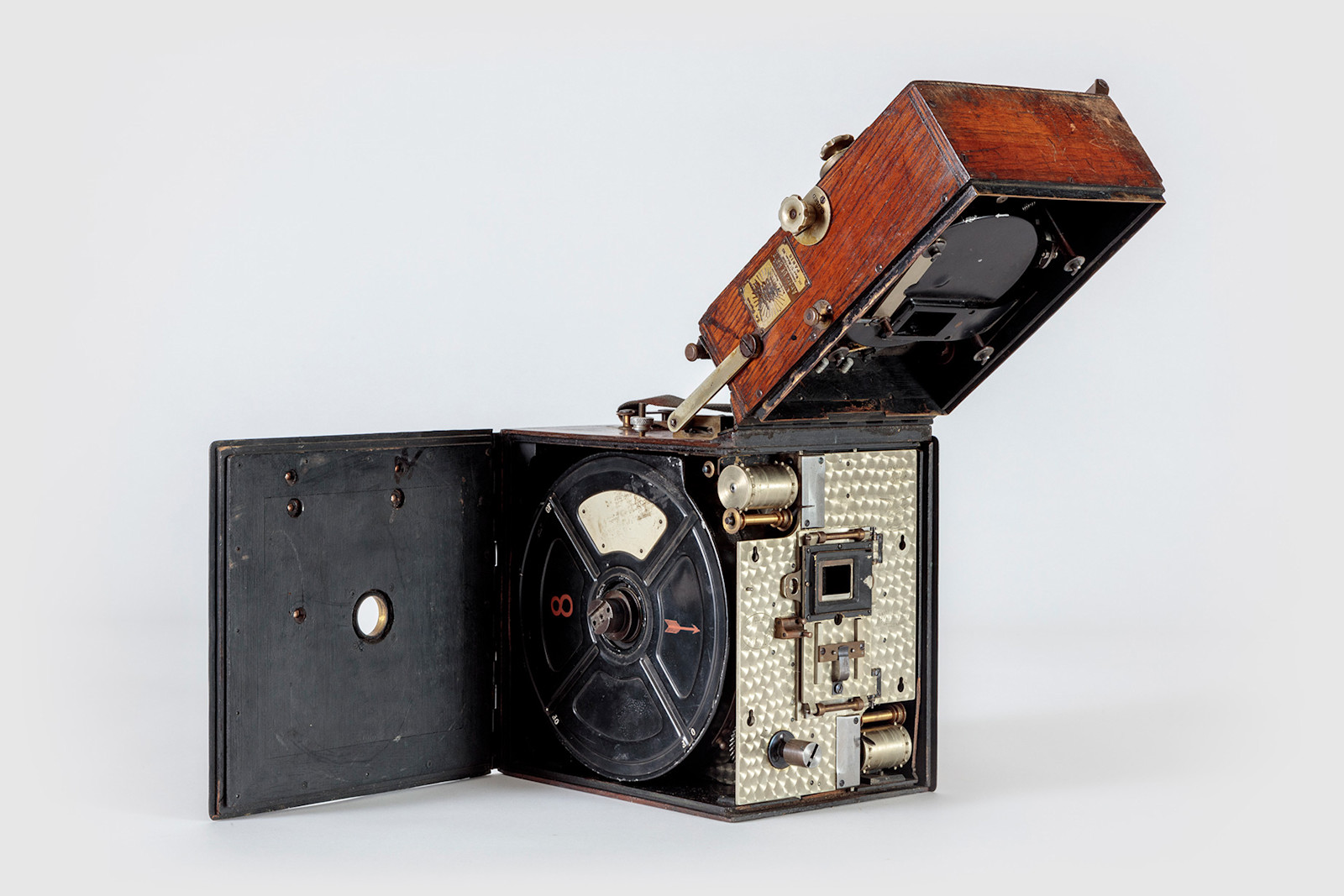
At first glance, the Debrie Parvo looks less like a machine for catching modern life than a small piece of polished furniture. Its walnut-colored doors close around the mechanism. A leather handle invites someone to lift it. There is no external film magazine rising above the body, no long cable tying it to a separate drive, no blimp swallowing it in a padded shell.
Open the doors and the apparent simplicity disappears. Inside are two film magazines, sprocketed rollers, a claw movement, a hardened-steel film channel, gears, counters, a shutter, and the path that draws 35 mm stock past the lens. The Parvo's achievement was not merely that it was small. It was that so much of a working camera traveled together.
That distinction matters. Miniaturization can make a device feel disposable or compromised. The Parvo made compactness look like professional concentration: film capacity, steadiness, speed control, focusing, special-effects affordances, and portability compressed into one coordinated instrument. Its success helped shift the movie camera from bulky studio apparatus toward something a crew could reposition without treating precision as the price of movement.[1][2]
Small meant complete
Joseph-Jules Debrie patented the underlying design in France on September 19, 1908; the camera was marketed the following year, and an improved model appeared in 1913. The Cinémathèque française's surviving 1913 Parvo measures only 30 by 15 by 22.5 centimeters when closed. Yet its body accommodates two internal magazines, each holding 120 meters of film, along with an adjustable two-blade shutter, footage and frame counters, a spirit level, a finder, and a speed indicator.[1]
Precision was not perfect on day one. The Cinémathèque's record notes that the 1913 revision changed a claw carriage that had sometimes lacked accuracy. That correction is central to the story rather than an embarrassing footnote. The Parvo is best understood as an evolving platform: its compact arrangement endured while the mechanism inside it became more exact.[1]
Those specifications describe a package, not a shortcut. At the silent-era norm of 16 frames per second, the operator turned the crank twice each second. The largest shutter opening produced an exposure of roughly 1/36 second. A needle indicated speed, but the operator still supplied the motor and therefore the temporal consistency. The camera made pace legible; it did not automate judgment.[1]
Focusing carried the same mixture of access and constraint. The operator could inspect the image on the taking axis before a shot, then frame through an external finder while film occupied the gate. Modern reflex viewing lets a cinematographer watch through the lens during exposure. The Parvo belonged to an earlier discipline: prepare the image precisely, shift into recording mode, and trust the calibrated relation between finder, lens, mechanism, and operator.
The 1926 Model L made the revision process visible. It added two stabilizing counter-claws, an intermittent pressure plate that withdrew while the film advanced, direct focusing on ground glass or film, and a mount for an electric motor. None of those features should be projected backward onto the first 1909 cameras. They show how Debrie kept improving registration and operating control without abandoning the internal-magazine box that made the Parvo recognizable.[5]
The integrated magazines changed the physical logic. Film did not need to travel from a conspicuous box mounted on top of the camera. It looped from one internal chamber through the gate to the other, protected by the outer case. The handle on the lid was therefore not decoration. It expressed the design argument: a production camera could be a contained object, ready to be lifted as a unit.[1][3]
Portability did not mean casual shooting
It is tempting to translate "compact" into "handheld" and imagine the Parvo as a wooden ancestor of a phone camera. That collapses a century of operating practice. Debrie designed a dedicated tripod platform with horizontal and vertical movement. The film still had to advance intermittently and settle at the gate; the crank still had to turn evenly; framing still had to survive the change from focusing to recording.[1]
Portability meant the crew could move a precision system, not that the system ceased to require a crew. That boundary is part of the machine's importance. The Parvo did not abolish preparation. It made preparation available in more positions.
The body also treated image manipulation as normal camera work. An operator could punch the film to mark a position, useful when planning trick photography, and could crank backward for superimpositions and other effects. The adjustable shutter allowed fades to be created during photography. These were not digital-style options applied after a neutral recording. They were physical decisions made by controlling how exposed stock passed through the same compact mechanism.[1]
This is where the wooden box becomes more than an attractive antique. It gathered recording and transformation into one machine. The Parvo could produce a steady conventional view, but its controls also anticipated filmmakers who wanted to reverse motion, layer exposures, change speed, or make the apparatus itself part of the event.
A European camera became a film actor
The Parvo's industrial position was especially strong in Europe. Laurent Mannoni of the Cinémathèque française describes the camera's combination of compact size, excellent lenses, precise registration, electric-motor options, and image steadiness as sufficient to displace the Pathé Professionnelle during the First World War. French avant-garde filmmakers used it extensively. Cinematographer Eduard Tisse used a Parvo L on nearly all of Sergei Eisenstein's classics from 1924 onward.[2]
That range is a warning against technological determinism. One camera does not dictate one style. Stable registration can serve monumental crowd composition; portability can serve street observation; reverse cranking can serve an overt trick. Hardware defines a field of practical possibilities, then filmmakers choose which possibilities become form.
Dziga Vertov made that relationship visible in Man with a Movie Camera (1929). The Parvo L is not hidden behind the finished image. It appears inside the film as equipment, emblem, and performer. The camera stands over streets, rides through the city, faces the audience, and seems to animate itself. A device built to contain its working parts becomes unusually legible as a single character.[2]
The joke works because the machine is both compact and unmistakably mechanical. Its crank announces labor. Its tripod gives it legs. Its box body supplies a head. Vertov can turn the camera into a mechanical eye without pretending that seeing happens by itself. The film repeatedly returns attention to the people and processes around the apparatus: the operator finds a position, exposed film reaches the editor, fragments become sequence, and projection returns movement to an audience.
The Parvo therefore sits at a productive threshold. It is small enough to travel through the world it records, yet substantial enough to remain visible as a machine. It can promise a more mobile eye while preserving evidence of the hands, timing, and transport that make that eye possible.
Sound exposed the compact body's limit
Silent photography had tolerated one major fact about the Parvo: a claw movement, gears, and hand crank make noise. Once productions needed synchronized dialogue, mechanical chatter stopped being incidental. A camera could be compact, steady, and portable and still contaminate the soundtrack.
Debrie's later Super Parvo turned the camera body into an acoustic problem. The Museum of Cinema in Girona describes the post-1932 Model U as a metal-bodied, internally soundproofed camera whose mechanism could operate with a microphone less than a meter away without being recorded as background noise. It held two 300-meter reels, later gained an external finder, and eventually appeared in a reflex version.[4]
The change did not invalidate the original design. It revealed what every successful technology leaves outside its first solution. The silent Parvo had concentrated the visual workflow: transport the stock, hold it still, meter its passage, frame the image, and let the operator alter exposure. Sound added another requirement—contain the camera's own presence while recording everyone else's.
That is the Parvo's most durable lesson. A camera is never just a lens pointed at the world. It is a negotiated enclosure for film, motion, time, noise, bodies, and labor. The 1908 machine looks beautifully self-contained because it solved one era's negotiation so coherently. The Super Parvo looks different because cinema changed the terms.
The original remained more than a stepping-stone. Its compactness helped precision travel, and its visible unity gave filmmakers an object they could move, trust, and even cast. Before the movie camera learned to disappear behind quiet operation and reflex viewing, the Parvo became complete enough to carry—and charismatic enough to enter its own film.
Sources
- Cinémathèque française and CNC, “Caméra film 35 mm: Le Parvo Modèle 1913” — institutional collection record covering the patent, dimensions, magazines, film transport, shutter, counters, focusing, speed, tripod, and effects controls.
- Laurent Mannoni, “Une caméra historique: la Parvo L d'Édouard Tissé,” Cinémathèque française — institutional account of the camera's development, precision, European adoption, avant-garde use, and appearances in films by Vertov and Eisenstein.
- Academy Museum of Motion Pictures, “‘Le Parvo’ 35mm Cine Camera, 1908” — collection record and photographic source for the surviving wood, metal, and leather camera shown above.
- Museum of Cinema, Girona, “Super Parvo Debrie Modèle U” — collection record on the soundproof metal body, 300-meter reels, close-microphone operation, later finder, and reflex development.
- Cinémathèque française and CNC, “Caméra film 35 mm: Parvo Modèle L Série M2” — institutional collection record on the 1926 camera's counter-claws, retracting pressure plate, focusing system, motor mount, and internal magazines.