The first surprise in The Great White Silence is color. Herbert Ponting's record of Robert Falcon Scott's British Antarctic Expedition carries whiteness in its title and across nearly every landscape, yet the BFI-restored version keeps changing hue. The Southern Ocean becomes cobalt. Men and sledges cross fields of mint green. Camp work burns amber. An ice grotto opens in violet and rose. White is never allowed to settle into blankness.[1][2]
Those colors are not a modern attempt to make the expedition footage look natural. The restoration team followed tinting and toning instructions Ponting had scratched onto the film, recovering a silent-cinema system in which color could suggest hour, weather, light and texture rather than reproduce the world literally.[3][4] That distinction is the key to the movie. The Great White Silence does not simply prove that an expedition happened. It continually converts evidence into sensation—and, by its end, sensation into memorial.
The conversion is beautiful, technically astonishing and politically compromised. Ponting assembled the feature in 1924 from moving images and photographs made during the expedition, alongside maps, paintings, models and intertitles. He therefore edited with knowledge his photographed subjects did not possess: Scott, Edward Wilson, Henry Bowers, Lawrence Oates and Edgar Evans would reach the South Pole after Roald Amundsen and die on the return.[4] Every cheerful demonstration can become a premonition because the editor already knows where the living image will stop.
Spoiler note: this essay discusses the film's final account of the polar party's deaths. It refers to the BFI-restored 1924 feature, with Simon Fisher Turner's score.
Color gives the ice a pulse
The restored palette first works as orientation. Warm sepia and gold belong to bodies, timber, provisions and the crowded life of the Terra Nova. Blue arrives with sea and distance. Green spreads across snowfields, seals and penguin colonies. Purple briefly turns an opening in the ice into a theatrical chamber. These associations are not perfectly fixed, which keeps color from becoming a code that can be solved once and ignored. A tint establishes a sensory condition, then the next one alters it.[1]
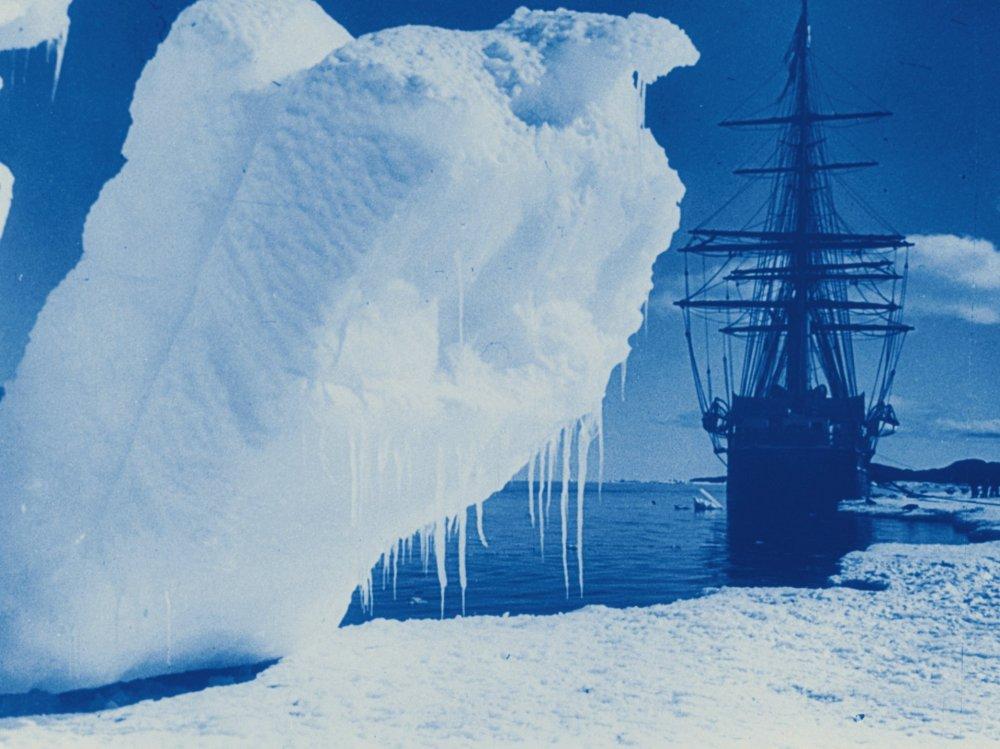
That mobility rescues the Antarctic from the title's abstraction. On untreated monochrome film, sky, snow and ice can collapse toward the same brightness. Here, color separates layers. A dark ship can sit inside blue water behind a pale, sculpted berg; tiny rigging remains legible against the distance. In the article image, the ice occupies most of the frame, but its cyan shadows and white ridges give it mass rather than emptiness. The Terra Nova does not conquer that mass. It looks provisionally admitted beside it.
The BFI's programme notes explain that the original tints were meant to evoke effects such as bright sun, midnight light and even the surface of a seal.[4] Ponting's achievement is to make temperature feel variable within a place casually imagined as one continuous cold. Amber can make labor look briefly habitable; blue can turn the same environment remote; violet can make an ice cave feel less like shelter than an aperture into another scale of time.
Simon Fisher Turner's modern score extends that strategy without pretending to restore a soundtrack that once existed. It incorporates the Terra Nova's bell and ambient silence recorded in Scott's Cape Evans hut.[3][4] These are not synchronized expedition sounds. They are surviving acoustical objects, added from the future. Like the tints, they make restoration an act of interpretation rather than a transparent cleaning of the past.
Scale arrives as resistance
Ponting repeatedly places human effort against surfaces that barely register it. The ship noses into pack ice. Men tug lines and unload boxes. A motor sledge moves across a field so open that its mechanical novelty shrinks to a dark interruption. In long shot, a sledging party is not heroic statuary but a fragile procession with almost no visual weight.[1]
One of the cameras Ponting used was itself a resistant object. The National Science and Media Museum identifies his Prestwich Model 5 as an 18-pound, hand-cranked machine whose enclosed magazines could carry up to 350 feet of 35mm film; he kept it in rotation with a Newman Sinclair camera. Cold threatened the lens with frozen moisture, while exposed metal could injure bare skin.[5] Those facts matter to the images without automatically ennobling them. The steadiness of a shot is evidence of a physical arrangement: tripod, crank, film stock, body, temperature and a chosen place from which to look.
For the view of the Terra Nova forcing through ice, Ponting had a platform projected over the ship's side so he could film near the bow.[5] The resulting angle makes collision the subject. Ice does not decorate the voyage; it pushes back against the frame. The ship advances only by splitting a surface that closes around it, while the camera's position turns observation into its own exposed labor.
Yet the film often answers danger with measurement. An intertitle estimates the enormous length of a berg and imagines the city of London laid on its back. Maps convert the route into a line. Men demonstrate sleeping bags, rations and tent routines as if procedure could make the landscape calculable.[1] The comparisons are useful, but the images keep exceeding them. The berg remains stranger after it has been measured; the figures remain small after their equipment has been explained.
The camera is not an innocent witness
The middle of the film spends generous time with seals, skuas and Adélie penguins. It is easy to receive this stretch as comic relief before the fatal narrative tightens. Ponting gives animals personalities through patient observation and playful intertitles; a crowded colony creates a social world adjacent to the camp.[1] For early audiences, such moving images also carried the charge of first encounter. Ponting had brought a still-young technology into a place few spectators could imagine seeing.[5]
But the sequence also exposes documentary intervention. One title explains that a nesting penguin was driven away at intervals so the chick's progress could be photographed.[1] The confession is startling because it breaks the fantasy that patient looking leaves its subject untouched. The camera records behavior partly produced by the camera crew's disturbance.
That small disclosure helps us read the human scenes more accurately. Camp routines and polar preparations are records, but many are also demonstrations arranged for an audience. Scott and his companions show how they will cook, eat and sleep inside a tent during the journey.[4] They are not falsifying expedition life; they are translating work into visible actions that a lens can carry home.
The Scott Polar Research Institute describes Ponting's surviving glass-plate photographs as both sweeping icescapes and intimate views of life inside the winter hut.[6] The Great White Silence operates between those poles. Monumental landscapes make exploration look mythic; rehearsed gestures make it practical and teachable. The same person can be an icon in a portrait and a colleague fumbling with bedding in motion.
A rehearsal acquires an ending
The tent demonstration is the film's most painful temporal knot. Scott, Wilson, Bowers and Evans sit close together, eat and settle into reindeer-hide sleeping bags. Nothing in their behavior announces a last testament. The scene was made to show competence: this is how a party turns a hostile environment into a routine.[1][4]
By 1924, however, Ponting could not edit it as neutral instruction. The tent would become the place where the search party found Scott, Wilson and Bowers. Familiar motions—unpacking, stirring food, arranging bodies for sleep—arrive burdened by their later repetition under fatal conditions. Cinema's ordinary promise to preserve the living becomes unusually literal. The men demonstrate how they intend to survive, while the completed film knows the demonstration will not be enough.
Ponting does not have moving images of the polar party reaching the Pole or making its final return. That absence reorganizes the final movement. Motion yields to an animated route line, painted reconstructions, portraits, dates and long passages drawn from Scott's diary. Oates's exit into the blizzard is not staged as spectacle. It is relayed by text, followed by a face that can no longer move.[1][4]
The change in materials is not a flaw concealed by editing; it is the film's deepest formal fact. While photographed motion is available, the expedition can still surprise the camera: ice breaks, animals turn, men smile. Once the record reaches the part Ponting could not witness, history advances through documents. The viewer stops watching events unfold and starts reading a reconstruction built around recovered records.
When evidence ends, empire writes the caption
The last images do more than mourn. They organize the deaths into a national legend. A cross fills the screen, and the closing intertitles claim the men for England, heroic endurance and “our Race.”[1] The film's line has moved from route to destiny: hardship becomes proof of collective character, and failure to return becomes a moral victory.
That rhetoric should not be dissolved into period atmosphere. The BFI warns that the restored film contains offensive racist language; an early intertitle gives the ship's cat a racist name.[1][2] The final language of race and imperial honor belongs to the same worldview, even when its register changes from casual abuse to exalted memorial. A recent essay places The Great White Silence inside a three-film cycle produced at a high-imperial moment, when polar cinema elevated the British male explorer and patronized Indigenous and local peoples elsewhere in the cycle.[7] In Ponting's film, the closing intertitles provide the narrower evidence: they turn national expansion and masculine endurance into a claim about racial destiny.
The boundary matters because Ponting's images are genuinely observant. The film notices labor, boredom, animal behavior, weather and companionship with a richness that exceeds its patriotic frame. Criticism need not flatten that visual intelligence; admiration need not accept the ideology that captions it. The movie remains valuable precisely because the tension is visible. The camera can preserve particular bodies and gestures while the intertitles recruit them into a grander, narrower story.
Restoration intensifies this tension rather than resolving it. The BFI team matched hundreds of short rolls, consulted Ponting's color instructions and returned detail to faces, animals and ice.[3][4] It did not update the 1924 film into an ethically comfortable object. Color gives the archive back its distinctions, while the preserved language lets us see the distinctions Ponting's memorial tried to enforce.
The title promises a great white silence, as though Antarctica were a single mute field waiting for heroic meaning. The film's best images undo that promise. Ice has color, texture and force. Animals resist or are disturbed. Machines stall against matter. Men rehearse survival without knowing how their gestures will be read. Then the moving record ends, and maps, diaries and national myth rush in to fill the space.
That is why the ice is never merely white. It is blue with distance, amber with remembered shelter, green with observed life and finally darkened by afterknowledge. The Great White Silence is not just an expedition preserved on film. It is a close view of the moment preservation becomes interpretation—and interpretation becomes a claim on the dead.
Sources
- Herbert Ponting, The Great White Silence (1924), full tinted-and-toned archival film on Wikimedia Commons, sourced from the Internet Archive — primary source for the images, intertitles, demonstrations and final memorial sequence.
- BFI Player, “The Great White Silence” — record for the 1-hour-47-minute BFI restoration, Simon Fisher Turner score and warning about discriminatory language.
- Angelo Lucatello, “BFI Recommends: The Great White Silence,” British Film Institute (2020) — original negatives, restoration workflow, Ponting's scratched tinting instructions, the Terra Nova bell and sound recorded in Scott's hut.
- BFI Southbank, “The Great White Silence” programme notes — the footage's changing archival forms, Ponting's 1924 assembly, restored tint and tone, tent demonstrations and the contemporary score's provenance.
- Kendra Bean, “Hidden Treasures of Our Collection: Herbert Ponting's Cine Camera,” National Science and Media Museum (2019) — camera design, weight, film capacity, cold-weather constraints and Ponting's platform beside the Terra Nova's bow.
- Scott Polar Research Institute, “Ponting Portfolio” — institutional account of the Terra Nova expedition's glass-plate negatives, icescapes and winter-hut photographs.
- Alessandro Antonello, “The flickering cryosphere,” Inside Story (2024) — centenary context for polar filmmaking and its high-imperial framing.