Douglas Sirk's Written on the Wind (1956) is one of those movies that people often approach through its aftertaste first.[1][2][3] They call it lurid, overheated, camp, hysterical, excessive. None of those labels is wrong. All of them become shallow if they are treated as a polite way of saying "too much." Sirk's achievement is that he understood melodrama's excesses as a method. He takes a story about oil wealth, fragile masculinity, frustrated desire, and a family rotting inside its own abundance, then pushes it until style itself becomes diagnosis.[1][2][5]
That is why the film matters in movement and genre terms, not only as an isolated Sirk classic.[2][3][4] Earlier Hollywood melodrama often organized sympathy around endurance: the virtuous woman under pressure, the family wound that must be borne, the sacrifice that restores moral order. Written on the Wind keeps some of that structure, but it mutates the atmosphere. The Hadley world is not built around deprivation. It is built around too much money, too much space, too much drink, too much sexual anxiety, too much decorative polish. Sirk turns prosperity into a pressure system.[1][2][6]
That shift helps explain the film's long afterlife. Critics, filmmakers, and television melodramas kept returning to it because it proved that glossy studio form could carry social poison without losing popular velocity.[2][3][5] You can watch it as family melodrama, as a critique of postwar American success, as a proto-camp landmark, or as one of the clearest bridges between 1950s Hollywood and later directors like Fassbinder and Haynes who learned how much critique could hide inside color, decor, and emotional overstatement.[2][3][4]
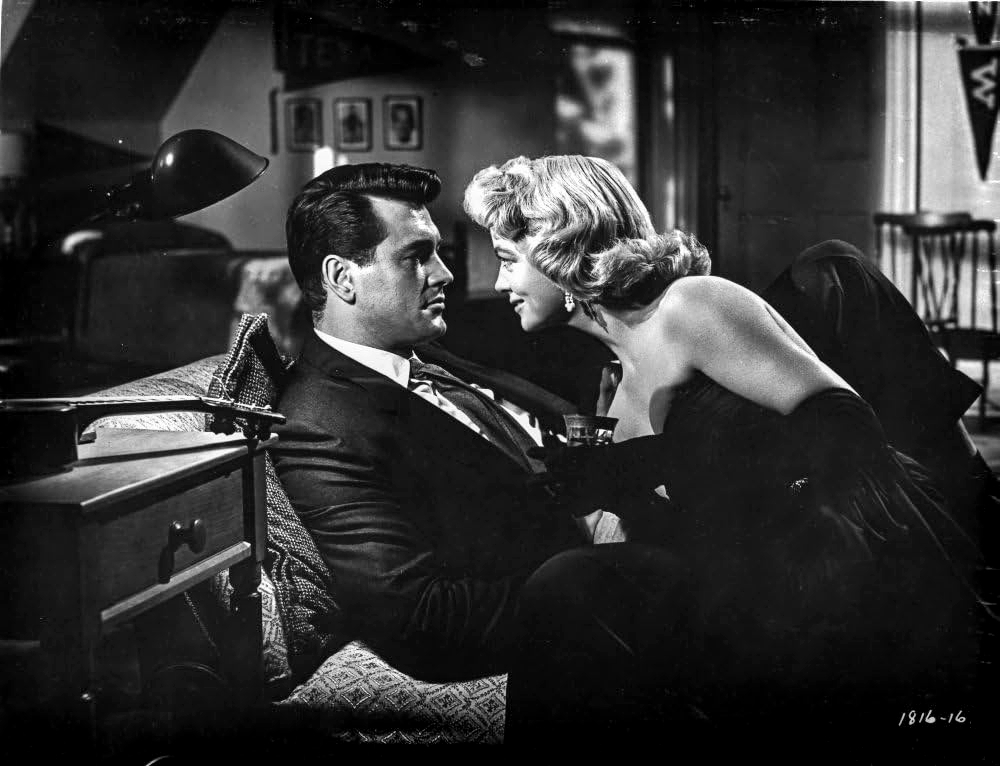
Image context: the lead image is a real 1956 Universal publicity still of Rock Hudson and Dorothy Malone from Written on the Wind. It fits this article because the movie's genre revolution happens right there in the bodies: Hudson's calm solidity belongs to old studio reassurance, while Malone's leaning, glittering instability pushes the same frame toward fever, appetite, and collapse.[7]
Sirk turns melodrama away from respectable suffering and toward diseased abundance
The basic outline sounds almost classical.[1][5][6] Mitch Wayne, the self-controlled geologist played by Rock Hudson, is tied to the oil-rich Hadley family. Kyle Hadley, played by Robert Stack, is rich, brittle, and increasingly consumed by sexual insecurity; his sister Marylee, played by Dorothy Malone, is volatile, desirous, and humiliatingly transparent about what she wants; Lucy, played by Lauren Bacall, marries into the family and finds herself trapped inside its emotional toxicity.[1][2][6] On paper, this could have become a neat cautionary drama about bad choices among the wealthy.
Sirk makes it stranger than that. Laura Mulvey's Criterion essay gets to the core when it describes the film as driven by failure and frustration spilling outward into visual excess.[2] The film is not content to tell us that these people are miserable. It keeps building a world in which their misery has already entered the furniture, the staircases, the cars, the liquor bottles, the color scheme, and the distances between bodies. In older melodrama, decor might intensify feeling. In Written on the Wind, decor behaves like evidence.
That is the genre hinge. Melodrama here stops being only a vehicle for moral ordeal and becomes a way of showing how a whole social order can look healthy while carrying disease.[2][5] The Hadleys have planes, servants, money, company power, and a family name big enough to dominate a region. None of it stabilizes them. Wealth only gives their panic more surfaces on which to register. Sirk does not strip melodrama down to realism. He lets melodrama become the truest way of photographing a world whose surfaces are already lying.[2][3]
Color, music, and decor do the work that dialogue cannot admit
This is where Written on the Wind starts looking like a manual for later filmmakers.[2][3] Sirk and cinematographer Russell Metty use saturated color, polished interiors, and aggressive contrasts not as ornament but as a system for sorting desire. Mulvey notes the film's careful color coding and singles out Marylee as its most explosive center, from her red sports car to her shocking pink negligee.[2] Those details matter because they shift melodrama from "what the characters confess" to "what the image already knows."
Marylee is the film's most radical figure for that reason.[2][3] She is often remembered as pure camp spectacle, and Dorothy Malone's Oscar-winning performance certainly invites that memory.[1][6] But the performance is stronger and sadder than camp shorthand allows. Marylee is not merely outrageous. She is what happens when a studio-era female role becomes too charged to remain decorative. Her movement, clothing, music, and emotional timing keep breaking the family's rules of tasteful concealment.
The famous sequence in which Marylee dances wildly in her bedroom while her father struggles up the staircase is the clearest demonstration.[2][3] Sirk crosscuts private abandon and patriarchal collapse until melodrama becomes montage. Music is no longer background support. It becomes pressure. The house is no longer neutral shelter. It becomes a channel through which rebellion, shame, and family authority crash into one another. That is why the film feels both classical and unruly at once. It still uses studio polish, yet it makes polish vibrate with something close to vulgar panic.
Rock Hudson's steadiness shows how far the genre has moved
Michael Koresky's essay on the Sirk-Hudson collaboration is useful here because it clarifies what Hudson contributes to Sirk beyond star power.[4] Hudson often functions as the calm axis around which Sirk can organize more unstable emotional weather. In Written on the Wind, Mitch is not the film's most interesting character, but he is structurally essential. He gives the audience a reference point for health, work, loyalty, and masculine steadiness. That reference point is what lets the Hadleys look not just dramatic but pathological.[1][4]
This matters for genre history because it reveals how Sirk transforms the standard romantic triangle. Mitch is the kind of reliable male center who might stabilize another studio melodrama. Here he cannot save the world around him.[1][3][4] His solidity only makes the surrounding disorder sharper. Kyle's panic about potency and inheritance, Lucy's misplacement inside the family system, and Marylee's humiliatingly unreturned desire all end up exposing a social order that cannot convert wealth into adulthood.[2][3]
So the movie's excess is never random.[2][3][6] It is precisely calibrated against Hudson's steadiness, against the clean lines of the mansion, against the public language of oil-company success, against the old promise that money and heterosexual couplehood should settle everything. Sirk keeps all those assurances in the frame just long enough for them to start curdling.
This is why the film sits between Hollywood melodrama, camp, and later American soap
BFI Player's note calls Written on the Wind a template for the hysterical oil-family drama later adopted by Dallas, and that is exactly the right kind of clue.[5] The film belongs to 1950s studio melodrama, but it also points forward toward forms that would become more openly serial, trashy, or knowingly stylized. It shows that family wealth, sexual humiliation, and inheritance panic could be played at a pitch higher than tasteful drama usually allowed, without losing narrative grip.[3][5]
At the same time, the film is more severe than later camp affection sometimes suggests.[2][3] Blair McClendon stresses that the central question in Written on the Wind is whether these men and women will act, and that focus matters because the movie is built around paralysis as much as flamboyance.[3] People drink, accuse, desire, posture, and spiral, but their tragedy lies in how badly they inhabit their own wants. Sirk lets their surfaces flare while their inner lives remain botched and frightened. The result is not liberating excess. It is poisoned excess.
That is why later filmmakers kept learning from Sirk rather than merely quoting him.[2][3][4] Fassbinder saw that melodrama's exaggerations could expose modern social cruelty more efficiently than sober realism. Todd Haynes learned that color, performance, and decor could carry ideological pressure without flattening characters into thesis props. Written on the Wind sits near the center of that lineage because it demonstrates, with brutal clarity, that style can be both luscious and diagnostic at once.[2][3]
A melodrama in which success itself has gone bad
The film's final power comes from how completely it joins personal breakdown to a social symbol.[2][3] Mulvey recalls Sirk's own emphasis on Dorothy Malone left alone with the oil well, clinging to the thing that represents the family's money and the wider nightmare of American society.[2] That image lands because the film has spent ninety-nine minutes turning success into something sticky, infantilizing, and spiritually sterile.[1][2][6]
That is the larger movement-and-genre lesson. Written on the Wind does not matter because it is "deliciously over-the-top." It matters because it helped move melodrama away from noble suffering and toward systemic sickness. It discovered that a glossy Hollywood movie could look fully alive while every value inside it was already decaying. Once Sirk proved that, the genre could never go back to innocence.[2][3][5]
Sources
- The Criterion Collection, "Written on the Wind (1956)" film page.
- Laura Mulvey, "Written on the Wind," The Criterion Collection.
- Blair McClendon, "Written on the Wind: No Good End," The Criterion Collection.
- Michael Koresky, "The Sirk-Hudson Connection," The Criterion Collection.
- BFI Player, "Written on the Wind" film page.
- MoMA, "Written on the Wind. 1956. Directed by Douglas Sirk."
- Wikimedia Commons, "File:Rock Hudson and Dorothy Malone in Written on the Wind.jpeg."