Spoiler note: this article discusses the childbirth death, the ending, and the resurrection scene.
Carl Theodor Dreyer's Ordet is one of the rare films whose ending is famous enough to intimidate people before they see it.[1][2][3] A resurrection sits at its center. That fact alone can make the film sound like a test of belief, or like a forbiddingly solemn classic that asks viewers to accept transcendence on command. But Ordet works by almost the opposite method. It does not hurry toward its miracle. It earns it by giving the ordinary world a density so complete that when the impossible arrives, it does not feel like an escape from embodiment. It feels like the most extreme thing embodiment could contain.[1][2][4]
That is why the film's patience matters so much.[2][4] Dreyer organizes nearly everything around a farm household: a parlor, adjoining rooms, doors opening and closing, chairs pulled into place, tea poured, bread cut, someone crossing an empty stretch of floor before the camera arrives a second later. The Borgen family argues about doctrine, sanity, marriage, and despair, but the movie's real persuasive power lies in how those arguments are absorbed by domestic space. Faith in Ordet is never only a matter of what characters say. It is a matter of where they stand, how slowly they move, what the room sounds like after they finish speaking, and how long the camera lingers as though the house itself were still listening.[1][2][3]
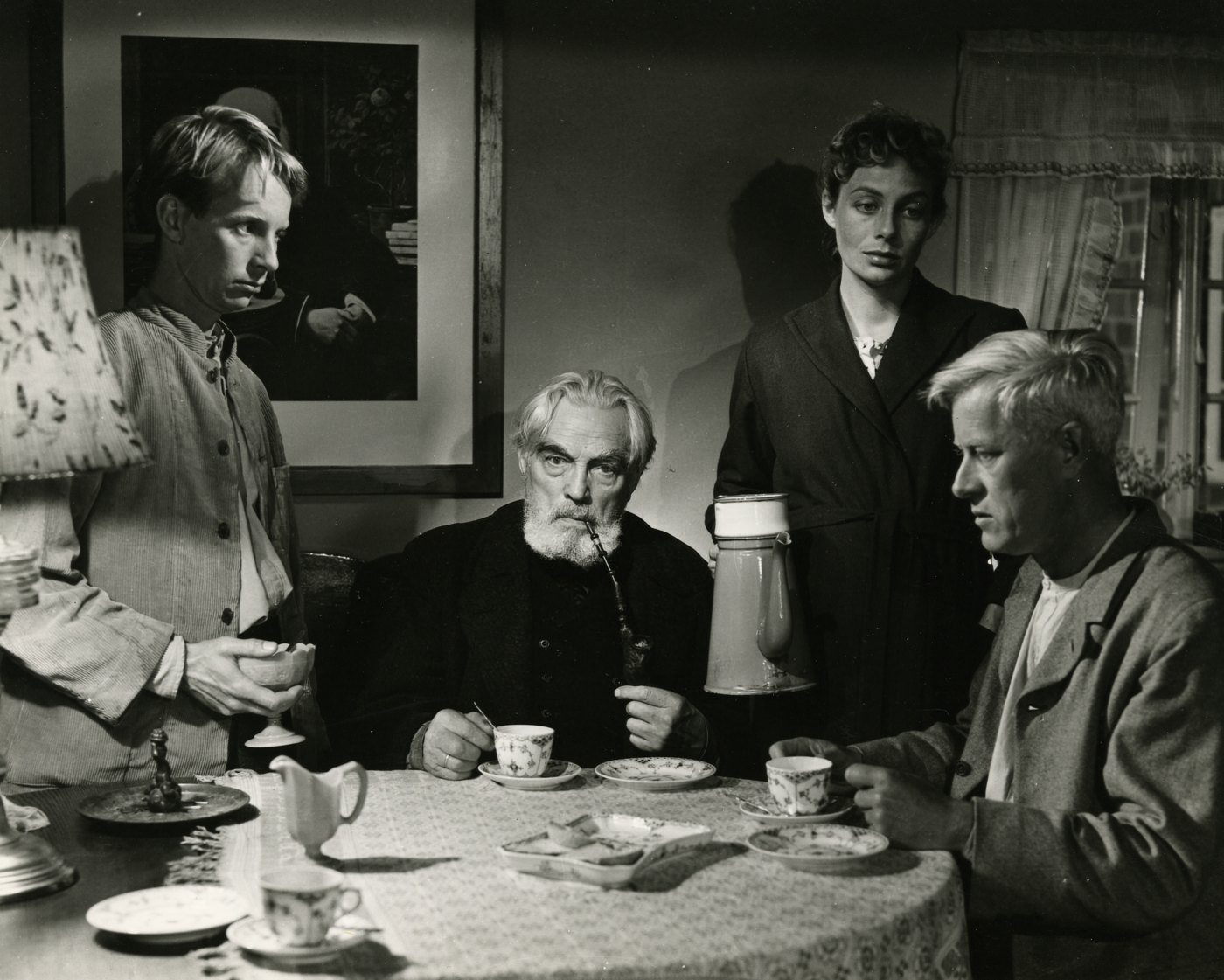
Image context: the lead image uses a Janus production still from the film's parlor interior. It is the right recognition image for this essay because Ordet turns theological dispute into family geometry. Before the resurrection, Dreyer has already made cups, tablecloth, spacing, and silence do as much dramatic work as doctrine.[5]
The parlor is not background; it is the film's moral instrument
Chris Fujiwara's Criterion essay is especially useful on this point because it insists on the strangeness of Ordet without pretending that strangeness floats free of ordinary life.[2] He notes that Dreyer fills the film's pauses with reaction, movement, and the physical presence of voices in chamber space.[2] That observation gets to the core of what the parlor does. The main room of the Borgen house is not just where scenes happen. It is where scenes continue resonating after the dialogue seems to end.
Dreyer keeps returning to the same domestic arena until the viewer begins reading it almost musically.[1][2][3] Old Morten Borgen holds court there. Inger moves through it with a practical serenity that steadies everyone else's sharper convictions. Mikkel sits inside it like a man who has lost his theological language without losing his vulnerability. Johannes drifts through it as both holy fool and household disturbance. Because the room keeps receiving these bodies in different states of certainty and fear, it stops feeling like decor and starts feeling like the film's measuring device. It tells us how close people are to one another, and how far apart.
This is why the movie can sustain so much talk about religion without becoming abstract.[1][3][4] Belief here is always being tested by proximity. A doctrine must survive the pressure of a family meal, a birth crisis, a lover's plea, a coffin in the next room. Dreyer does not set faith above daily life so much as force it back through the grain of daily life. The parlor becomes the chamber in which metaphysics has to breathe the same air as fatigue, appetite, grief, and habit.
Doorways and camera movements make space feel predictive
One of the film's deepest formal tricks is that the camera rarely seems surprised.[2][4] It glides, waits, and turns with a calm that feels almost clairvoyant. Fujiwara writes that the camera follows the characters but also goes beyond them, carrying both the sympathy of an observer and an eerie foresight about where they will appear next.[2] That is exactly the sensation of Ordet: the camera behaves as though space already knows what kind of suffering is about to enter it.
Doorways are central to that effect. Dreyer uses thresholds less as emphatic visual symbols than as pressure valves. People pause in them, overhear through them, or arrive a fraction too late through them. The room beyond a doorway is never merely the next room. It is the place where knowledge is about to change status. Somebody will discover that labor has become danger, that doctrinal confidence has become helplessness, or that the household's calm has already cracked. The camera's slow assurance means these thresholds do not feel theatrical. They feel fated.
This is also where Dreyer's slowness stops being a matter of prestige pacing and becomes an ethical method.[2][4] Fast cutting could turn Ordet into argument or sensation. Dreyer wants something harder. He wants the viewer to inhabit the lag between event and recognition. The camera crosses a stretch of empty floor, or holds on a face after someone else has stopped speaking, and in that pause the scene's emotional meaning finishes arriving. Space becomes predictive because the film has trained us to understand that what matters most often lands one beat after the obvious action.
Johannes matters because he bends the household's tone without leaving it
Many viewers first encounter Ordet through talk of its miracle, but the stranger problem arrives earlier in Johannes.[1][2] He believes he is Jesus, speaks in prophetic cadences, and moves through the farm with a combination of irritation, terror, and visionary force.[2] Fujiwara is right that Dreyer seeks the audience's shock and alienation in the character.[2] Johannes does not exist to make the film picturesque or quaintly mystical. He exists to bend the film's tonal register away from realism without ever allowing it to leave the material world of the house.
That is crucial, because Ordet would be much easier to dismiss if Johannes belonged to a separate symbolic layer while everyone else remained safely naturalistic.[2][4] Dreyer refuses that split. Johannes eats the same air, walks the same floors, and troubles the same family system as everybody else. His speech sounds otherworldly, yet his body is always there among chairs, doorframes, windows, and worried relatives. The film does not place transcendence in a distant heaven; it places it in a son who has become unbearable to live with and impossible to explain away.
Seen from that angle, Johannes prepares the ending not by announcing it as a prophecy machine, but by unsettling the household's scale of what can count as reality.[2][4] He makes every domestic scene carry a second pressure. There is the practical problem in front of the family, and there is the more difficult question of whether practical judgment is sufficient to describe what is happening. Dreyer keeps both levels active at once. That tension is the film's true suspense.
Inger's death gives the miracle a bodily cost
The film would collapse into pious allegory if it treated death as a convenient stage on the way to transcendence.[1][2][3] Instead Dreyer does something harsher. He makes Inger the human center of the household and then makes her childbirth crisis painfully physical. This matters because Inger is not just "the good woman" in a schematic sense. She is the figure who most fully binds the household's competing moods into one lived world.[2][3] Her warmth toward Anders and Anne, her negotiations with Morten, and her patient handling of Mikkel's despair give the parlor its sense of inhabitable order.
When that order breaks, the film does not leap over the damage.[1][2] It stays with the room after life has gone out of it. The same domestic space that earlier held meals, talk, and quarrels now holds vigil. The miracle only has force because Dreyer lets the viewer feel the indecency of asking grief to become meaning too quickly. He does not argue that faith cancels physical cost. He insists on the cost first.
That insistence is what keeps the ending from turning sentimental.[2][4] The film has already shown the limits of doctrine when pressed by actual suffering: Mikkel's agnosticism is no longer an abstract intellectual pose, and the rival forms of Christianity in the film are no longer merely colorful differences in emphasis. They are ways of facing, or failing to face, the body under pressure. By the time the final scene arrives, Ordet has earned the right to ask whether faith can speak to the dead because it has first made us watch faith speak inadequately to pain.
The final kiss matters because the miracle returns Inger to relation, not spectacle
The ending is often remembered for resurrection as event, but Dreyer stages it more precisely than that.[1][2][3] He does not build the scene around pyrotechnic astonishment. He builds it around relation. The child who asks for her mother, Johannes's command at the coffin, Mikkel's shattered unbelief, Inger opening her eyes, and finally the kiss between husband and wife: each movement pulls the miracle away from abstraction and back into human attachment. The point is not that a supernatural demonstration has occurred in front of witnesses. The point is that a marriage, a family, and a room are suddenly asked to receive life again.
That final kiss is the decisive stroke. Without it, the resurrection could remain an emblem, an article of doctrine, or a majestic shock. With it, the miracle returns to the scale on which Dreyer has been working all along.[2][3] Inger does not rise into symbol. She comes back into touch. The film's theology lands not in an idea but in a restored relation between bodies that had already been separated by death.
This is why Ordet feels so devastating rather than merely edifying.[1][2][4] Dreyer spends the whole film proving that ordinary life is dense enough to bear metaphysical weight. The parlor is not disposable once the miracle arrives. The miracle confirms how much the parlor already mattered. Cups, clocks, offscreen footsteps, pauses between sentences, a doorway crossed too slowly, a husband who can no longer protect his wife with reason alone: all of it prepares the viewer for the ending by teaching us that the household is already full of invisible consequence.
The resurrection feels earned because Dreyer never treats transcendence as a shortcut around the world.[1][2][3][4] He treats it as the most difficult claim that can be made about the world once one has looked at that world hard enough. Ordet does not ask viewers to stop believing in rooms, bodies, and grief. It asks whether rooms, bodies, and grief have been fully understood yet. That question is what keeps the film alive. The miracle arrives at the end, but the achievement begins much earlier, when Dreyer makes a parlor feel large enough to hold both despair and the impossible.
Sources
- Janus Films, "Ordet" film page.
- Chris Fujiwara, "Ordet," The Criterion Collection.
- The Criterion Collection, "Ordet (1955)" film page.
- Senses of Cinema, "Carl Theodor Dreyer" (Great Directors profile).
- Janus Films, Ordet stills package ZIP.