Spoiler note: this article discusses the final carnival sequence and the film's closing movement.
Marcel Carné's Children of Paradise is often introduced through scale: the great French epic, the grand romantic fresco, the film with four men orbiting one woman across nearly three hours of theatrical intrigue.[1][2][3][4] All of that is true, but it does not yet explain why the movie feels so emotionally inexhaustible. Its real achievement is spatial. Carné, screenwriter Jacques Prévert, cinematographer Roger Hubert, and production designer Alexandre Trauner do not merely tell a large story. They build a world in layers, then force longing to move through those layers in public. Streets are crowded before desire arrives. Stages are always backed by wings, curtains, and dressing rooms. Audiences watch performers, performers watch audiences, and the camera keeps reminding us that love in this film is never fully private.[2][3][4]
That is why the movie's famous richness never feels like simple decorative prestige.[1][2] The boulevard, the Funambules theater, the gallery seats that give the film its title, the side corridors where glances are caught too late, and the final carnival crowd all belong to the same technique. Children of Paradise keeps arranging bodies on multiple planes so that intimacy has to cross distance, class, noise, and spectacle before it can become legible.[2][3][4] The result is a romantic film in which feeling always seems to have an audience, even when the characters wish it did not.
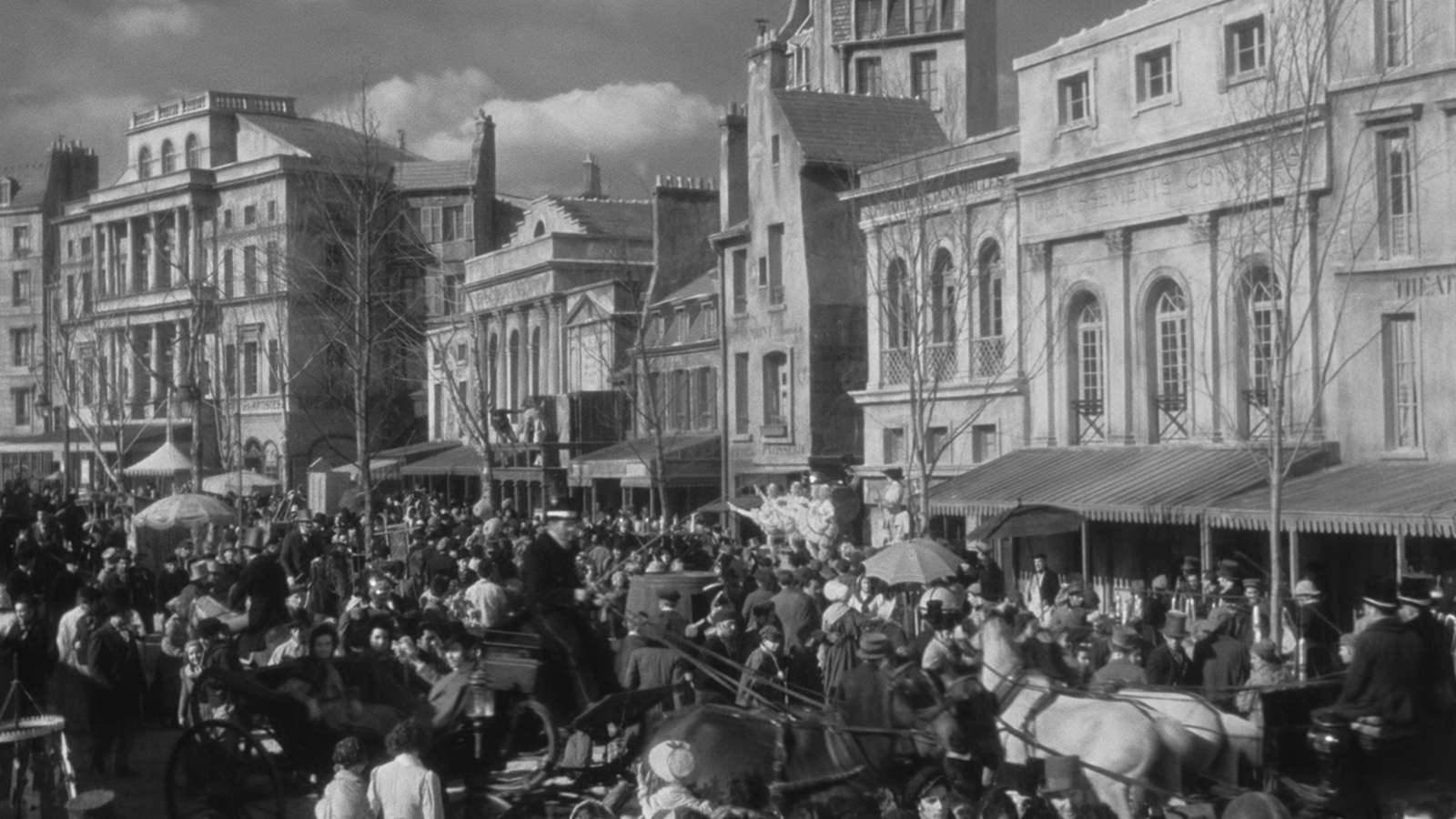
Image context: the lead image uses an official Janus still of the Boulevard du Crime. It is the right film image for this essay because the boulevard is not a neutral establishing shot or a pretty historical backdrop. It is the movie's first machine for producing emotional pressure: private desire enters a space already crowded with witnesses, commerce, performance, and traffic.[5]
The boulevard is not background; it is the film's depth engine
The opening street material tells you almost everything about the movie's craft.[1][3][4] Stonehill's Criterion essay stresses the production's wartime making and the way period engravings helped inspire Trauner's extraordinarily deep sets.[4] Dudley Andrew's piece goes further by describing the majestic sweep of the opening and the film's balance between crowded choral scenes and intimate encounters.[3] Those observations matter because the boulevard is not just a historical scene-setter. It is a spatial grammar lesson.
Look at how the street works. There is always more than one thing happening at once: hawkers, thieves, carriages, spectators, actors, gossip, side-glances, police intervention, and theatrical promotion all compete inside the same field.[1][2][4] That density does two things at once. First, it gives the film an immediate social amplitude. You feel that this Paris contains classes, trades, and appetites beyond the central lovers. Second, it makes recognition difficult. A person is seen, but never under clean conditions. Garance can be noticed, accused, desired, rescued, and reinterpreted within seconds because the street is already a public sorting machine.[1][3][4]
This is where Trauner's set design becomes more than mere grandeur.[2][4] The boulevard recedes, but it also stratifies. Foreground movement never cancels the middle distance; the middle distance never empties the background. Carné keeps emotional information traveling through all three zones. Someone performs in front, someone reacts at the edge, someone else enters from deeper in the set carrying the next complication. The frame remains alive with contingency. Romance therefore does not bloom in isolation. It has to find a path through public clutter.
Curtains, wings, and doorways turn theater into a truth machine
If the boulevard gives the film horizontal depth, the theater gives it thresholds.[2][3][4] Andrew's essay is especially sharp on this point when it argues that the architecture of the theater organizes the film's oppositions, with the curtain separating public action from what happens onstage and backstage.[3] That is exactly the right way to see the movie. The curtain in Children of Paradise is not only a piece of decor. It is the device that keeps reversing identities.
Characters cross it and change status. A performer comes offstage and becomes vulnerable. A lover in the wings becomes an unwilling spectator. A staged fiction reveals a real humiliation. Makeup, costume, and role are constantly being put on or taken off, but the deeper effect is that the film never lets public display and private feeling stay separate for long.[3][4] The Funambules is a workplace, a stage, a court of judgment, and a trap. The instant someone believes they have reached a private corner, another line of sight opens up.
This is why the backstage scenes feel so charged even when very little happens in purely plot terms.[2][3] The wings are full of overhearing. Doorways hold bodies for one extra beat. A character is framed listening rather than speaking, or watching rather than entering. Carné repeatedly places feeling one threshold away from action, which means desire in the film is experienced less as possession than as adjacency. People stand next to revelation, or just behind it, or arrive one second after it has shifted elsewhere. The set turns delay into heartbreak.
The film's famous romanticism depends on spectatorship, not escape
It would be easy to describe the movie as a lush retreat into nineteenth-century theatrical legend, especially because it was made under Occupation and released as France was emerging from war.[2][4] But the technique is harsher than that. The film's romanticism only works because spectatorship is built into every major emotional event. Stonehill notes that Carné called the film a homage to the theater and that the title initially refers to the cheapest, highest gallery seats, before widening to include performers and finally us.[4] That widening is not a side note. It is the whole structure.
Baptiste's mime is the clearest example.[2][3] Mime in this film is not a retreat into purity; it is a way of concentrating attention. Baptiste can only become fully himself before witnesses. His silence lands because the crowd is there to feel it, because Garance is there to read it, and because the frame keeps balancing his interiority against the louder, brasher social energies represented by Frédérick, Lacenaire, the crowd, and the city itself.[2][3] In Children of Paradise, private feeling becomes real by surviving an audience, not by hiding from one.
That principle extends to the whole movie. Frédérick's theatrical bravura converts public performance into erotic power.[3] Lacenaire treats self-presentation as a weapon. Garance moves through the film as both person and spectacle, looked at by men who keep mistaking access for possession.[1][2][3] Even Nathalie's suffering takes place within institutions of display: marriage, theater, reputation, and the daily fact of being seen. The film's grandeur comes from recognizing that love is lived inside systems of spectatorship, not outside them.
Why the final carnival crush feels so cruel
The ending is devastating because it takes the whole film's spatial logic and removes the last hope of clear passage.[1][2][3] Earlier scenes gave characters thresholds, wings, balconies, corridors, and stage business through which desire could at least try to reach its object. The carnival gives them a crowd without edges. The city becomes pure human weather. Bodies surge, costumes blur, noise rises, and movement stops belonging to any one character. Baptiste does not simply lose Garance in the abstract; he loses her to a public mass that has absorbed the entire film's history of spectatorship and turned it into obstruction.[1][3]
That is why the sequence feels larger than melodramatic bad luck. The crowd is not random.[3][4] It is the final form of the movie's method. From the opening boulevard onward, Carné has been showing that this world is built from layers of looking, interruption, and public circulation. The carnival merely makes the rule inescapable. Feeling can no longer even pretend to carve out a chamber of privacy. It is swept into collective motion.
The cruelty is amplified by how visually ecstatic the scene remains.[1][2][3] The frame is alive, energetic, festive, and nearly intoxicated with movement, but that vitality serves denial. This is one of the film's deepest technical achievements: it uses abundance against fulfillment. The more bodies, masks, streamers, and surging directions the frame contains, the less chance there is that the central lovers can secure a clean line toward one another. Scale does not rescue intimacy. It buries it.
Why the movie still feels bigger than most epics
Many epics achieve scale by multiplying events. Children of Paradise achieves scale by multiplying planes of attention.[1][2][3][4] Its sets are deep, but so are its systems of watching. A glance from the gallery changes the meaning of a performance below. A gesture in the wings poisons the stage. A street crowd turns accusation into theater. A carnival turns longing into pure impossibility. Carné's craft is not about making Paris look large for its own sake. It is about making emotional life travel through public architecture until every private wish carries social weight.
That is why the film survives summary so easily and exhausts summary just as quickly. You can reduce it to four lovers and one woman, or to poetic realism at heroic scale, or to French cinema's great wartime masterpiece.[1][2][3][4] None of those descriptions is wrong. They are simply too flat for a film built on depth. What stays with you is the sense that every scene contains another ledge, another witness, another threshold, another plane on which feeling has already started to move. Children of Paradise turns space itself into melodrama, and the final result is that rare thing: an epic whose true grandeur lies in the precision with which it denies people the room they most need.
Sources
- Janus Films, Children of Paradise film page.
- The Criterion Collection, Children of Paradise (1945) film page.
- Dudley Andrew, "The Romance of Children of Paradise," The Criterion Collection.
- Brian Stonehill, "Children of Paradise," The Criterion Collection.
- Janus Films, official still from Children of Paradise, still 683id-344.