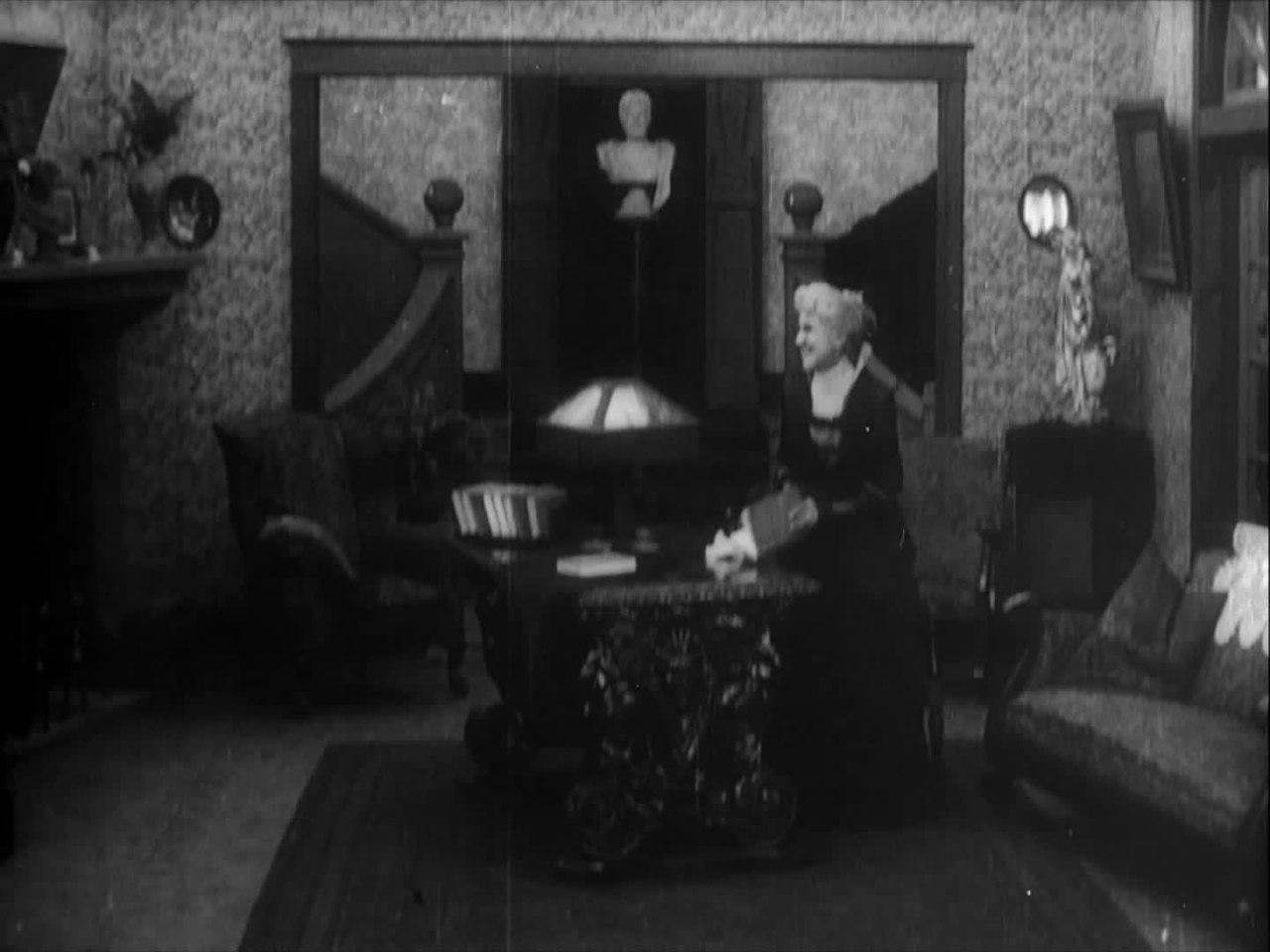
Within Our Gates begins like a melodrama with too many doors open at once: a broken engagement, a scheming cousin, a gambler, a school in danger, a Boston errand, a stolen purse, a philanthropic accident, a romance, and finally a violent childhood history that arrives late enough to change the meaning of almost everything before it. That crowdedness can look ungainly if the film is measured against the smooth continuity standards of studio Hollywood. But Oscar Micheaux's 1920 feature is strongest when its pressure is allowed to stay visible. It is a movie about a society that keeps demanding proof from Black life, then punishing the evidence when it becomes too direct.[1][2]
The plot's clearest public problem is practical: Sylvia Landry, played by Evelyn Preer, tries to raise money for a struggling rural school for Black children in the South.[1][4] That mission gives the film its moral spine. Education is not treated as sentimental uplift alone. It is a contested institution, dependent on travel, persuasion, charity, and the willingness of people with money to hear more than the version of the South that flatters them. Micheaux turns a schoolhouse into a pressure point: if the children are to be protected, Sylvia must carry their claim through spaces built to question her credibility.
That is why the Northern philanthropy section matters more than a plot synopsis suggests. Sylvia's journey to Boston looks, at first, like a route out of Southern danger. Yet the North in Within Our Gates is not a clean refuge. It is a room where Black suffering has to be translated into an acceptable appeal. The wealthy Elena Warwick can fund the school, but her decision is surrounded by competing narratives: Sylvia's dignity, Mrs. Stratton's racist paternalism, and the film's own insistence that charity without truth is too fragile to count as justice.[1][4]
Micheaux's film keeps asking who is permitted to narrate harm. The Library of Congress catalog record lists the film's subjects in institutional terms - African American educators, schools, physicians, race relations, racism, lynching - and that list is useful because it shows how many public systems the movie draws into one story.[1] The school plot is not separate from the lynching flashback. The physician is not separate from political speech. The drawing room is not separate from the mob. Each social space tests whether Black testimony will be received, managed, doubted, softened, or cut.
The censors understood the film too well
The film's censorship history is not background trivia; it is part of the close reading. Daniel Eagan's National Film Registry essay notes that when Micheaux opened the film in Chicago and Detroit in January 1920, authorities and critics immediately argued over whether scenes of lynching and attempted rape would provoke unrest, and cuts were demanded in several cities.[2] The San Francisco Silent Film Festival essay by Scott Simmon adds the sharper context: Chicago was still living in the aftermath of the 1919 race riots, and the debate over the film's release explicitly weighed the danger of showing racial violence against the urgency of exposing existing injustice.[3]
That controversy proves the film was not merely reporting violence. It was changing the terms under which violence could be seen. Censors often defend themselves as guardians of public order, but Micheaux's case exposes the circular logic: racial violence could be tolerated as social reality, while the image of that violence from a Black filmmaker's viewpoint became the alleged danger.[2][3] The problem was not that Within Our Gates made violence appear from nowhere. The problem was that it refused to let violence remain offscreen, abstract, or narratively owned by white fear.
Micheaux's relation to D. W. Griffith's The Birth of a Nation matters here, but the film is more than a rebuttal. Simmon reads the final backstory as a response to Griffith's racist landmark, especially in storyline and crosscutting style.[3] Eagan likewise points to Micheaux's reversal of Griffith's rape panic, noting how the film's attempted assault exposes white sexual violence rather than inventing Black threat.[2] The deeper point is structural. Micheaux does not simply say "Griffith lied." He builds a melodrama in which withheld truth becomes the engine. Sylvia's past cannot remain hidden because the present order depends on not knowing it.
The late flashback changes the whole movie
The film's most radical formal decision is to delay Sylvia's traumatic history until the final stretch. For much of the running time, she is seen through social roles: fiancee, teacher, fundraiser, patient, possible wife, respectable emissary. The late flashback does not add a shocking backstory for decoration. It reorders the film's moral accounting. The woman who has been asking for school money has also survived the collapse of every institution that should have protected a family: law, property, local authority, white neighborliness, religion, and public memory.[1][2][3]
This is where the film's sometimes awkward structure becomes an argument. If Sylvia's history had opened the film, the audience might read the school mission as a direct recovery plot. By delaying it, Micheaux forces viewers to experience a quieter form of ignorance first. We watch people assess Sylvia without knowing what she carries. We watch philanthropists decide whether Black education deserves money before the film reveals the violence that makes that education an emergency. The flashback turns respectability inside out: Sylvia did not earn care because she is respectable; respectability itself is exposed as a thin shield against power.
The surviving version complicates any confident claim about original design. The Library of Congress record states that the 1993 reconstruction came from a nitrate print of La Negra, a Spanish-language version, with English intertitles translated back from Spanish and informed where possible by Micheaux's novels and Body and Soul.[1] Simmon, who supervised the reconstruction, stresses that what survives is only one version and that Micheaux likely edited different versions partly under censorship pressure.[3] In other words, the film we read today is already marked by loss, translation, and repair.
That should make interpretation more careful, not weaker. The rough transitions, missing materials, and reconstructed titles do not erase the film's force. They make its afterlife resemble its subject. Within Our Gates is about evidence surviving hostile systems, and the film itself survived through a displaced print, a changed title, replacement intertitles, and later archival work.[1][3][6]
The school is the future, but not an innocent one
The rural school might sound like the film's safe moral object: who could oppose children learning? Micheaux's answer is bleakly practical. Plenty of people can oppose it if education threatens the story they need to tell about racial hierarchy. The school in Within Our Gates is underfunded not because it is marginal to the plot, but because Black futures have been made administratively fragile. Sylvia's work is to make that fragility visible to people who can afford not to see it.[1][4]
Yale Film Archive's notes emphasize the familiar melodramatic tradition behind the film and the way Micheaux uses flashbacks to tell Sylvia's story, including the censorship cuts that followed the lynching material after release.[4] That combination is essential. Micheaux uses melodrama because melodrama can carry accusation through feeling. A budget ledger, a sermon, a purse theft, an accident, and a revelation of parentage all belong to a form that keeps insisting private life is never merely private.
The film's ending has often felt uneasy, and it should. Dr. Vivian's patriotic language and the marriage resolution can sound like the film is trying to close a wound with civic optimism.[3] But Sylvia's face, and the preceding flashback, resist easy fusion. The movie has shown too much to let a romantic ending settle the matter. The school may be funded. Sylvia may be loved. Yet the systems that made her appeal necessary remain intact.
That tension is why Within Our Gates still feels alive rather than only historically important. It is the earliest surviving feature by an African American director, a fact repeated by the San Francisco Silent Film Festival and the Public Domain Review, and the milestone is real.[3][5] But its lasting power is not only priority. Micheaux made a film in which form itself seems to be fighting for jurisdiction: who can tell the story, which scenes must be cut, what charity can hear, what memory can restore, and whether a school can stand as protection when law has failed.
Seen closely, Within Our Gates is not a clean answer to racist cinema. It is a counter-record with scars. Its power comes from the way it lets education, melodrama, censorship, and flashback collide until the viewer understands that the title is not welcoming. It is accusatory. The question is not who lives within the gates. The question is who built them, who guards them, and what truths have to survive before they can be opened.
Sources
- Library of Congress, "Within our gates" catalog record - plot summary, subjects, National Film Registry status, and 1993 reconstruction notes.
- Daniel Eagan, "Within Our Gates," Library of Congress National Film Registry essay - Micheaux's race-film context, censorship history, and formal analysis.
- Scott Simmon, "Within Our Gates," San Francisco Silent Film Festival - program essay on Micheaux, the film's structure, censorship, survival, and reconstruction.
- Yale Film Archive, "Film Notes: WITHIN OUR GATES" - screening notes on melodrama, flashback, school plot, censorship, and release context.
- The Public Domain Review, "Within Our Gates (1920)" - public-domain presentation and historical framing of the film as an early surviving African American feature.
- Wikimedia Commons, "File:Within Our Gates HQ.webm" - public-domain 1920 film file sourced to the Library of Congress, used for the preserved-frame article image.