Norman McLaren is easiest to praise with the wrong vocabulary. He was innovative, experimental, influential, and decorated, but those labels can make his films sound like museum proofs for techniques. The films are stranger and warmer than that. McLaren's real distinction is that he treated cinema as a physical relationship: hand to filmstrip, frame to frame, sound mark to image mark, actor to camera interval, viewer's eye to afterimage. He did not merely animate drawings. He animated the conditions under which cinema becomes perceptible.[1][3]
The National Film Board of Canada's biography gives the useful career spine. McLaren began making films in the 1930s, caught John Grierson's attention at the Scottish Amateur Film Festival, worked at Britain's General Post Office Film Unit, and joined the NFB in 1941 after Grierson became Canada's first Government Film Commissioner.[1] That institutional path matters because McLaren's art depends on an unusual mix of public-film purpose and workshop freedom. He could make wartime films, technical demonstrations, abstract studies, anti-war fables, dance films, and optical-sound experiments without pretending that all cinema had to move toward feature narrative.
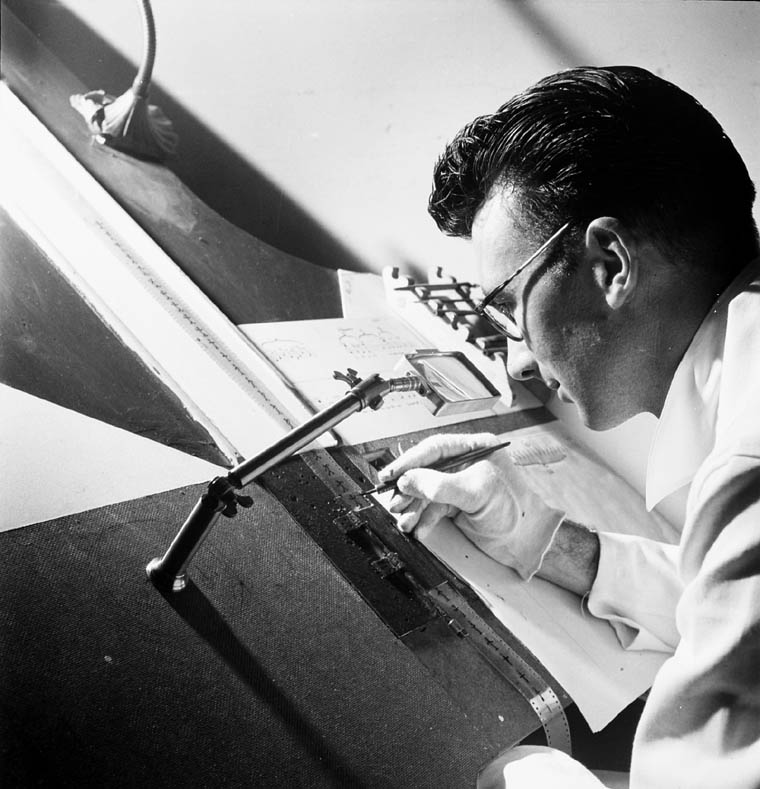
The cover image catches the profile's central fact better than a poster would. In a 1944 photograph, McLaren is not posing on a set or pointing toward actors. He is drawing onto film itself.[6] The gesture is modest, almost deskbound, but it contains the whole argument. For McLaren, film was not only a transparent carrier of photographed reality. It was a surface to scratch, paint, time, expose, and hear. His career keeps asking what happens when the filmmaker does not stand outside the medium as a manager, but works at the level where image and sound are being born.
Direct Animation Was Not a Shortcut
McLaren's direct-on-film work can look like a charming workaround if one describes it too quickly: no camera, so draw on the strip. But that misses the severity of the method. Drawing, painting, or scratching directly on film removes the cushion between idea and projection. Every mark has duration. Every gap has rhythm. Every color or incision must survive enlargement, flicker, light, and the viewer's persistence of vision.
That is why Begone Dull Care, made with Evelyn Lambart in 1949, remains a key entry point. The NFB describes the film as McLaren and Lambart painting colors, shapes, and transformations directly onto the filmstrip, creating a visual interpretation of jazz played by the Oscar Peterson Trio.[3] The description is compact, but its implications are large. Jazz is not being illustrated after the fact. It is being met with another improvising surface. Lines swell, colors flare, textures jump, and the filmstrip behaves less like a window than like a percussion instrument.
The direct method also clarifies McLaren's temperament. He was not experimental because he rejected discipline. He was experimental because he pursued exact relations through unorthodox means. A painted burst had to arrive with the music. A scratch had to last long enough to be seen but not so long that it became inert. An abstract passage had to move with enough internal structure that it felt composed rather than decorative. This is the craft behind the play. McLaren's films can feel spontaneous because their timing is so exact.[1][3]
That distinction matters for modern viewers, who may be used to thinking of animation as software layers, character rigs, or rendered worlds. McLaren's lesson runs in the opposite direction. Animation begins when time is built frame by frame. The tool can be a brush, a needle, a card system, a camera, a body, or a computer, but the essential decision remains temporal: what changes, when, and with what force?
Neighbours Turns Human Bodies Into Stop-Motion Evidence
If Begone Dull Care shows McLaren making film behave like music, Neighbours shows him making human bodies behave like animated objects without draining them of moral meaning. The NFB's film page summarizes the method plainly: McLaren uses principles normally applied to drawings or puppets to animate live actors, building a parable about two people who fight over possession of a flower.[2] The result is often described as pixillation, but the word should not soften the violence of the effect.
In ordinary live-action, a body moves through continuous time. In Neighbours, two men jerk, slide, pop, and snap through intervals. At first the technique is comic. Their movements look too crisp, too puppet-like, too absurdly polite. Then the same discontinuity turns harsh. The quarrel accelerates into territorial panic, and the frame-by-frame control makes aggression look both childish and mechanical. The anti-war argument does not sit on top of the technique. It is inside the technique. People become easier to move, manipulate, and brutalize once social rhythm has been broken into commands.[2][4]
The UNESCO Memory of the World nomination text is emphatic about the film's stature, calling Neighbours a 1952 animated work directed and produced by McLaren and placing it within a career of constant technical invention.[5] The NFB page also notes the film's Oscar recognition as Best Documentary Short Subject for 1952.[2] The category now sounds odd because the film is so obviously constructed. But the oddness is revealing. Neighbours uses artificial movement to document a real political pattern: how quickly ownership, fear, and boundary-making can turn a peaceful common space into a killing field.
McLaren's genius here is compression. The flower is not a complicated symbol. The set is not elaborate. The men do not require psychological backstory. The whole machine works because movement itself becomes the argument. A tiny patch of land, two chairs, two houses, two bodies, one flower, and a camera that refuses continuous motion: that is enough to make possessiveness look ridiculous before it becomes fatal.
He Wanted Audiences To See What They Hear
McLaren's sound experiments make the same point from another direction. He was not satisfied with synchronizing image and music in the usual sense. He wanted to expose the hidden kinship between visual pattern and sound pattern. The NFB's page for Synchromy describes the 1971 film as synchronization of image and sound "in the truest sense": McLaren used optical techniques to compose piano rhythms on the soundtrack, then moved those forms in multicolor onto the picture area so viewers effectively see what they hear.[4]
That phrase could serve as a compact theory of his late work. Cinema usually hides optical sound in the margin, where the projector reads it but the spectator does not. McLaren brings that hidden system into the center of attention. Sound becomes visible without becoming less audible. Image becomes musical without needing to represent musicians. The film does not translate sound into metaphor; it makes the shared mechanism legible.
This is why McLaren belongs in movie history, not only animation history. He understood cinema as a machine for coordinating senses. A conventional director may coordinate camera, actor, set, and edit. McLaren coordinates mark, pulse, light, sound, and retinal memory. The scale is smaller, but the ambition is not. In some ways it is larger because it asks what cinema is before it becomes a story delivery system.
The UNESCO nomination's compressed language is helpful here because it treats Neighbours not only as an anti-war message film but as evidence of McLaren's wider habit of technical research.[5] That historical placement matters, but it should not confine him to canon or classroom memory. McLaren's work remains alive because it keeps returning to first principles. What is a frame? What is a sound track? How little continuity does the eye need? How can a body be both actor and animated material? When does abstraction become felt experience rather than design?
The Workshop Was Part of the Authorship
McLaren's NFB context should not be treated as background paperwork. It shaped the art. The NFB gave him a public institution, collaborators, technical resources, and a studio culture in which short films could be research as well as release objects.[1] His authorship was personal, but it was not isolated. Lambart's collaboration on Begone Dull Care is essential to that film's visual intelligence.[3] The Board's catalog of McLaren titles shows a career that could move across techniques and purposes while remaining legible as one inquiry.[1]
That institutional setting also complicates the usual romance of the lone experimental artist. McLaren was a handworker, but not simply a solitary craftsman. He made films inside a publicly supported environment where education, propaganda, art, technology, and national culture overlapped. Sometimes that meant practical constraints. Sometimes it meant unusual freedom from commercial feature logic. The result was a body of work that could be playful without being trivial and technical without being sterile.
This may be McLaren's most useful lesson now. New moving-image tools arrive constantly, and each one tends to generate a brief panic over whether the machine has replaced the artist. McLaren's films suggest a better question: has the artist found the point of contact where the tool becomes perceptible as time? He did not fetishize apparatus for its own sake. He found pressure points. A filmstrip could be painted. A soundtrack could be drawn. A body could be moved frame by frame. A viewer's afterimage could become part of the composition.[2][3][4]
That is why his work has not aged into mere novelty. The specific techniques can be historicized; the attitude remains contemporary. McLaren keeps reminding filmmakers that cinema is not only what appears inside the frame. It is the frame's timing, the interval between frames, the light through the strip, the sound hidden beside the image, the body altered by exposure, and the viewer completing motion in the mind.
Norman McLaren made animation a contact sport with film itself. The phrase sounds playful, but the stakes are serious. His films ask the maker to touch the medium closely enough that its hidden rules become available for feeling. They ask the viewer to notice that motion is built, not given. And they ask movie history to leave room for a director whose greatest sets were sometimes strips of celluloid under his hands.
Sources
- National Film Board of Canada, "Norman McLaren" - official director biography, career chronology, and NFB filmography context.
- National Film Board of Canada, "Neighbours" - official film page, method description, synopsis, and Oscar note.
- National Film Board of Canada, "Begone Dull Care" - official film page describing McLaren and Evelyn Lambart painting directly onto the filmstrip.
- National Film Board of Canada, "Synchromy" - official film page describing McLaren's optical sound/image synchronization method.
- UNESCO Memory of the World Register, "Neighbours, animated, directed and produced by Norman McLaren in 1952" - nomination file on the film's significance and McLaren's technical research.
- Wikimedia Commons, "File:Norman McLaren drawing on film - 1944.jpg" - archival photograph used as the article image.