


Wings of Desire is often remembered through its premise first: angels above Berlin, hearing the thoughts of strangers, then one of them falling in love and giving up immortality.[1][4] That summary is correct, but it still undersells what the film actually does. Wim Wenders's deeper achievement is not simply to contrast heaven and earth. It is to make descent into a change of scale. The movie begins by giving us a city's interior murmur in the aggregate, then slowly teaches us why a cup of coffee, a bruise, a winter coat, a hand on a shoulder, or a circus body in midair can feel heavier than omniscience.[1][2][4]
That is why a video collection works better here than a single embedded clip. Janus describes the film as a city symphony made not long before the fall of the Berlin Wall, shot in black and white and color by Henri Alekan.[4] The trailer clarifies the film's first level: Berlin as a divided mental landscape where human thought hangs in the air like weather.[1][4] Criterion's brief Peter Falk clip then clarifies the second: incarnation in this movie is not a theological abstraction but a street-level appetite for texture, fatigue, and chance contact.[2] Finally, the BFI Q&A is useful because it returns the film to history and hears Wenders speak about a work that was made in one Berlin and is now watched in another.[3][4]
The collection's narrative thread is therefore simple and exact. Video one gives the city's listening architecture. Video two gives the bodily answer to that architecture. Video three gives the historical afterimage that makes the whole film feel even more fragile and precise today.[1][2][3]
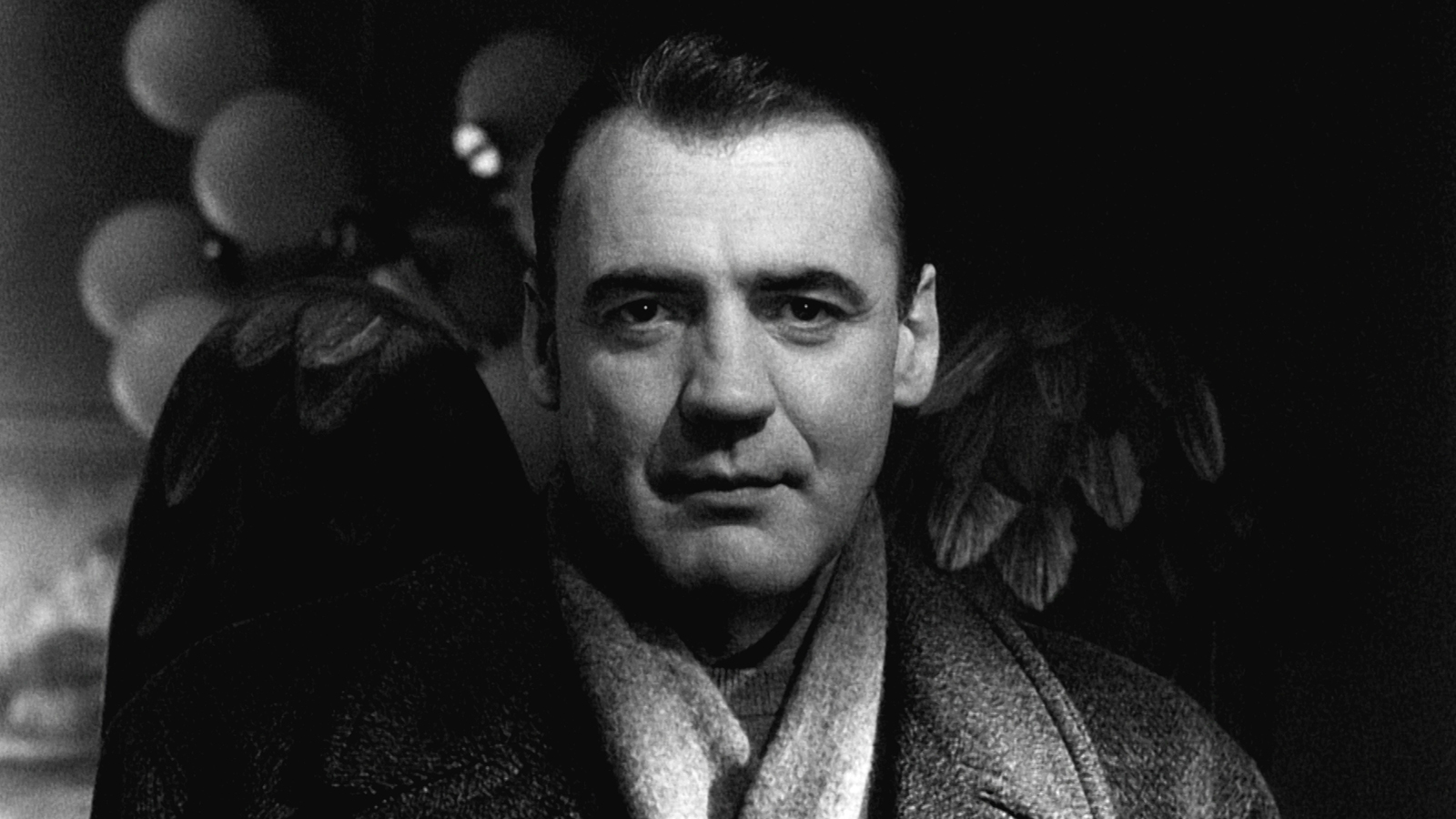
Image context: the cover uses a real Janus still of Bruno Ganz as Damiel with his wings still visible behind him. It is the right image for this article because the film's drama is not "angel versus human" in the abstract. It is the moment when an angel already starts to look like a man who has entered the city's grain.[4]
Video 1: the trailer reveals that Berlin arrives as a chorus before it arrives as plot
Curzon's restoration trailer is a strong opening anchor because it compresses the film down to its governing grammar rather than merely advertising story beats.[1] Even in short form, the trailer makes clear that Wings of Desire is built out of two linked perceptions: distance and intimacy. Berlin is seen from above, across walls, streets, libraries, transit spaces, and winter air, but it is also heard from the inside through the private speech of people who do not know they are being accompanied.[1][4] The result is not generic urban melancholy. It is a city presented as a field of simultaneous inwardness.
That matters because the film's black-and-white imagery is sometimes remembered as pure mood.[1][4] The trailer helps correct that. In Wings of Desire, black and white is not merely elegant; it belongs to the angelic register of observation, patience, and suspension, while color hits with the force of risk and embodiment.[1][4] The point is not that one mode is superior. It is that Wenders turns sensory change into philosophical change. To become human in this film is to stop hovering over experience and to enter its irreversibility.
Seen this way, the romantic premise is almost secondary. The trailer's mention of Bruno Ganz's guardian angel falling in love with a trapeze artist is crucial, but the richer point is why that love matters.[1] Marion is not just an object of desire. She represents gravity, performance, risk, and the body's unavoidable exposure to time. The trailer establishes that Wings of Desire will not solve loneliness through celestial knowledge. It will solve nothing, in fact, until the film learns to value limits, bodies, and one-sided human perspective over the fantasy of total perception.[1][4]
That is why the trailer's Berlin feels so important. This is not a decorative backdrop for a supernatural romance. It is the condition that gives the film its moral scale: a divided city, filmed shortly before the Wall fell, crowded with solitary thought and historical weight.[1][4] The city has to be listened to before it can be loved, and Wenders understands that listening itself can become a burden.
Video 2: Peter Falk turns incarnation from idea into appetite
Criterion's thirty-six-second Peter Falk clip is tiny, but it carries a disproportionate amount of the film's secret.[2] Falk does not enter Wings of Desire as a metaphysical lecturer. He enters as a walker, a body in weather, a man who seems entirely at ease with the frictions of earthly life.[2] That matters because Damiel's desire to become human can sound grand or solemn if described too abstractly. Falk breaks that solemnity. He makes being human look practical, comic, hungry, and immediate.
This is one of the film's sharpest structural decisions. If the angels only watched suffering from above, Wings of Desire could have drifted into noble sadness. Peter Falk gives the movie another register: curiosity with dirt on it.[2] He suggests that mortality is not valuable because it is tragic, but because it is textured. The pleasures on offer are embarrassingly modest by celestial standards. Coffee. Smoke. Cold air. A hat. A street corner. A line of thought interrupted by an errand. Yet that is exactly the point. Wenders does not argue that meaning has to pass through grand transcendence. He argues that meaning has to pass through finite surfaces.
Falk also does something else for the film's rhythm. He lowers the pressure without thinning the seriousness. Around him, Wings of Desire becomes warmer, looser, more amused by contingency.[2] That tonal shift is essential. Without it, Damiel's choice could read as symbolic conversion alone. With it, the choice becomes legible as a movement toward the ordinary world of missed connections, bodily inconvenience, and fleeting pleasures that do not need cosmic validation.
That is why this short clip belongs in the center of the collection. The trailer teaches us how the film listens to a city.[1] Falk teaches us why listening is not enough.[2] To remain only a witness is to stay outside weight, error, hunger, and touch. Falk's street-level presence gives the article its hinge: Wings of Desire comes down to earth not to abandon wonder, but to relocate wonder inside the body's finite terms.
Video 3: the BFI Q&A restores the historical city the film was about to lose
The BFI Q&A earns the final position because it changes the temperature of the whole film.[3] After the trailer and the Falk clip, one could still describe Wings of Desire as a timeless fable of longing. Hearing Wenders discuss the movie in retrospect makes that reading feel too soft. The film is timeless in one sense, but it is also stubbornly tied to a particular Berlin, a city still organized by division, memory, and enclosure when the film was made.[3][4]
That historical placement matters for the film's sadness. The angels drift through libraries, transit spaces, empty lots, performance venues, and streets that feel full of private speech yet constrained by political form.[1][3][4] When Wenders reflects on the work later, the viewer can feel a second layer entering the film: not just the loneliness inside divided Berlin, but the fact that the physical city we are watching has already changed. The movie becomes a record of a vanished urban condition as well as a drama about desire.
This is also where the article's emphasis on listening comes back with greater force. The BFI description foregrounds angels silently watching everyday lives and listening to human thoughts.[3] In another setting, that premise could become whimsical. In Wenders's Berlin it feels archival. The angels overhear not only loneliness, but a whole city's historical pause. They are custodians of suspended time. That is why Damiel's decision matters so much. He does not merely choose love over eternity. He chooses to enter history instead of floating above it.
Placed at the end of the collection, the Q&A sharpens the film's achievement. Wings of Desire is not simply poetic because it gives us angels and monologues. It is poetic because it knows that cities change, regimes end, bodies age, and images outlive the conditions that produced them.[3][4] Wenders's retrospective voice makes the movie feel less like a dream detached from politics and more like a fragile document that somehow preserved tenderness without losing historical grain.
What the three videos reveal together
Watched in sequence, these videos show that Wings of Desire is built on a deliberate descent. The trailer gives us a city heard from above, where consciousness seems almost atmospheric.[1][4] The Peter Falk clip narrows that atmosphere into appetite, gait, and comic earthly presence.[2] The Q&A then reopens the frame, but now historically: the city below the angels was not any city, and the longing in the film was not floating free of time.[3][4]
That is why the movie still feels so distinct. Many films about transcendence want to go upward toward vision, mastery, or revelation. Wings of Desire moves in the other direction. It keeps discovering that truth becomes more persuasive as it becomes more limited: one body instead of many minds, one touch instead of infinite witness, one city at one historical moment instead of an abstract allegorical anywhere.[1][2][3][4] The miracle in the film is not that an angel can see everything. It is that the movie persuades us that seeing less, feeling more, and entering time can count as a gain.
That is the argument this collection makes. Wings of Desire becomes fully itself only when it stops treating humanity as a theme and starts treating it as weight.[1][2][4] Berlin's voices, Peter Falk's ease inside material life, and Wenders's later historical recollection all point to the same conclusion. The film does not descend in order to become ordinary. It descends in order to make the ordinary feel exact, costly, and worth choosing.
Sources
- Curzon, "WINGS OF DESIRE (4K RESTORATION) | Official UK trailer (HD) In Cinemas 24 JUNE," YouTube video.
- CRITERION, "Peter Falk in Wings of Desire - The Criterion Collection," YouTube video.
- BFI, "Wim Wenders on Wings of Desire | BFI Q&A," YouTube video.
- Janus Films, "Wings of Desire film page with restoration and production notes."
- Wim Wenders, "Der Himmel uber Berlin" companion-book page for Wings of Desire (Verlag der Autoren, Frankfurt am Main, 1987).
- Janus Films, Wings of Desire press notes PDF.