Michelangelo Antonioni's L'Avventura arrives with the outline of a mystery and then refuses the satisfactions that outline seems to promise.[1][2] Anna disappears during a yachting trip and, by ordinary narrative logic, the film should tighten around clues, suspects, and resolution. Instead it slackens on purpose. Search becomes drift. Evidence becomes landscape. The result is one of modern cinema's sharpest reversals: the missing woman does not organize the film for long. Her disappearance reorganizes everyone else's emptiness.[1][3][4]
Spoiler note: this close reading discusses Anna's disappearance, the shift from Anna to Claudia, and the film's final hotel-terrace scene.
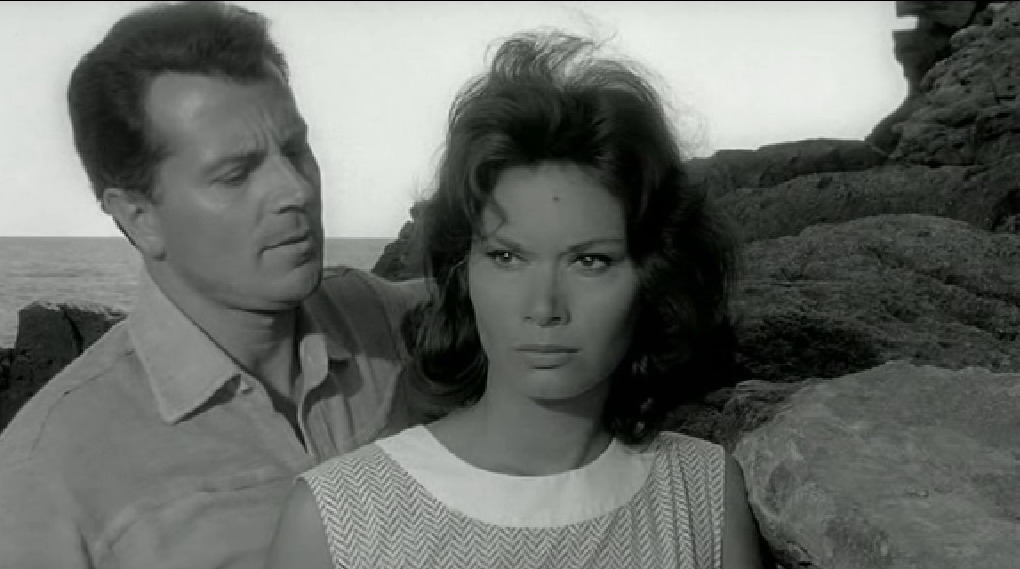
Image context: the cover uses an archival still of Claudia and Sandro on the rocky shore. It belongs here because the film's emotional geometry is already visible in their spacing: she faces outward into distance while he remains just behind her, close in physical terms and uncertain in every other one.[5]
On Lisca Bianca, rock defeats plot
The early island sequence matters because Antonioni makes physical space sabotage dramatic expectation.[1][2][4] Lisca Bianca is not filmed as picturesque adventure terrain. It is abrasive, wind-cut, irregular, and full of surfaces that deny easy orientation. People scatter across the rock in small clusters, call to one another, vanish behind ridges, and reappear in ways that make the island feel larger than the story's control over it. When Anna disappears, the film does not produce a clean line from absence to investigation. It produces a new relation between bodies and terrain. Human intention starts looking thin.
That formal move is the real beginning of the film. Antonioni's Cannes statement, written after the uproar at the premiere, argues that the old emotional and moral habits no longer fit the modern world they move through.[3] L'Avventura does not illustrate that idea with speeches. It does it with duration and placement. The search party is wealthy, mobile, and socially fluent, yet on the island they look helpless before empty space. The modern people in the frame have money, boats, and erotic freedom, but they do not have moral weight or narrative command. Rock has more permanence than desire.
This is why the film feels so unsettling even before it settles into its longer middle stretch. Anna's disappearance is not treated as a single shocking event from which everything else simply follows. It is treated as a subtraction that reveals how little inner structure the group had to begin with.[1][4] Once Anna is gone, conversation thins out, loyalties slide, and urgency decays with alarming speed. The scandal is not only that a woman has vanished. The scandal is how quickly the search starts coexisting with flirtation, boredom, vanity, and opportunism.
Claudia becomes the film's center because Antonioni makes replacement feel spatial before it feels moral
Monica Vitti's Claudia is the film's great formal discovery.[1][2][4] At first she seems secondary, the friend who inherits Anna's emotional wake. Then Antonioni slowly rebuilds the film around her changing position in space. Claudia is repeatedly framed at windows, on terraces, in hotel corridors, against blank walls, inside plazas too large for comfort. Those settings do not merely decorate her anxiety. They materialize it. She is the one character who still feels the wrongness of substitution, and Antonioni keeps placing her where architecture can measure that wrongness.
Sandro, by contrast, drifts through the same spaces as if they were opportunities for self-forgetting.[1][4] His background as an architect matters here because the film keeps associating him with stalled design, compromised ambition, and surfaces that no longer hold conviction.[1] He moves easily through churches, towns, hotels, and drawing-room interiors, but nothing in him suggests genuine form. He has taste without fidelity. He wants intensity, then immediately corrodes it. When he turns from Anna to Claudia, the film does not frame the movement as melodramatic betrayal alone. It frames it as a symptom of a class that can no longer keep attachment from collapsing into appetite.
Antonioni's genius is that he never lets Claudia's conflict become a simple moral lecture about loyalty. He gives it texture instead.[2][4] In Sicilian towns, streets open into empty squares that feel both public and deserted. Buildings promise order, yet the order is strangely exhausted. Claudia moves through this world with real hesitation, and that hesitation gives the film its conscience. She registers what the others suppress: that Anna's absence has not been absorbed, only paved over. Desire continues, but with a hollow sound.
The final scene matters because pity survives after romance and investigation both fail
By the time the film reaches its last hotel sequence, Antonioni has stripped away both detective momentum and romantic idealism.[1][2][4] Anna has not returned. Sandro and Claudia have not built anything stable from the void she left behind. What remains is a man who has already cheapened himself once again, and a woman forced to decide what kind of response is still possible after disillusion has become ordinary. The scene is devastating because Antonioni refuses the two easiest endings. He does not give us triumphant clarity, and he does not give us total emotional annihilation.
Instead he gives us one of cinema's most delicate gestures: Claudia's hand resting on Sandro's head.[4] It is not exoneration. It is not sentimental reunion. It is a form of exhausted recognition. She sees his weakness clearly, and she also sees that contempt alone will not restore moral order or narrative meaning. The touch matters because it arrives after the film has shown, over and over, how poorly these people inhabit freedom. Compassion enters at the point where solutions have already failed.
That is why the ending still feels modern. Antonioni does not claim that alienation is glamorous. He shows its shabby repetitions, its erotic laziness, its social polish, and its emotional waste.[2][3][4] Yet he also refuses to flatten the characters into satire. The final image allows a damaged form of human contact to survive inside a world that has already proved incapable of steadiness. The film does not solve the disappearance because solving it would narrow the argument. Anna's absence has become too large to be reduced to a plot answer. It has turned into the measure of everyone else's incompletion.
Why the film still feels radical
The usual shorthand for L'Avventura is that it "breaks" narrative, and that is true as far as it goes.[1][2] But the deeper achievement is more exact. Antonioni does not abandon story for abstraction. He relocates story into time, weather, architecture, and failed emotional succession. What happens after Anna disappears is not nothing. Plenty happens: a search drags, a couple forms, a class reveals itself, and pity survives where desire has worn thin. The radical move is that Antonioni makes those developments feel less like events than like spatial pressures gathering around already weakened people.[3][4]
That is why the film remains such a durable scandal. It asks viewers to accept that the central absence will stay open, and that the real subject lies in what human beings look like while living around an open absence.[1][2][4] Rock, plazas, windows, corridors, and hotel terraces become more than backgrounds. They are the film's method for proving that modern freedom, without emotional discipline, leaves people wandering through beautifully composed spaces with no durable way to answer one another. L'Avventura stays haunting because Antonioni never fills that void. He just teaches us how to see its shape.
Sources
- The Criterion Collection, "L'Avventura" film page.
- BFI, "L'avventura (1960)" film page.
- The Criterion Collection, "L'Avventura: Cannes Statement."
- Senses of Cinema, "L'Avventura."
- Wikimedia Commons, "File:L avventura (1959) Antonioni.jpg."