A biplane crossing an empty sky can look almost parked. Remove the ground, flatten the distance, and give the eye no fixed object to measure: the propeller turns, but the aircraft seems pinned to blue. Wings solved that problem before it solved the spectacle of combat. William A. Wellman wanted clouds behind his airplanes because speed is not a property the camera simply collects. Speed has to be made visible against something that appears still.[1]
That choice is the key to the 1927 film's aerial sequences. Their force does not come only from the often-repeated fact that real airplanes were photographed in real flight. Director Wellman, cinematographer Harry Perry, military adviser-pilots, actors, camera crews, editors, effects technicians, and exhibitors built a chain of reference points: a face against a cockpit, one airplane against another, both against a cloud bank, an attack against a clearly established line of pursuit, and finally the small standard image against a screen that suddenly grew for the battle. Reality supplied danger. Craft made the danger readable.
Wings is now routinely introduced as the first recipient of the Academy Award for Outstanding Picture. That milestone can turn the film into an answer to a quiz rather than a live piece of filmmaking. Its stronger claim is visible in the images: it worked out how to give an audience a pilot's scale and a battlefield's scale without letting either dissolve into noise.[2][8]
Spoiler note: this essay discusses the film's final combat and its aftermath.
Version note: the discussion refers to Paramount's 139-minute restored edition. Institutional screening records list restored presentations at 136 and 141 minutes. Historical theatrical versions also varied: color and Magnascope appeared in the roadshow era, while AFI dates the nationally released synchronized score-and-effects version to January 1929.[1][2][4][6][7]
A cloud is a measuring instrument
Wellman had flown in World War I, so his practical insight began with perception rather than hardware. An aircraft photographed against clear sky offers few cues to velocity. Put a textured cloud behind it and the relation changes every instant: a wingtip crosses a bright edge, a fuselage cuts into gray, and a climbing plane seems to carve depth rather than slide across a flat field. The background does not decorate the maneuver. It measures it.[1]
This is why weather became part of the apparatus. The production could supply aircraft, pilots, camera mounts, explosives, and thousands of uniformed bodies; it could not order a cloud bank into position. Waiting for the right sky was therefore not downtime between the “real” work. It was an exposure decision on the scale of a production schedule. When the clouds arrived, camera planes had to hold useful relations to performers and stunt pilots long enough for the motion to register.
The resulting long shots resist the two failures that often make photographed flight inert. The planes are neither specks moving without drama nor abstract shapes cut away from geography. Their silhouettes stay clean while the clouds supply layers, direction, and changing contrast. A dive gains weight because the background rises. A turn gains force because the horizon tilts or another aircraft crosses the curve. The eye can feel acceleration before an intertitle has to name danger.
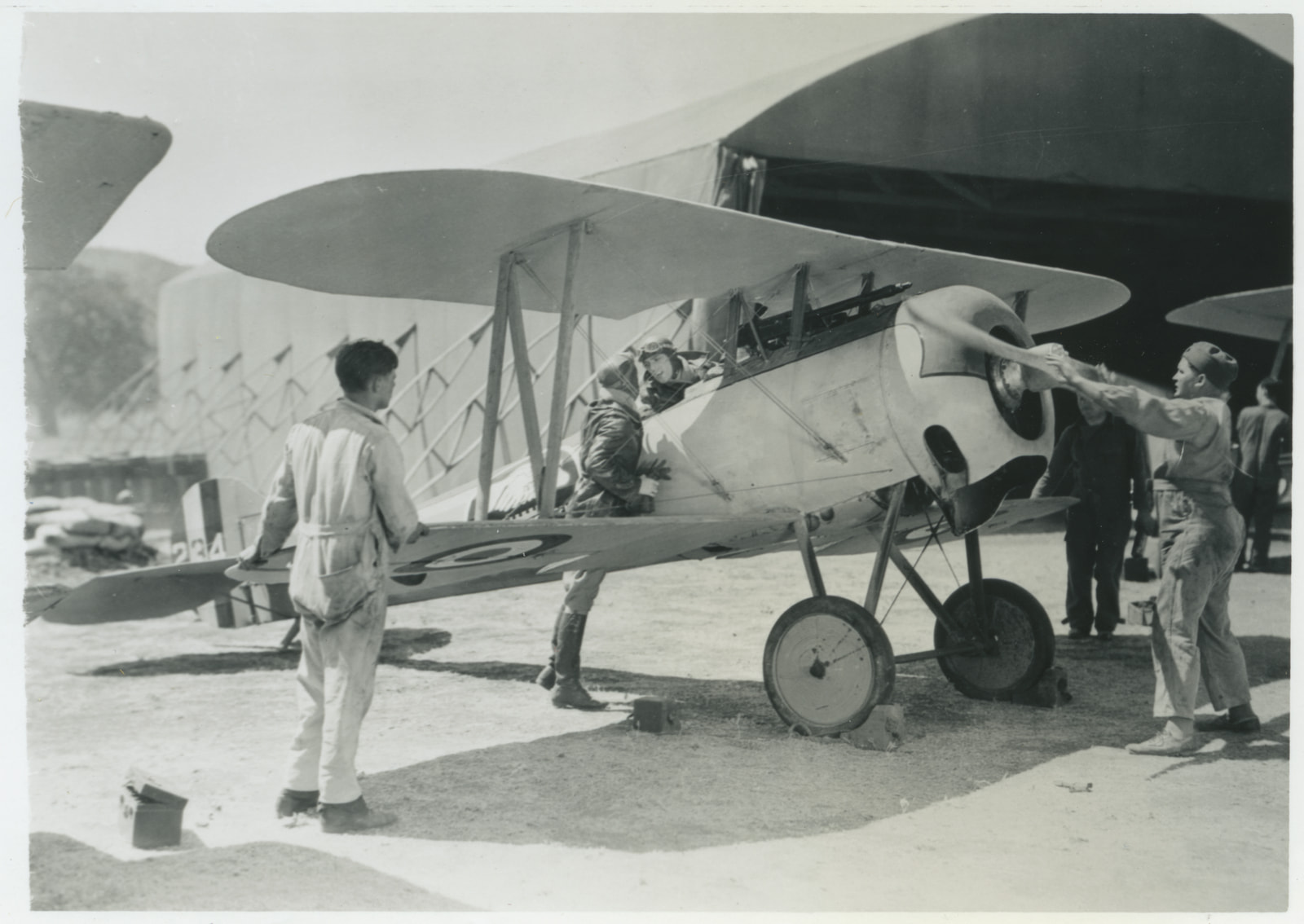
The Museum of Flight identifies the production's mix of aircraft as including Thomas-Morse MB-3s and Curtiss P-1s in combat markings, along with Jennys, DH-4s, and SPAD VIIs available around the San Antonio fields. The institution's archival still above holds the material problem in one frame: pilot, ground crew, fabric wing, struts, wheels, and propeller all have to be ready before the sky can become an image.[3] The variety matters less as a catalogue than as evidence of the film's central constraint: every shot depended on a physical machine, a qualified pilot, and a camera position that could survive the maneuver.
The close-up has to fly too
Long shots could prove that airplanes shared the sky, but they could not keep Jack Powell and David Armstrong inside the action. For that, Wings needed a second system. The Library of Congress essay describes motorized cameras mounted on the aircraft: Perry's crews filmed alongside for wider views, while cameras fixed to the performers' planes supplied close-ups and point-of-view material. Charles “Buddy” Rogers and Richard Arlen did some of their own flying; Rogers learned during production, and institutional and retrospective accounts describe the actors operating cameras in some airborne sequences.[1][2][5]
The technical gain is easy to state and harder to appreciate. A conventional close-up isolates a face by removing unstable surroundings. These close-ups do the opposite. Struts, wind, vibration, open sky, and shifting light remain active around the performer. Rogers does not merely mime flight in a neutral portrait. His cheeks, goggles, eyeline, and shoulders occupy the same exposure as the air moving past him.
That shared exposure changes performance. Silent acting often makes thought legible by enlarging a gesture. In the cockpit, the film can reduce the gesture because the environment supplies pressure. A glance outside the frame becomes meaningful after an exterior shot has established an approaching aircraft. A recoil reads as both emotion and bodily response to the plane's movement. The cut back to the sky then inherits the face's fear or concentration.
The camera mount therefore does more than certify that an actor was really aloft. It joins interior and exterior space. The audience learns that the face, the controls, the attacking plane, and the cloud bank belong to one event. That continuity is the film's real illusion—not fake flight made convincing, but dispersed pieces of actual flight made emotionally continuous.
A dogfight is an editing problem
Real aircraft can still produce incomprehensible footage. Two pilots may execute a dangerous maneuver while the screen shows only unrelated machines entering and leaving unrelated frames. Wings repeatedly restores the relation: attacker, target, line of sight, response. The film alternates scale without surrendering direction.
Its basic unit is a small circuit. A wide view establishes relative position. A cockpit view gives one pilot's attention a direction. A point-of-view or closer exterior image supplies the object of that attention. Another cockpit registers the consequence. The sequence can then widen again with more meaning than it had before. Each cut answers a spatial question raised by the last one.
This structure becomes devastating near the end. David escapes in a German aircraft, and Jack attacks without recognizing him. The mistaken identity is melodramatic, but the scene's pain depends on the film's earlier visual discipline. Aircraft type, direction, cockpit, and eyeline have taught us how to follow a pursuit. Now that fluency traps us: we can understand the geometry while Jack cannot understand the person inside it. When recognition finally arrives on the ground, the technical system that made aerial action clear has delivered moral blindness with equal clarity.
The film occasionally multiplies the frame or adds effects, but its dogfights rarely ask a device to replace orientation. Spectacle grows from accumulated relations. A burst of gunfire matters because the edit has shown who can see whom; a fall matters because cloud and horizon let us read lost altitude. The planes remain heavy objects governed by distance rather than tokens shuffled across a blue field.
The battlefield was a control room without monitors
The same problem expanded at ground level. For the St. Mihiel reconstruction, military support supplied locations around San Antonio, aircraft, pilots, troops, trenches, ordnance knowledge, and large-scale coordination. The Museum of Flight reports 3,500 troops and more than 150 planes in the recreated battle, while Wellman's production recollection describes ten days of rehearsal, 65-odd pilots, elevated camera positions, and dozens of camera stations for the largest attack material.[3][5] Those figures describe different working layers, but together they show why “realism” is too small a word for the result.
The sequence is an exercise in timing. Infantry must advance through a frame that explosions will soon occupy. Aircraft must cross the photographed space at the instant ground action gives them scale. Cameras placed at different distances have to return material the editor can align. Smoke is both event and visibility hazard. A failed cue is not just a bad take; around live aircraft and explosives it can become an emergency.
This logistical achievement also deserves a boundary. Wings did not conjure authenticity through individual bravery alone. It converted federal military infrastructure into production value. AFI's record names the War Department contribution, technical advisers, pilots, troop labor, constructed trenches, explosives, and San Antonio locations that made the film possible.[2] The images are extraordinary, but their scale belongs to an institution as well as to an auteur. The camera could appear fearless because a vast organization had arranged where fear would occur.
That organization is visible in the finished rhythm. The ground battle does not play as a single undifferentiated panorama. Wide frames establish the field; closer images isolate bodies and impacts; aerial views redraw the same space as terrain to be crossed. Scale contracts and expands while the battle remains one place. The film's cameras do not merely witness an event. Together, they manufacture a position from which the event can be understood.
The last camera was the theater
The surviving image is only part of what theatrical audiences encountered. According to the Library of Congress, presentations used tinting and added color accents for gunfire and burning aircraft, while certain equipped theaters supplied General Electric synchronized effects and Magnascope enlarged the aerial battles. A standard 15-by-20-foot picture could expand to roughly 25 by 40 feet, requiring a specially configured additional projector.[1] AFI separately records the 1929 national score-and-effects release as well as contemporary reports of tinted skies, flames, and enlarged aerial passages.[2]
Magnascope completed the film's logic. First, a mounted camera put the spectator close enough to read a pilot's face. Then long shots from camera planes organized pursuit against clouds. Editing turned separated views into continuous danger. Finally, the theater changed the size of the image when flight demanded a larger field. The film did not treat exhibition as delivery after the creative work was finished. Exhibition was the final shot scale.
Modern restoration can recover tint, effects, detail, and a score; Paramount's 2011 restoration with the Academy Film Archive recovered the original tints and recreated the additional Handschiegl color effects.[4] It cannot make every living room double in width as the planes enter combat. That missing expansion matters because Wings was designed to change the spectator's body from the outside. The screen itself seemed to take off.
The film's aerial achievement is often summarized as courage: real pilots, real crashes, real risk. Courage was present, sometimes under conditions no responsible production should romanticize. But danger alone does not compose an image. Wings endures because it converted risk into relations the eye could follow. It gave speed a cloud, the pilot a camera, the dogfight a grammar, the battlefield a schedule, and the theater a moving boundary. The airplanes flew; the filmmaking taught us how to feel them move.
Sources
- Dino Everett, “Wings,” Library of Congress National Film Registry essay — motorized aircraft cameras, cloud-backed photography, tinting, synchronized effects, Magnascope dimensions, and the limits of modern presentation.
- American Film Institute Catalog, “Wings” — release history, aerial presentation, cast flying, production photographers, War Department support, San Antonio locations, engineering effects, and restoration history.
- Amy Heidrick, “And the Oscar Goes to . . . Wings!,” The Museum of Flight, January 22, 2019 — aircraft, San Antonio fields, military participation, production scale, and battle reconstruction.
- Academy of Motion Picture Arts and Sciences, “Wings (2011)” — Paramount and Academy Film Archive restoration, original tint recovery, recreated Handschiegl effects, 141-minute presentation, and principal craft credits.
- Paul Tatara, “Wings,” Turner Classic Movies, December 7, 2007 — Rogers's flight training, actor-operated cameras, Wellman's production recollection, rehearsal, camera placement, and crew credits.
- Harvard Film Archive, “Wings,” November 10, 2017 — archival screening version, Wellman's aviation background, aircraft-mounted cameras, performer flying, battlefield reconstruction, and color tinting.
- Paramount Pictures, “Wings” — official 139-minute restored-edition listing, release date, synopsis, cast, and principal crew.
- Academy of Motion Picture Arts and Sciences, “The 1st Academy Awards: 1929” — official record of Wings winning Outstanding Picture and Roy Pomeroy winning Engineering Effects.