Spoiler note: this profile discusses the central action and outcome of Monangambée and Sambizanga.
There is a prison at the center of Sambizanga, but Sarah Maldoror refuses to let the prison determine the film's shape. Colonial officers can seize Domingos Xavier, hide him behind walls, and torture him. They cannot stop his disappearance from becoming a question passed from one person to another. His wife, Maria, walks with their baby from office to prison to police post. A boy carries scraps of information through Luanda. Women compare what they have heard. Organizers work out who has been taken and where. Knowledge travels along a human chain faster than the authorities can make one man vanish.[3][4]
That relay is the clearest signature in Maldoror's cinema. She made films about revolution, but the decisive image is rarely a solitary hero delivering history. It is a face receiving news; a phrase that changes meaning as it crosses a colonial border; a song holding several people in the same emotional time; a conversation in which culture becomes something exchanged rather than displayed. Her politics live in the route between bodies.
This is why the familiar labels—pioneer, militant filmmaker, a foundational woman of African cinema—are true and still insufficient. They name Maldoror's historical importance without quite describing what happens when her images move. Her direction turns solidarity from a slogan into an editing principle: one life acquires political force because another life answers it.
A stage becomes a camera
Born Sarah Ducados in southwestern France in 1929 to a French mother and a Guadeloupean father, she moved to Paris and chose the name Maldoror from Lautréamont's Les Chants de Maldoror. In 1956, she helped found Les Griots, the first all-Black theater company in Paris. The company created serious roles for Black actors and brought Black writing onto a stage that routinely confined them to servile parts.[1]
The move from theater to film was not a rejection of performance. It was an expansion of the room. Maldoror studied filmmaking in Moscow in the early 1960s, then worked in Algeria as an assistant on Gillo Pontecorvo's The Battle of Algiers. In a later interview, she described cinema as the medium best able to reach African audiences excluded from written political culture, while insisting that Black filmmakers had to make African history visible from their own perspectives.[2]
Her formulation was not a demand for sealed cultural ownership. In the same interview, she called culture an exchange and a mixture of ideas.[2] Her own working life proved the point: Caribbean and French origins, Soviet training, an Angolan political partnership with Mário Pinto de Andrade, Algerian production, and collaborations across languages and borders. The exchange was international, but never neutral. Who controls the camera, who is given a role, and who gets to interpret an image remain material questions.
Les Griots had already taught her that representation is also infrastructure. A new part onstage requires actors, writers, rehearsal, money, and an audience prepared to see differently. Her cinema carries that lesson forward. Liberation is not announced by a single perfect image. It is built by arranging the conditions under which people can appear to one another.
Colonial power mishears a meal
Maldoror's first short, Monangambée (1969), compresses that idea into a linguistic catastrophe. Adapted from a story by the imprisoned Angolan writer José Luandino Vieira, the film follows a woman visiting her partner in a colonial jail. She promises to bring him a complet, an everyday Angolan meal. A Portuguese official hears an unfamiliar word and imagines a coded escape plan. Ordinary care is converted into evidence, and the prisoner is tortured.[2][5]
The misunderstanding has a flicker of absurdity, but Maldoror does not use humor to soften the violence. She uses it to expose the colonial institution's intellectual poverty. The officer can command a prison yet cannot imagine that a word might carry a local meaning he does not know. His ignorance becomes lethal because the system gives it force. What he cannot translate, he punishes.
The Art Ensemble of Chicago's score refuses the discipline of the cell in another register. Its jazz does not politely explain the prisoner's pain; it jars, surges, and opens space around bodies the guards want to reduce to files and suspicions.[1] The wife's phrase and the musicians' sound perform related work. Both carry knowledge that exceeds the authorities' grammar.
This is already Maldoror's cinema in miniature. Political violence enters through an intimate exchange. A woman is not positioned outside history, waiting for male militants to act; her visit reveals the entire mechanism by which colonial power turns cultural incomprehension into physical control. Resistance begins with preserving the meaning the prison tries to destroy.
The missing reels are part of the history
Her first feature-length project, Des fusils pour Banta (Guns for Banta, 1970), followed a woman involved with the liberation struggle in Guinea-Bissau. The production was financed through Algeria, filmed amid an active anti-colonial war, and then seized after a dispute with the authorities. The negatives have not been recovered.[8]
It is tempting to treat a lost film as a mysterious parenthesis before the surviving masterpiece. That would make the absence too romantic. A missing negative is evidence of how vulnerable political cinema can be to the institutions that fund, store, censor, or neglect it. Maldoror's career was shaped not only by what she placed inside a frame but by recurrent struggles over whether the frame could circulate at all.
The surviving accounts suggest that Guns for Banta, like Monangambée and Sambizanga, placed a woman's labor inside a liberation movement rather than beside it.[6][8] We cannot reconstruct the film's form from descriptions and production photographs, and should not pretend otherwise. We can recognize the pattern of pressure: the state that commissioned an image also claimed the power to withhold it. Control of editing and control of history met at the same missing reels.
Sambizanga turns searching into form
Made in 1972 and set at the start of the Angolan War of Independence in 1961, Sambizanga gives Maldoror's relay its fullest dramatic architecture. Domingos is taken after his work in the independence movement is discovered. Maria does not know which authority holds him. Her search advances through repeated encounters, while an underground network conducts a parallel search of its own.[3][4]
The repetition matters. A lesser film might compress Maria's route into a brisk bridge between arrest and discovery. Maldoror makes duration carry the cost. Maria walks, waits, asks, is redirected, and keeps the baby with her. The same bureaucracy that brutalizes Domingos exhausts his family through uncertainty. Colonial violence is not confined to the torture room; it is also distance, withheld information, and the forced repetition of a plea.
Yet the film never turns Maria into a passive container for suffering. Each question she asks alters the field around her. A description is remembered. A vehicle is identified. News enters shops and homes. The resistance does not possess a panoramic view; it assembles one from partial acts of attention. Maldoror's editing lets no single participant own the whole process. The collective becomes intelligent because its members notice for one another.[5]
That structure changes how the prison scenes work. Domingos's body is isolated, but the film keeps cutting back to a social world the jailers cannot fully see. The cuts do not rescue him, and the outcome is not falsely consoling. They deny the regime's preferred image of an invisible captive whose pain has no witness. Every return to Maria, the child, a messenger, or a gathering makes the secrecy incomplete.
Maldoror also allows daily life to retain its unruly weight. A baby cries for longer than tidy symbolism would permit. Conversations take time to locate their subject. Music, work, clothing, sunlight, and faces remain sensually present. Critics have sometimes treated the film's beauty as if aesthetic care diluted its politics; participants in a later roundtable argued the opposite, locating its political force precisely in the dignity and community that beauty makes perceptible.[5]
The cast included nonprofessionals, some with direct ties to anti-colonial struggle, and the soundtrack moves among Portuguese, Lingala, and Kimbundu.[5] Those choices do more than authenticate a setting. They prevent liberation from speaking in one official voice. The film is coherent because difference is coordinated, not erased.
Beauty refuses the jailer's frame
Maldoror's images are composed, luminous, and emotionally direct. That is not the same as making oppression palatable. Colonial visual culture had spent generations treating African people as specimens, scenery, laboring bodies, or faceless crowds. To photograph Maria's movement with grace, or to hold on a prisoner's face as a face rather than evidence of a type, is already to refuse the jailer's frame.
The distinction is easiest to feel in Sambizanga's parallel movement. The authorities reduce Domingos to information they want extracted. Maldoror expands every person around him into relationships the authorities cannot measure. Beauty belongs to that expansion. It lets a patterned cloth, a child's discomfort, a shared room, or a held gaze keep meanings that political synopsis would otherwise strip away.
This is also why plot alone cannot contain the film's revolution. A synopsis can tell us that Maria searches and Domingos dies. It cannot reproduce the accumulating recognition by which private loss becomes shared knowledge. Maldoror directs the interval between those states. Resistance is not a revelation dropped from above; it is grief learning that it has company.
The portrait is another kind of meeting
After the liberation films that made her name, Maldoror worked across television fiction, reportage, artist portraits, and documentaries. Her subjects included Aimé Césaire, Léon-Gontran Damas, Toto Bissainthe, Wifredo Lam, and Joan Miró; she also filmed carnival, migration, working life, and the Black diaspora in France and the Caribbean. The breadth matters because it resists turning her into the director of one exemplary revolutionary feature. Centre Pompidou's 2025 retrospective counted more than forty works across shorts, features, television, and documentary.[6]
The later portraits continue the early method at a different tempo. They combine conversation, music, archival material, places, and other voices rather than forcing a life into an authoritative chronology.[7] A poet is not separated from the language and public that answer the poems. An artist is not reduced to a sequence of achievements. Biography becomes another relay.
Maldoror's recurring attention to Césaire is especially revealing. She returned to him across several films, not because one portrait had failed, but because a cultural figure changes when approached through a different place, interlocutor, or historical moment.[6] Repetition here is not redundancy. It is an admission that no person belongs to a final cut.
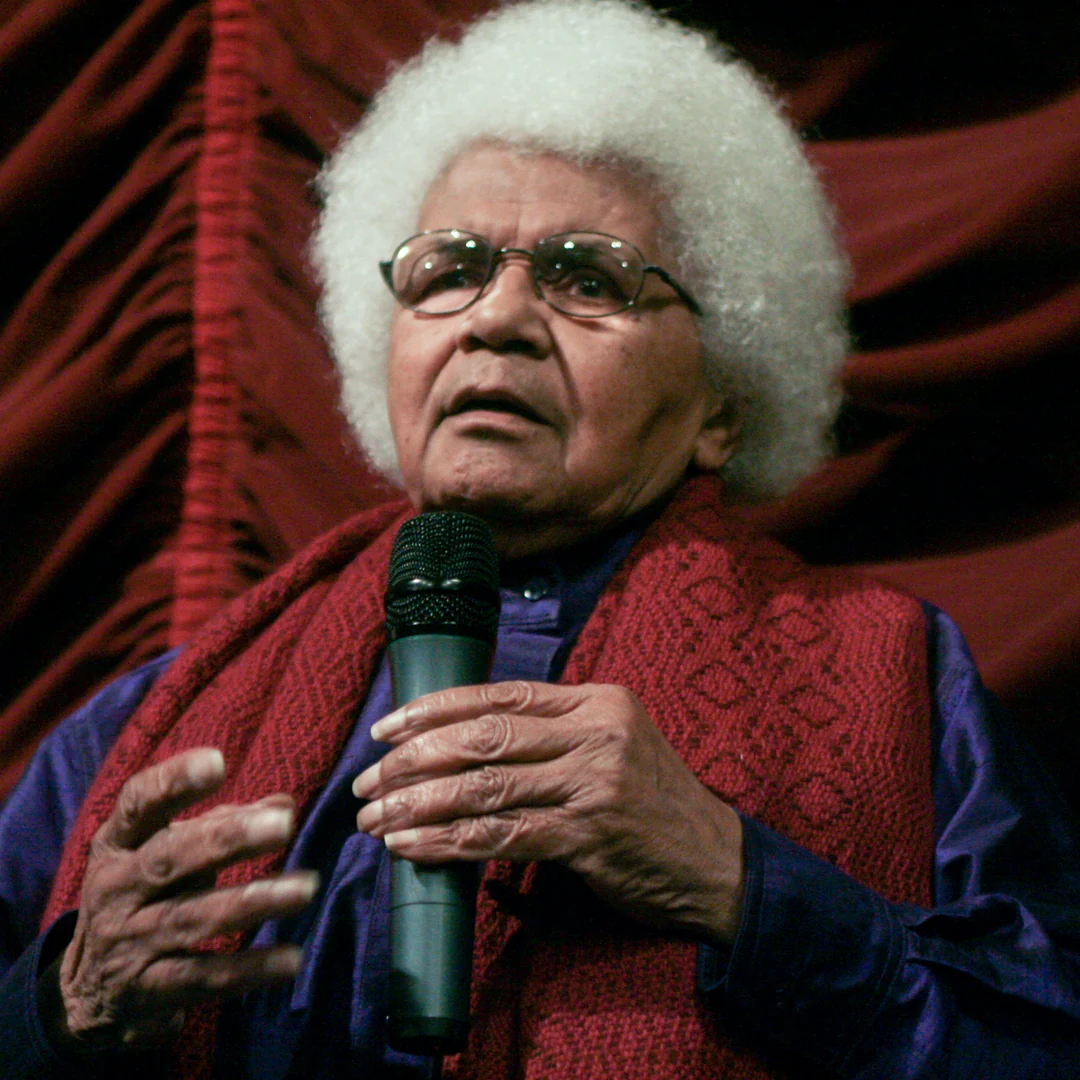
Even the 2009 photograph above carries that social form.[9] Maldoror is not isolated in a studio portrait or frozen into pioneerhood. She has a microphone at a public discussion around Sambizanga: a filmmaker, a film, and an audience meeting again decades after production. The image catches authorship in circulation.
Restoration extends the relay
Circulation cannot be taken for granted. In 2021, Sambizanga was restored in 4K from its original 35 mm negatives by The Film Foundation's World Cinema Project and Cineteca di Bologna, in association with Maldoror's family and other partners. Her daughter Annouchka de Andrade and cinematographer Jean-François Robin supervised the color grading.[4] That detail is more than technical housekeeping. For a film whose color and light are part of its political dignity, restoration determines whether future viewers can encounter the argument in its full visual register.
The labor has continued beyond one title. MoMA's 2025 retrospective premiered eight restorations and presented works once thought lost or destroyed, following two decades of preservation work by Annouchka de Andrade.[1] The archive does not simply confirm a finished reputation. It changes the career that audiences are able to see: a celebrated feature becomes part of a larger practice of comedy, portraiture, poetry, television, and reportage.
There is an apt continuity here. Maldoror made films in which knowledge survives by passing between people. Her films now survive through another network—family, archivists, laboratories, programmers, scholars, projectionists, and viewers. No participant alone possesses the whole work, but each can keep it from disappearing at the next wall.
Sarah Maldoror made resistance move from face to face because she understood that history is not only what power records. History is also a meal whose meaning a prisoner and visitor preserve between them, a name carried through a neighborhood, a song that keeps a body from becoming an abstraction, and a restored color timed carefully enough to reach an audience not yet assembled. Her camera does not ask one hero to stand in for a people. It watches people become visible to one another—and makes that visibility move.
Sources
- The Friends of Sarah Maldoror and Mário de Andrade, “MoMA 2025 May 1–15, 2025” — the MoMA retrospective text covering career chronology, Les Griots, collaborators, early films, new restorations, and preservation history.
- Berlinale Shorts, “The Importance of a Black Perspective / Sarah Maldoror” (January 25, 2017) — primary interview on Les Griots, Moscow, The Battle of Algiers, Monangambée, cultural exchange, and authorship of African history.
- Janus Films, “Sambizanga” — distributor record for the 1972 film, its central journey, political context, spiritual songs, format, and emphasis on women's place in liberation.
- The Film Foundation, “September 2022 / Sambizanga” — 1961 setting, character and story context, restoration provenance, original negatives, color supervision, and African Film Heritage Project partners.
- Another Gaze, “The Legacies of Sarah Maldoror (1929–2020): A Roundtable Discussion” — complet as language and hunger, beauty as political form, community, quotidian duration, and Maldoror's counter-history.
- Centre Pompidou, “Sarah Maldoror: Rétrospective en écho à l'exposition ‘Paris noir’” (April 3–7, 2025) — filmography scale, artistic and political commitments, portrait subjects, unrealized projects, and restoration context.
- Katie Goh, “Where to begin with Sarah Maldoror,” BFI (updated September 20, 2021) — overview of Sambizanga, Maldoror's working-class feminist emphasis, and the plural form of her documentary portraits.
- film-documentaire.fr, “Des fusils pour Banta” — production record, Guinea-Bissau shoot, Awa's role in the liberation struggle, the editing dispute, confiscation, and the film's continuing lost status.
- Karim Amar, “Sarah Maldoror.jpg,” Wikimedia Commons — source page, 2009 screening-discussion context, dimensions, authorship, and CC BY-SA 2.0 license for the photographic portrait.