On 5 February 1956, three films that had not been planned as a trilogy met at London's National Film Theatre. Lindsay Anderson's O Dreamland watched visitors pass through a Margate amusement park. Karel Reisz and Tony Richardson's Momma Don't Allow followed a Saturday night at a Wood Green jazz club. Lorenza Mazzetti's Together moved with two deaf dockworkers through the bomb-scarred East End. Documentary, nightlife study, and fiction did not add up to a genre. Projected together, however, they made an argument.[1][2]
The programme was called Free Cinema. Its brief manifesto insisted on personal filmmaking, the significance of everyday people, and a relationship in which images speak while sound comments. Those principles are often compressed into one reassuring idea: here was a camera finally looking honestly at ordinary Britain. The films are less innocent and more interesting than that. They do not remove the filmmaker's attitude from reality. They make attitude audible—in a mechanical laugh, a jazz rhythm, a sudden silence—and let it rub against what the camera sees.[2][3]
Free Cinema's decisive freedom was therefore not freedom from artifice. It was freedom to turn modest means into a point of view. Small cameras and separately recorded sound did not produce transparent access to postwar life. They created a gap between image and soundtrack, observation and judgment, sympathy and unease. The movement became vivid inside that gap.
The first programme was already a montage
The word “movement” can make Free Cinema sound tidier than it was. Its first films were made separately, under different circumstances, before the screening gave them a common banner. O Dreamland had been shot in 1953 and remained unshown for three years. Momma Don't Allow, originally called Jazz, received support from the BFI Experimental Film Fund. Together was the programme's outlier and its hinge: a staged narrative with nonprofessional performers, filmed amid real East End streets and ruins.[1][3][4]
The act of programming supplied the first edit. Margate's crowds, Wood Green's dancers, and Mazzetti's isolated dockworkers became three answers to the same question: what parts of contemporary life could British cinema treat as worthy of sustained attention? The answer included chips, arcade machines, teenage courtship, shift work, bomb sites, pubs, markets, and bodies at leisure. These were not establishing details behind a grander drama. They were the material.
The scale mattered institutionally. The BFI's account describes films made on shoestring budgets, often with unpaid crews and handheld 16 mm Bolex cameras; most received help from its Experimental Film Fund.[1] Yet “free” never meant untouched by institutions or money. Later work was supported by the BFI, Ford of Britain, and other patrons, while screenings depended on the National Film Theatre.[1][2] The movement's independence was conditional, negotiated, and incomplete. What it protected was not production purity but the right to make a small film personal—and then fight for a place to show it.
That distinction keeps Free Cinema from becoming a sentimental do-it-yourself legend. Cheapness was real, but scarcity alone did not create style. The style emerged when filmmakers made each limitation expressive.
Sound refuses to behave like proof
Portable equipment let crews enter streets, clubs, markets, and railway sheds with less machinery than a feature production required. Faster film stock and lighter cameras widened that mobility.[5] Sound remained a stubborn boundary. Before lightweight synchronized recording became practical, image and audio were often gathered separately. A conventional documentary might hide that break beneath explanatory narration. Free Cinema used the break as composition.[1][2]
In O Dreamland, the camera surveys fairground attractions without a guiding voice telling viewers what each image means. The soundtrack does not leave the pictures neutral. A mechanical dummy's laughter returns until amusement becomes mockery; music, sales patter, machinery, and crowd noise turn pleasure into a pressure chamber. Anderson later remembered Free Cinema as an effort to put uncelebrated life on screen, but a BFI reassessment stresses how savage and strange this film already is. The fair is observed, certainly, yet the observation carries disdain as well as fascination.[3]
That ambivalence is a feature, not a lapse from documentary honesty. The film does not pretend that pointing a camera at popular pleasure automatically equals solidarity. Its separated soundtrack makes interpretation impossible to miss. We hear Anderson thinking about what he sees.
Momma Don't Allow has a warmer pulse. The film follows young workers as they finish their jobs, enter the Wood Green Jazz Club, and dance to the Chris Barber band. BFI describes the regulars' ease and the awkward arrival of wealthier visitors, whose presence changes the room's social temperature.[4] The camera studies faces, shoes, instruments, and partners; the music gives these fragments continuity. Because the sound is not a neutral live record, the filmmakers can build a night rather than merely preserve one. Workday gestures accelerate into weekend rhythm.
The result is neither raw actuality nor a musical imposed from above. It is a social edit. Class becomes visible in who knows how to occupy the floor, how bodies answer the band, and whose arrival makes confidence turn self-conscious. Sound does more than certify that jazz was played. It organizes belonging.
Together breaks the realist label open
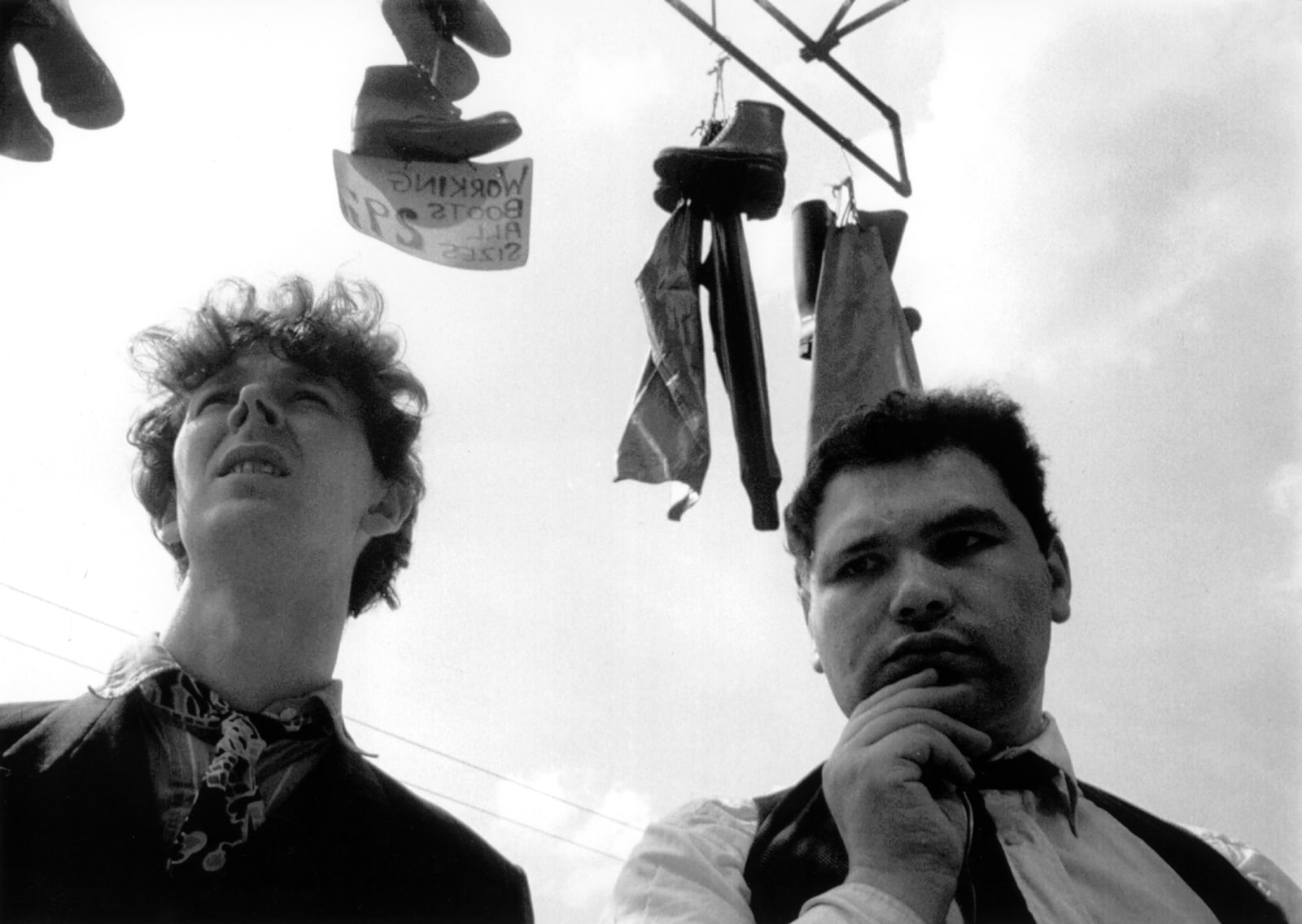
If Free Cinema were simply a documentary turn toward ordinary subjects, Together would be an awkward exception. It is better understood as the film that reveals the category's real width. Mazzetti's story follows two deaf dockworkers, played by the artists Eduardo Paolozzi and Michael Andrews, through a London of warehouses, narrow rooms, wasteland, children, pubs, river traffic, and half-cleared wartime damage. It is fiction built from the physical presence of a city that no studio could reproduce.[3][6]
The film also rearranges the movement's signature relation between hearing and seeing. Its protagonists move through a noisy public world without sharing its sound. Minimal dialogue and a constructed soundtrack make the audience's access unstable: we can hear parts of the city they cannot, yet their faces and gestures carry knowledge the surrounding city refuses to read. Silence is not an absence waiting to be filled by commentary. It becomes a social condition—one way the film registers companionship, exposure, and exclusion.
Mazzetti's position matters here. Later accounts often let Anderson, Reisz, and Richardson stand for Free Cinema because their careers led into famous British New Wave features. The first programme tells a less convenient history. Mazzetti signed the manifesto, made its longest and only narrative film, and supplied the work that most clearly joined street observation to psychodrama and avant-garde displacement. Anderson helped complete the edit and soundtrack, but the film's East End belongs to Mazzetti's imagination.[3][6]
Recent BFI writing places Together at the centre rather than the margin of the movement and uses it to challenge Anderson's later realist origin story.[3] That correction changes Free Cinema as a whole. The movement was not a straight road from documentary truth to kitchen-sink features. From its opening night, it contained fiction, fantasy, alienation, and a city made subjective by sound.
Looking at class is not the same as escaping class
Free Cinema gave unusual screen time to working-class work and leisure, but the camera did not become classless by changing its subject. ACMI's collection note identifies the movement's challenge to class-bound British cinema while also warning that its filmmakers could view working-class life from a middle-class perspective, sometimes with left-wing sentimentality.[5] The warning is essential because affection can flatten people almost as efficiently as contempt.
The strongest films resist that flattening through duration and contradiction. Teenagers in Momma Don't Allow are not illustrations of “youth culture”; they are workers changing clothes, choosing partners, watching rivals, and controlling a room. Covent Garden porters in Anderson's later Every Day Except Christmas are not just picturesque remnants; their repeated labor gives the film its temporal structure. The railway workers in Michael Grigsby's Enginemen speak across images of a workplace facing the transition from steam to diesel, while the film refuses an authoritative voice-over that would settle their loss for them.[1][2]
Still, sympathy never guarantees equality between filmer and filmed. O Dreamland lets condescension remain in the room. Together turns observation into a deliberately shaped tragedy. We Are the Lambeth Boys seeks closeness to youth-club life while preserving the asymmetry of who controls the cut. Free Cinema's value lies partly in making these tensions available for scrutiny. Its films have attitudes; they do not disguise those attitudes as pure access.
Six programmes, not one house style
Five more Free Cinema programmes followed before the organizers ended the series in March 1959. Half of the six programmes brought in films from outside Britain, including work associated with emerging French and Polish cinemas and American independent documentary.[1][2] That outward turn matters. Free Cinema was not only a national style being announced; it was a temporary exhibition network connecting locally made shorts to other ways of working beyond dominant industries.
The British films also kept widening the field. Market labor, railway work, refugee disorientation, teenage leisure, nuclear-disarmament marches, and vanishing streets entered the programmes. Technicians such as Walter Lassally and John Fletcher helped small productions solve practical problems, while institutional grants and sponsored commissions kept the work possible.[1][2] The movement's history belongs as much to this infrastructure—to cameras, tape recorders, technicians, funds, and a receptive screen—as to its future celebrity directors.
Its best-known legacy is the British New Wave. Reisz, Richardson, and Anderson moved into features whose working-class settings, location textures, and social conflict reached larger audiences. That connection is real, but it can make the shorts look like rehearsals. They were not. Their compact scale allowed stranger relations between sound and image, looser borders between fiction and documentary, and a more direct encounter with public spaces than narrative features would always preserve.[1][5]
Free Cinema lasts because it did not discover a neutral method for recording ordinary life. It discovered that ordinary life could carry formal pressure. A fairground laugh could accuse the picture beside it. Jazz could turn a room into a map of class confidence. Silence could make a bomb-damaged city feel hostile to the people crossing it. The camera looked outward, but the soundtrack kept reminding viewers that looking is never innocent. That friction—small, personal, imperfect, and fully composed—was the freedom.
Sources
- British Film Institute, Free Cinema three-DVD collection — institutional overview of the 1956–59 screenings, production conditions, equipment, funding, filmmakers, and complete British programme.
- LUX, “Free Cinema” in Luxonline Histories: 1956 — six-programme history, international selections, image-and-sound disjunction, technicians, funding, and the movement's relation to everyday culture.
- Henry K. Miller, “O dreamlands: why Lindsay Anderson was never the realist he claimed to be,” BFI (17 April 2024) — reassessment of Anderson's realist origin story and Together as Free Cinema's central fiction.
- British Film Institute, “Momma Don't Allow (1956)” — official film page on the Wood Green Jazz Club setting, Experimental Film Fund, nonsynchronous sound, class contrast, and first Free Cinema programme.
- Australian Centre for the Moving Image, “Free Cinema” — collection context on light cameras, faster stock, the challenge to class-bound British film, and the limits of middle-class observation.
- Henry K. Miller, “Left Bank, East End: when Vali Myers met Lorenza Mazzetti,” BFI (18 July 2023) — Together production context, East End locations, cast, narrative form, and BFI National Archive preservation.