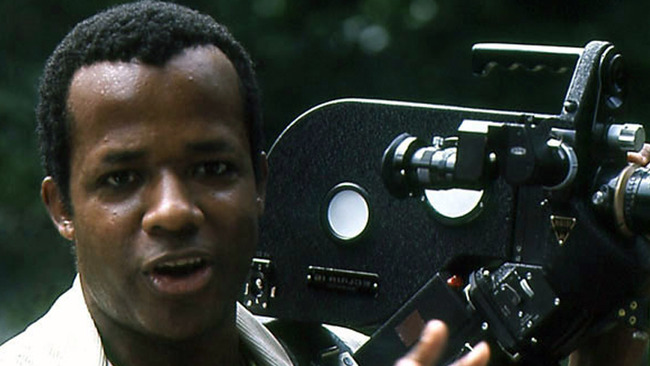
William Greaves wanders through Central Park in a green mesh shirt, apparently untroubled by the confusion around him. His crew wants a clearer account of the movie they are making. He keeps the assignment slippery. In Symbiopsychotaxiplasm: Take One, the director's reassuring manner becomes its own source of irritation: someone must know what is happening, and the man in charge declines to settle the question.[1]
It is a mischievous introduction to a filmmaker whose career depended on formidable practical competence. Greaves worked as an actor, learned documentary production in Canada, helped lead a national television program, and made films about Black political and cultural life. Read together, those activities suggest a persistent concern: appearing in an image gives you one kind of presence; deciding how images are made and circulated gives you another.[2][8]
An actor moves behind the camera
Before directing, Greaves performed with dancer Pearl Primus, worked on Broadway, and joined the Actors Studio. His screen experience included films made for Black audiences during segregation and the Hollywood drama Lost Boundaries (1949). As scholar Scott MacDonald explains, the narrow, often degrading opportunities available to Black actors helped push him toward filmmaking. Training at Canada's National Film Board offered a route into work that the American industry had obstructed.[2]
This was an apprenticeship in the unglamorous operations that make an image possible. Editing and sound work preceded directing. When Greaves returned to New York in the early 1960s, he brought experience that could sustain an independent production company and documentary assignments.[2][3]
That background changes how his later performance in Central Park looks. The amiable man allowing a shoot to unravel had learned how to organize one. His apparent uncertainty could become an artistic instrument because uncertainty was no longer simply his professional predicament.
A program about Black life needed Black editorial power
The distinction became concrete at Black Journal. When the public-affairs series began in 1968, its Black subject matter and staff did not mean Black producers held the decisive positions. In August, most of the Black staff went on strike over editorial control. Their demand for a Black executive producer eventually brought Greaves into the post, replacing Al Perlmutter.[3]
The American Archive of Public Broadcasting describes Greaves imagining the program as a communal space resembling a Black barbershop. That comparison suggests conversation with an audience that already has knowledge, arguments, and interests of its own. Viewers need not be introduced to themselves through an outsider's explanation. Behind the scenes, production training also helped new Black media workers acquire the skills to shape future programs.[3]
Here, authority meant responsibility for an institution: who proposed a story, whose questions organized it, and which audience was assumed to be listening. This gives the seemingly frivolous Central Park experiment a sharper edge.
The crew becomes the subject
Greaves shot Symbiopsychotaxiplasm: Take One in 1968; its first screening came in 1971. The date distinction matters because the film belongs to the upheavals of its production moment, although its public life unfolded much later.[4]
The setup is easy to picture despite the title. Actors repeat an abrasive marital argument. One camera concentrates on their scene, another observes the crew, and a third ranges across the larger situation, including the surrounding park. The frame keeps expanding to include the people normally protected by their position behind it.[4]
Eventually, crew members film their own discussions about Greaves and the production. They question his competence and try to work out whether their frustration is precisely what he wants. Michael Koresky's account emphasizes the additional force of a Black director exercising unexplained authority over a largely white crew. The film makes that arrangement visible without supplying a single interpretation of everyone's behavior.[1]
It also leaves an uncomfortable limit in place. We cannot confidently sort every reaction into spontaneous protest or successful manipulation. Maria San Filippo's essay for the National Film Registry treats the uncertainty as fundamental to the film. A camera recording dissent does not automatically tell us who created the conditions for it.[5]
Nor does the rebellion abolish the director. Greaves selected its footage for the finished work. San Filippo points to that final editorial power, which survives the challenge to his authority on set.[5] The result invites two responses at once: pleasure in the crew's refusal to obey blindly, and suspicion of how neatly their refusal can become the director's achievement.
That tension is more useful than a secret explanation of the experiment. It makes collaboration something a viewer can examine. Who gets to object? Who can keep recording? Who decides whether the objection survives the cut?
Keeping a political gathering on film
With Nationtime, Greaves faced a different assignment: recording the 1972 National Black Political Convention in Gary, Indiana. Speeches, performances, and backstage interviews supplied the material. He financed the production himself and served as director, chief cameraman, producer, and editor; his son David worked on camera and his brother Donald recorded sound.[6]
David's recollection in the distributor's press kit gives this work a physical specificity. Recorded sound drifted out of synchronization with the picture. Back in the editing room, he calculated the necessary speed adjustments and made corrected transfers. The historical record depended on somebody making voices and bodies line up again.[6]
This is a useful companion to the Central Park film. There, production trouble becomes something to inspect. Here, production labor makes a major gathering available to people who were absent. The film's later recovery and restoration by IndieCollect, supervised by Louise Greaves, extends that labor into preservation.[6] Recording an event begins its public life; it cannot guarantee that life will continue.
A career larger than its most famous experiment
The experimental project eventually continued in Symbiopsychotaxiplasm: Take 2½ (2005). Audrey Henningham and Shannon Baker returned from the earlier production, bringing elapsed time into the encounter between acting and lived experience. Criterion's edition presents the two films together, allowing the later reunion to complicate the original's youthful instability.[7]
But the enduring appeal of Take One can also distort the scale of Greaves's work. His films addressed figures including Muhammad Ali, Ida B. Wells, and Ralph Bunche. The career assembled in William Greaves: Filmmaking as Mission includes public history, education, performance, and experimental cinema, along with the work of collaborators such as Louise Greaves.[8]
Seen across that range, his achievement becomes easier to grasp. The man in the green shirt understood both the pleasure of unsettling a production and the necessity of getting one completed. He could question a director's power because he knew what acquiring that power had cost—and how much remained to be done with it.
Sources
- Michael Koresky, “Man with a Plan: William Greaves in Symbiopsychotaxiplasm Take One.” The Criterion Collection, February 5, 2014 — Greaves's on-screen performance, crew dynamics, and the film image used here.
- Scott MacDonald, “Q&A: Scott MacDonald on William Greaves, a Pioneer of African American Filmmaking.” Columbia University Press Blog, February 9, 2022 — acting career, Canadian training, and return to independent production.
- Christine Acham and Ashley S. Young, “Black Journal,” in “Televising Black Politics in the Black Power Era.” American Archive of Public Broadcasting — the staff strike, editorial leadership, audience, and production training.
- Amy Taubin, “Symbiopsychotaxiplasm: Still No Answers.” The Criterion Collection, December 4, 2006 — production and screening chronology, camera assignments, and the film's structure.
- Maria San Filippo, “Symbiopsychotaxiplasm: Take One.” National Film Registry essay hosted by the Library of Congress — uncertain spontaneity, crew resistance, and the director's continuing editorial authority.
- Kino Lorber, Nationtime press kit — convention filming, production credits, David Greaves's recollections of sound synchronization, and restoration provenance.
- The Criterion Collection, “Symbiopsychotaxiplasm: Two Takes by William Greaves” — director-approved edition, credits, and the returning actors in Take 2½.
- Scott MacDonald and Jacqueline Najuma Stewart, editors, William Greaves: Filmmaking as Mission. Columbia University Press, 2021 — publisher's overview and contents documenting the breadth and collaborative context of Greaves's career.