Spoiler note: this essay discusses the nightmare sequence and the outcome of the bomb-disposal climax.
A bottle of whisky becomes enormous. Clocks multiply around a man who cannot make the waiting end. In The Small Back Room, domestic objects acquire the power to overwhelm their owner; later, on a beach, his survival will depend on attending to an object with extraordinary precision.[3] The movement between these scenes gives the film its peculiar suspense. How does someone who feels so little command over himself find enough steadiness for the next movement of his hands?
Michael Powell and Emeric Pressburger's 1949 adaptation of Nigel Balchin's novel stars David Farrar as Sammy Rice, a weapons expert, and Kathleen Byron as Susan, his colleague and lover.[1][4] Christopher Challis's black-and-white photography followed the filmmakers' celebrated excursions into Technicolor.[2] Here, their taste for extravagant invention survives inside a story of offices, private misery, and difficult work.
The bottle takes over
Sammy's nightmare enlarges the whisky bottle until it dominates him. Jeremy Arnold's account for TCM singles out the surrounding clocks as well as the towering prop.[3] The two objects torment differently: the bottle promises an immediate escape, while the clocks make every moment of resistance conspicuous.
Scale becomes a way of assigning power. A drink that Sammy might ordinarily reach for now seems capable of reaching him. My reading is that the extravagance makes craving feel less like a choice considered at a comfortable distance and more like a change in the proportions of the world. Everything else has become smaller.
The film gives this private distress a bodily context. Sammy lives with a painful prosthesis; in one scene, he will not remove it in Susan's presence, although she makes clear that his disability does not diminish her feelings for him. The BBFC's account identifies the shame implied in that refusal.[6] This matters to the romance. Susan's affection is present, but Sammy has trouble accepting what it tells him. Being loved and believing oneself lovable remain painfully separate experiences.
That gap keeps Byron's role from being merely a reward awaiting the hero. The intimacy already exists. What the couple needs is a way to inhabit it without every gesture being put on trial.
A room that will not listen
Public life offers a different kind of helplessness. At a Whitehall meeting, Sammy reads weapons-test results while the minister looks through art prints, street drilling intrudes, and officials fuss with the blackout. Nick James's Criterion essay draws attention to how these distractions surround information that soldiers actually need.[4]
The scene's comedy depends on a grotesque mismatch of attention. The machinery of consultation is functioning: people have assembled, a report is being delivered, authority is in the room. Yet the act of listening scarcely happens. Sammy can produce the evidence; he cannot make the people responsible for acting on it care.
Placed beside the bottle sequence, the meeting complicates any easy reading of his difficulties as exclusively personal. The film can recognize his destructive behavior while also giving his professional disgust an object. A man may be difficult to live with and still be right about a bad weapon.
These scenes also prepare two very different meanings of control. In the office, control belongs to whoever can determine what gets heard. On the beach, status will have little use. Attention must answer to the thing in front of him.
The beach arrives before the journey
One brief transition begins that change. When Sammy receives the telephone call about a discovered bomb, the film dissolves to the device on the beach, watched by a lone soldier. Then it dissolves back to Sammy, still talking. Arnold describes this unusually economical passage in detail.[3]
The return is crucial. We have briefly visited the place that the conversation is making present to him. A routine call has acquired a landscape and a waiting danger before the journey begins.
It also changes the audience's relationship to information. The committee could let a report pass through the room without taking it in. Here, the film makes us picture what Sammy hears. Listening produces an image that cannot be comfortably filed away.
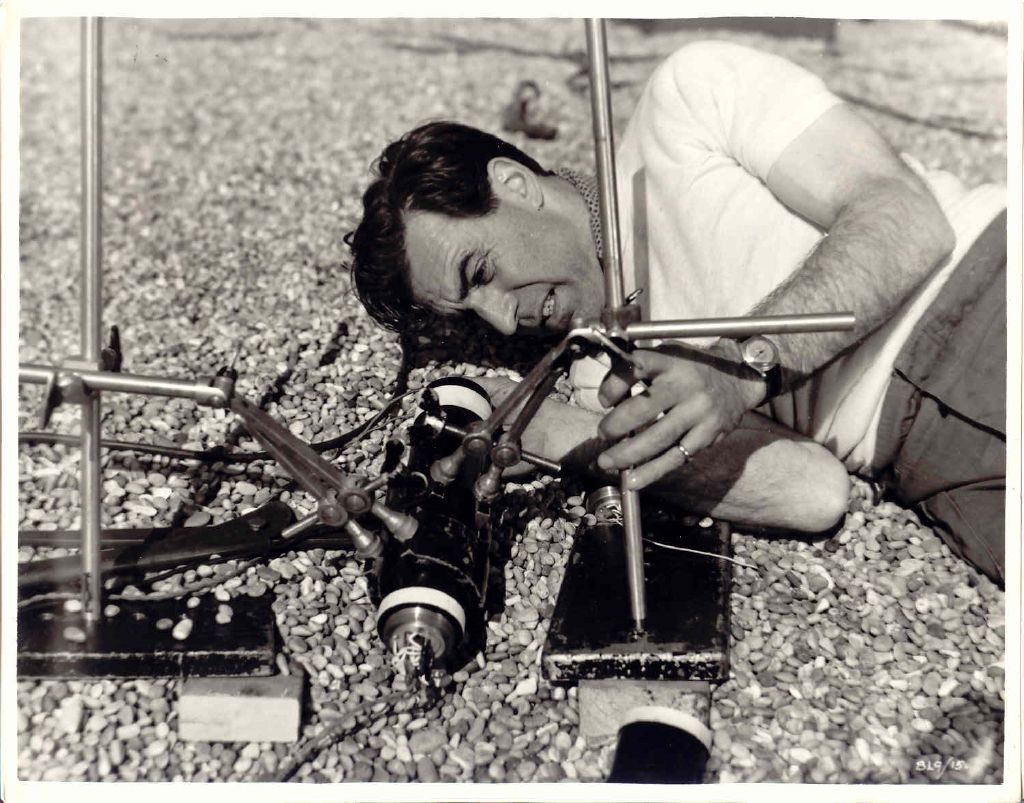
At Chesil Beach, the shingle offers an exposed, unstable workplace. Surviving studio publicity captions identify Sammy using a reaching rod from a trench and later working directly on the device. They also establish the loss hanging over his attempt: Captain Stuart has died while trying to dismantle another bomb.[5] The photograph accompanying this essay belongs to that publicity record; it documents the film's staged action, not an actual wartime disposal operation.
What the hands can prove
The climax gives each small action a consequence. Its tension comes partly from the modest scale of the work: after the monstrous bottle, we watch a man attend to something he can hold. Physical size has stopped being a reliable measure of danger.
A radio transcript of the previous expert's final moments brings another person's failed attempt into the present one.[6] Sammy's skill therefore operates in the presence of a limit. Someone else had knowledge, courage, and a procedure, and still died. Confidence alone cannot settle the problem.
After Sammy succeeds, Colonel Strang praises his hands; the exchange is preserved in the original publicity captions.[5] The praise is specific enough to carry weight. It recognizes something Sammy has done.
There is a temptation to enlarge that recognition into a complete recovery. The more persuasive reading stays close to its scale. One successful task cannot establish what happens to pain, drinking, or the strain between two people afterward. What the film has made visible is an interval in which Sammy can act with care despite everything that has made care difficult.
The bottle filled his world. The bomb requires him to notice a small part of it. For a while, his hands can do that work.
Sources
- Rialto Pictures, “The Small Back Room” — release year, adaptation, cast, creative credits, and restoration provenance.
- BFI Player, “The Small Back Room” — Christopher Challis's photography and the film's place after Powell and Pressburger's Technicolor productions.
- Jeremy Arnold, “The Small Back Room — Michael Powell & Emeric Pressburger's Rarely Seen 1949 Drama The Small Back Room on DVD,” TCM, May 20, 2008 — bottle sequence, phone-call dissolves, and suspense construction.
- Nick James, “The Small Back Room: Whisky Galore!,” Criterion, August 18, 2008 — the Whitehall meeting, bureaucratic distraction, and Sammy's professional judgment.
- The Powell & Pressburger appreciation site, “The Small Back Room (1949)” — scans of studio publicity photographs and original captions, especially BL9/14, BL9/15, and BL9/4; source of the accompanying photograph.
- British Board of Film Classification, “The Small Back Room,” 2023 cinema classification — detailed content descriptions of the prosthesis scene, alcohol imagery, and bomb-disposal transcript.