Spoiler note: this essay discusses the escape attempt and betrayal in Jacques Becker’s Le Trou (1960).
A man strikes the floor. Another takes over when his strength runs out. The camera stays with the work. In the most arresting passage of Le Trou, the changing hands and accumulating rubble make an unusually persuasive promise: whatever else happens, this effort has actually been spent.[3]
That promise is the film’s great source of suspense. We learn to believe in what we can watch being done. But an escape requires confidence in people as well as tools, and another person’s intentions cannot be inspected like a broken surface. Becker patiently brings those two kinds of belief close enough to hurt each other.
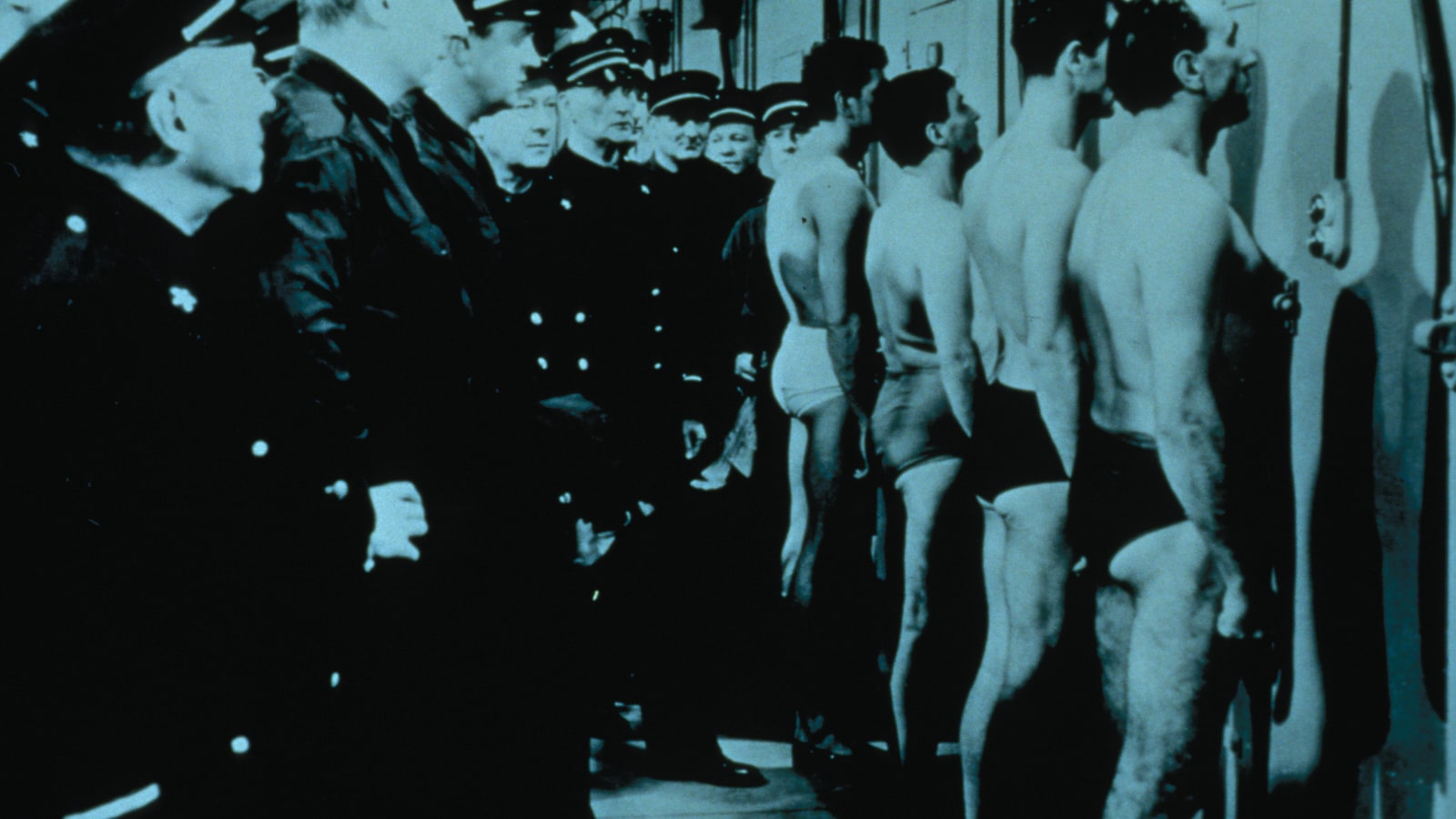
Released in 1960, Le Trou adapts José Giovanni’s novel about a prison escape. Ghislain Cloquet photographed it; Marguerite Renoir and Geneviève Vaury edited it.[1] At La Santé prison in 1947, four cellmates have planned a way out when Claude Gaspard arrives. They must decide whether to admit the stranger to their secret.[2]
The handoff is the action
The floor-breaking shot continues as Roland gives way to Manu, then Géo. Chris Fujiwara measures the unbroken take at just under four minutes. A change of worker does not produce a change of shot: exhaustion enters the image, and somebody else answers it.[3]
For a moment, the practical question of getting through concrete becomes a question of how people sustain one another. Each man’s limit gives the next man something to do. The handoff matters as much as the blow. A condensed sequence could convey the progress of the hole; this duration lets us feel the transfer of responsibility.
It also makes the floor wonderfully indifferent. Determination does not soften it on cue. The men have to accommodate their bodies to the task, and the audience has to accommodate its attention to their pace. Cooperation acquires a weight that an oath of loyalty would struggle to supply.
Listen for the blow that stops
The soundtrack makes that accommodation physical. Jodi Brooks’s study of Le Trou distinguishes its hammering, emphatic breathing, and quiet dialogue. She argues that their recurring pulse drives the experience of watching, including when the hammering falls silent.[4]
The blows carry two wishes at once. We want the work to continue because the opening must grow; we want it to become quieter because the men might be heard. Every productive sound is also an exposure. The CNC’s account specifies that the prisoners exploit daytime prison noise to cover their assault on the floor.[2]
Brooks’s emphasis on listening helps explain why waiting can feel strenuous here. A pause leaves an unfinished action hanging in the ear. The viewer is already anticipating the next impact, already participating in its danger. With music withheld until the closing credits, the men’s immediate sounds occupy an exceptional amount of emotional space.[4][5]
A mirror gives knowledge a frame
Roland’s improvised periscope uses a mirror fragment, a toothbrush, and thread to let the prisoners watch the guards. Darragh O’Donoghue draws attention to the resulting miniature, distorted view of the corridor: an optical intervention inside an otherwise materially exact world.[5]
The device makes a useful distinction visible. The men can extend their sight beyond the cell, but every extension still has an edge. My reading is that the periscope offers a small model of the escape itself: ingenuity changes the conditions of imprisonment without granting complete knowledge of them.
That is a particularly sharp limit in a story about trust. A mirror can answer whether somebody is standing outside. It cannot tell the men what someone beside them intends to do. Sharing a confined space has made observation intimate, but intimacy has not made it exhaustive.
When the film starts leaving things out
O’Donoghue notes a shift after the first underground reconnaissance: once the men construct a timer, the editing compresses work more readily. The early abundance of visible procedure gives way to gaps.[5] We have been taught to attend closely, and now attention cannot recover everything.
The Cinémathèque française places Becker’s command of duration alongside his precise editing when explaining the film’s suspense and its relationship to later crime cinema.[6] That pairing matters. The long take establishes a measure against which a later omission can register. Patient observation has prepared us to notice what we are no longer allowed to observe.
Gaspard’s interview with the prison director alters his prospects: his wife has withdrawn her complaint. The escape is subsequently betrayed and the guards intervene.[2] The crucial change in the group’s situation comes through a conversation, after so much of its progress has been made through visible labor.
This is where the film’s formal choices become painful. The floor-breaking shot has given us evidence of effort; the missing pieces around a person’s decisions offer no comparable assurance. We have invested in the team through an experience of work, and the ending exposes the limits of that investment.
Yet the betrayal cannot make the earlier handoffs imaginary. The men did relieve one another. The hole did require their labor. To my eye, Le Trou leaves that achievement intact even as escape fails. What has been shared remains real; what sharing can guarantee remains terribly uncertain.
Sources
- The Criterion Collection, “Le trou” — 1960 release, 131-minute edition, adaptation and production credits.
- CNC, “Trou (Le) de Jacques Becker,” December 16, 2014 — educational synopsis, setting, escape preparations and betrayal.
- Chris Fujiwara, “The Time It Takes: Le Trou and Jacques Becker,” Criterion, October 2001 — floor-breaking shot and source of the accompanying film still.
- Jodi Brooks, “The Sound of Knocking: Jacques Becker’s Le trou,” Screening the Past, issue 12, March 2001 — sound, rhythm and spectator attention.
- Darragh O’Donoghue, “Le Trou,” Senses of Cinema, May 2006 — the periscope, music boundary and changing treatment of narrative time.
- La Cinémathèque française, “Le Trou” — institutional program note on duration, editing and the film’s place in crime cinema.