
The original theatrical trailer for Vertigo does something smarter than ordinary suspense advertising.[1] It does not begin by asking who committed a crime, what hidden fact will be uncovered, or which clue will unlock the plot. It begins by defining a condition. The dictionary page, the spoken word "vertigo," and the whirlpool graphics adapted from Saul Bass and John Whitney's title design turn the film into a sensation before it becomes a story.[1][4] Long before the trailer clarifies Scottie's pursuit of Madeleine, it teaches the viewer to expect dizziness, engulfment, and a loss of stable distance.
That emphasis makes sense because Hitchcock's 1958 film has always worked less as a clean puzzle than as a movie about possession and fabricated desire.[2][3] TCM's production history stresses Hitchcock's deliberate shift from surprise toward suspense, especially in the way the film eventually reveals what the audience needs to know before Scottie does.[2] Thomas Leitch's Library of Congress essay goes harder and closer to the nerve: Vertigo is a "series of possessions," with one identity designed for another person's need and then redesigned all over again.[3] The trailer does not explain that full mechanism. What it does instead is establish the emotional weather in which that mechanism will feel inevitable.
That is why this preview is worth an annotated viewing in its own right. In just over three and a half minutes, it compresses Hitchcock's San Francisco into a machine of slopes, windows, portraits, stairways, and repeated female images.[1][2][3] It is still promotional material, but it is unusually faithful promotional material. Rather than promising that the movie will solve confusion, it promises that confusion will become the movie's native atmosphere.
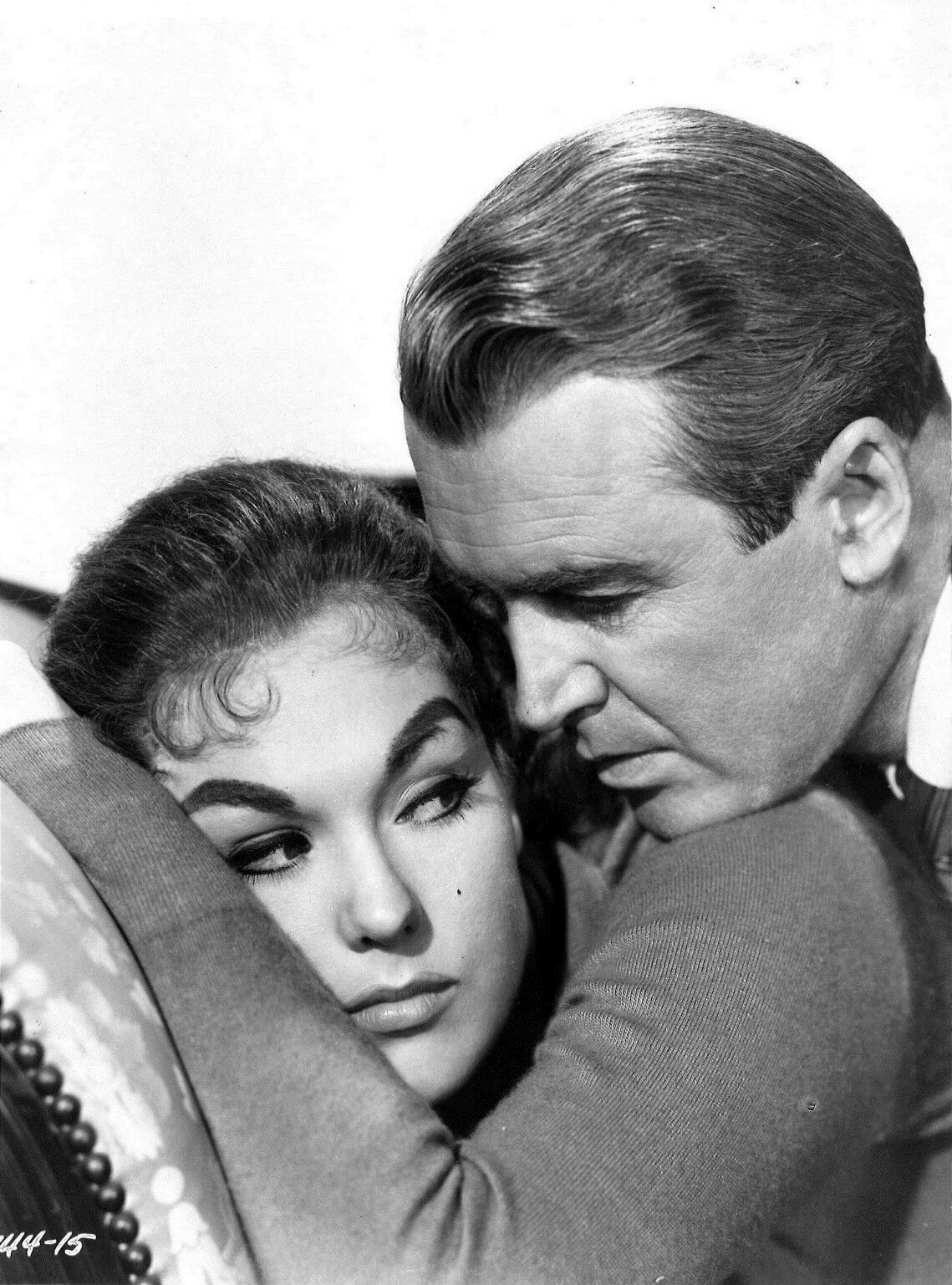
Image context: the lead image uses a 1958 Paramount publicity still of Kim Novak and James Stewart from Wikimedia Commons. It fits the article because the trailer repeatedly returns to the same emotional geometry: a man trying to secure a woman inside his gaze, his arms, or his memory, while the image itself keeps slipping toward duplication and loss.[5]
At 0:00, the trailer defines a symptom before it introduces a plot
The opening move is blunt and elegant. We see the dictionary entry for "vertigo," then the trailer isolates the phrase about a swimming dizziness in the head and a state in which things seem engulfed in a whirlpool of terror.[1] It is hard to think of a more literal way to turn title into method. Bass's typography and Whitney's spirals do not merely decorate the word; they make definition behave like a trap door.[4] The viewer is not being prepared to gather facts. The viewer is being prepared to submit to a condition.
That choice matters because Hitchcock's film is famously about compromised seeing.[2][3] Scottie is a detective, but the trailer does not flatter the spectator into feeling like a detective too. Instead it lowers us into uncertainty from the first seconds. The movie's title is treated as diagnosis rather than brand. By the time the yellow Vertigo lettering lands against black, the preview has already told us that perspective itself will not be reliable.[1][4]
This is a notably accurate way to sell the film. TCM's account of the adaptation emphasizes Hitchcock's decision to favor suspense over withheld surprise.[2] The trailer reaches the same conclusion at the level of mood. It does not say, "Come for the twist." It says, more or less, "Come watch a man enter a state where the world, and then another person, can no longer be held at a safe distance."
Around 0:30, romance arrives as drift, rescue, and unstable enclosure
One of the trailer's shrewdest cuts comes when it moves from definition and graphics into the embrace by the water.[1] Scottie is already holding Madeleine against a bright coastal backdrop, which means the romance is introduced not as a first meeting but as a rescue image. That is crucial. Even in compressed trailer form, their bond is framed as something born from crisis and asymmetry. He catches; she falls. He steadies; she yields. The image looks protective, but it already contains the film's deeper sickness: intimacy has been routed through control.
From there the preview keeps shifting between domestic interiors, hotel-like rooms, and shots in which Novak appears both present and unreachable.[1] A bedroom image, a doorway entrance, and Scottie's searching movement through enclosed spaces all make the relationship feel less like courtship than like pursuit leaking into private rooms. Leitch's essay is especially useful here because it names possession, not romance, as the film's organizing pressure.[3] The trailer never states that argument directly, yet nearly every image pushes in that direction. Madeleine is not sold as a stable beloved. She is sold as a figure who can be watched, followed, recovered, and lost again.
That is also why the trailer's prettiest images feel dangerous. The Bay, the woods, and the carefully arranged interiors give the film a floating, almost narcotic beauty.[1][2] But the beauty does not calm the preview down. It functions like a soft surface over compulsion. The embrace is lovely, yet the trailer cuts it together with watchfulness, distance, and rooms that seem to have already trapped the characters inside someone else's design.
Around 1:12, San Francisco stops being backdrop and becomes a vertical machine
Another important pivot arrives once the trailer begins leaning on geography: the Golden Gate Bridge, steep streets, rooftops, and finally the bell-tower imagery that has become inseparable from the film's afterlife.[1][2] TCM notes that Hitchcock moved the story from Paris to San Francisco and exploited the city's inclines as a structural extension of Scottie's fear of heights.[2] The trailer understands this immediately. San Francisco is not scenic padding. It is an engine for vertical stress.
The rooftop hanging shot is especially telling.[1] Reduced to a single promotional image, it does more than announce danger. It shows Scottie suspended between knowledge and incapacity. He can see the crisis, but he cannot master the height that frames it. That tension is central to the whole film: desire keeps pulling him upward, closer, farther in, while vertigo turns every ascent into a risk of collapse.[2][3]
The bell tower matters in the same way. The trailer does not explain the full narrative function of the mission sequence, and it should not.[1][2] But it keeps advertising the tower as an end point, a place where visual desire and bodily limitation must finally meet. In a lot of thrillers, the climactic location is just where the secret gets exposed. Here the location feels heavier than revelation itself. The architecture is already the argument. It stands for the point where longing, fear, imitation, and physical inability become impossible to separate.
In the final minute, the trailer sells obsession as a process of remaking
The strongest stretch of the trailer may be the run of doubled female images: the red-lit superimposition, the portrait-like close-up, the hallway appearance, and the later shots that suggest Scottie confronting not one woman but a woman being made to resemble another.[1] Even if a first-time viewer does not yet know the plot mechanics, the trailer makes one thing unmistakable. Identity in Vertigo will not be singular. It will be layered, projected, and revised.
This is where the preview comes closest to Hitchcock's cruelest idea. Leitch argues that the film's last movement turns Scottie himself into a maker and manipulator, emptying Judy of her own identity in order to refashion her as the false Madeleine he cannot relinquish.[3] The trailer cannot spell that out without ruining its own suspense, but it can stage the feeling of it. Faces slide over one another. The same blonde profile keeps returning in slightly different visual states. Even the intertitles and star billing help. "James Stewart as you've never seen him before" is not only a star sell; it announces deformation, a beloved American screen presence driven into mania.[1]
This is why the trailer still feels so modern. It is not simply promising thriller mechanics or Hitchcock prestige.[1][2][4] It is promising an image system in which desire itself becomes a graphic operation: zoom in, overlay, repeat, ascend, lose balance, repeat again. The closing red spiral title seals that contract.[1][4] You leave the trailer with less factual clarity than a contemporary marketing department would tolerate, but with a much stronger understanding of what sort of experience the film intends to become.
That is the preview's real achievement. It sells Vertigo as a movie where the central danger is not ignorance but fixation.[1][2][3] The mystery matters, the San Francisco landmarks matter, the bell tower matters, yet the trailer keeps insisting that the deepest threat is the act of wanting one image to hold still long enough to live inside it. Hitchcock's film remains devastating because it knows that such stillness cannot be secured. The trailer remains great because it teaches that lesson before the movie has properly begun.
Sources
- Universal Pictures UK, "Vertigo Original Theatrical Trailer," YouTube video.
- Brian Cady, "Vertigo (1958)," TCM / AFI's Top 100.
- Thomas Leitch, "Vertigo," Library of Congress National Film Registry essay PDF.
- Ben Radatz, "Vertigo (1958)," Art of the Title.
- Wikimedia Commons, "File: Kim Novak James Stewart Vertigo Still.jpg."