Jack Clayton's The Innocents (1961) is often praised as one of the great ghost stories on film, and the label is deserved.[1][4][5] But the movie's lasting force does not come from a solved supernatural premise. It comes from a much meaner and more elegant achievement. The film keeps teaching the viewer to look under conditions that make looking unstable. Deborah Kerr's Miss Giddens arrives at Bly thinking vision will be a moral instrument: if she watches carefully enough, she will understand the children, the house, and the danger gathering around them.[1][2] Clayton and cinematographer Freddie Francis keep undoing that confidence. Every image in the film asks the same question in a slightly altered form: what if sight is not the remedy for uncertainty but the medium through which uncertainty spreads?[1][3][5]
That is why The Innocents remains so unnerving even for viewers who already know Henry James's The Turn of the Screw or the film's famous ambiguity.[1][2][4] The terror is not simply a matter of whether Peter Quint and Miss Jessel "exist." The terror comes from how the house, the light, the decor, and the soundtrack keep making Miss Giddens's vigilance feel both necessary and contaminated. The film does not separate psychological panic from external haunting into two clean options. It lets each possibility borrow strength from the same sensory field.[2][3][5]
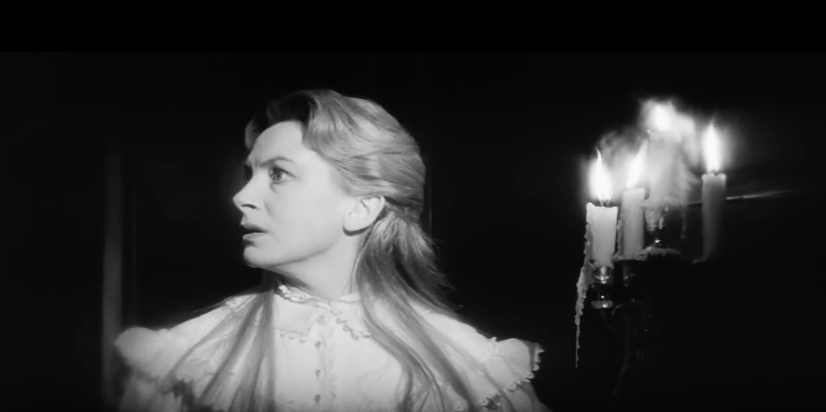
Image context: the lead image uses a real trailer still of Deborah Kerr as Miss Giddens from Wikimedia Commons. It is the right recognition image for this essay because The Innocents keeps treating her face as a screen where conviction and fear overwrite each other. Even in a static frame, the film's central drama is already visible: a woman trying to hold order while darkness keeps pressing in from the edges.[7]
Spoiler warning: this close reading discusses the lake apparition, the children's behavior, and the ending.
1. Candlelight makes vision local, fragile, and self-defeating
The first great trick in The Innocents is that it does not use darkness as simple concealment.[1][3][5] Freddie Francis described the look of the film as a "cocoon of darkness," and that phrase matters because the dark in this movie is not empty background.[3] It presses around candles, faces, lace, banisters, and doorways, making every lit object feel briefly rescued from a larger field it cannot master. Light in horror cinema often promises revelation. Here it behaves more like a narrowing device.
Miss Giddens repeatedly carries candles through Bly as if she were carrying authority itself.[1][3][5] The gesture feels practical, even righteous: she will inspect, confront, and clarify. Yet the candlelight never stabilizes the world. It creates islands. A face becomes legible while the corridor behind it grows deeper. A curtain glows while the room beyond it retreats. A hand or a cheek catches brightness, but the surrounding architecture starts to feel more watchful precisely because it remains unmastered.[3][5] The film is terrifying not because we cannot see anything, but because we can only see a selected patch at a time.
That localness matters psychologically. Miss Giddens is a governess and therefore an interpreter by profession. She has come to read manners, gestures, and signs correctly.[1][2] Candlelight seems to align with that mission, giving her a literal tool for inspection. Clayton turns the tool against her. The more she searches, the more her search becomes visible as an act of projection and strain. A flame held close to the body can suggest vigilance, but it can also suggest obsession: a person feeding the very instrument that isolates her from the larger scene.
This is one reason the film's black-and-white CinemaScope frame feels so strange and so modern.[1][3] Widescreen might be expected to open space up, yet Francis and Clayton use width to make emptiness active. A candlelit figure can occupy one part of the frame while the rest waits like a reserve of doubt. The image never quite settles into either objective space or pure subjectivity. It keeps hovering between the two, which is exactly where fear thrives.
2. Curtains, windows, and decorative veils turn the whole house into a screening device
If candlelight limits what can be seen, the film's fabrics and thresholds complicate how seeing happens at all.[2][5][6] The Innocents is full of curtains, translucent lace, reeds by the lake, windowpanes, mirrors, carved banisters, and floral clutter. In another Gothic film these might function mainly as period texture. Here they work like filters. Clayton keeps putting vision through something.
That design is crucial to the apparitions. Quint on the tower, Miss Jessel across the lake, faces glimpsed through panes or reflected surfaces: these shocks land because the movie almost never grants a clean, frontal relationship between viewer and object.[2][5] The sighting has distance built into it. Something is seen through glass, across water, behind ornament, or at the far edge of the frame. The result is not simply that the ghost might be unreal. The result is that the act of sight itself has acquired a veil. We never encounter the image naked.
BFI's writing on the film is especially useful here because it stresses the balance between presentation and withholding.[5] Clayton shows enough to let dread take form, but he rarely gives enough to let interpretation rest. That is why the house never becomes a neutral container for supernatural events. Bly is an engine for mediated perception. Its décor is not decorative after all. Curtains, roses, ribbons, and polished surfaces do not soften the horror; they civilize it into something more poisonous.[5][6]
The costume design deepens the same logic.[6] Claire Smith notes that Miss Giddens's dresses move from airy floral softness toward darker, heavier textures as the film progresses.[6] That progression is more than visual elegance. It makes Kerr's body look increasingly absorbed by the house's atmosphere, as though innocence, repression, mourning, and identification were all being rewritten through fabric. By the end, clothing no longer feels separate from psychology. It has become one more membrane between certainty and disturbance.
3. "O Willow Waly" makes sound arrive before proof
The film's most haunting element may not be visual at all.[1][2][3] Before The Innocents fully explains its setting, it gives us the child's song "O Willow Waly," sung with a purity so delicate that it almost feels detached from the body that should be producing it.[1][2] The effect is devastating because sound enters the film earlier and more intimately than evidence does. We hear dread before we can place it.
That ordering changes the whole movie. Once the song has entered the house, every later silence starts to feel provisional.[1][2][5] The grounds at Bly may appear calm, but the soundtrack has already informed us that calm can carry a residue. The song does not function like a conventional warning cue announcing that something monstrous is about to leap into frame. It works more subtly and more cruelly. It makes innocence itself acoustically suspicious. A nursery voice, a tune associated with childhood, and an atmosphere of mourning begin occupying the same register.
This is why the children's speech matters so much.[2][5] Flora's songs and Miles's unnervingly polished phrases are frightening not because they are loud or aggressive, but because they seem slightly too composed for the age and setting. Maitland McDonagh's Criterion essay gets close to the nerve of the film when it treats Miles's language as chillingly adult without ever becoming explicit.[2] The house is full of words and sounds that are almost proper, almost sweet, almost harmless. The horror lies in that almost.
Sound also helps explain why the film's ambiguity never feels like an abstract puzzle.[1][3][5] If the movie merely withheld factual certainty, it could become an intellectual game. Instead, it floods the viewer with sensory conviction. A voice, a song, a breath, a rustle, a distant cry: these details persuade the nerves before the mind has chosen a theory. That is the film's real mastery. It makes the body believe first and leaves interpretation scrambling behind.
4. The ending turns rescue into contamination
By the final movement, The Innocents has trained us so thoroughly in unstable perception that the ending becomes unbearable not because it solves the mystery, but because it refuses to separate salvation from violation.[1][2][4][5] Miss Giddens's determination hardens into certainty. She will force the hidden truth into daylight, force Miles to name Quint, force the house to yield its secret.[2][5] In another kind of horror film, that would be the heroic gesture. Here it feels like the last stage of contamination.
The close-ups matter enormously. Clayton does not stage the ending as a grand exorcism but as a collapse of distance.[1][2] Faces move nearer. Breath becomes heavier. The frame loses what little composure it had. Miss Giddens's need to save the child and her need to confirm her own interpretation become impossible to disentangle. The final kiss is therefore terrifying because it refuses clean moral placement. It can be read as benediction, desperation, repression breaking form, or catastrophic misrecognition all at once.[2][5] The film has spent ninety minutes teaching us that sensation will arrive before certainty; the ending merely pushes that rule to its limit.
That is why The Innocents still feels richer than many later films that either overexplain haunting or treat ambiguity as a prestige accessory.[1][4][5] Clayton's movie is not coy. It is exact. Candlelight isolates. Curtains filter. Song stains the air. Each device narrows the distance between feeling and interpretation without ever closing it. The film does not ask us to decide once and for all whether Bly is haunted or Miss Giddens is unraveling. It asks us to experience how a world can become haunted the moment every act of attention starts carrying too much desire, too much fear, and too little proof.
Sources
- The Criterion Collection, "The Innocents (1961)" film page.
- Maitland McDonagh, "The Innocents: Forbidden Games," The Criterion Collection.
- Freddie Francis, "Freddie Francis on The Innocents," The Criterion Collection.
- BFI, "The Innocents (1961)" film page.
- Geoff Andrew, "The Innocents and the power of suggestion," BFI.
- Claire Smith, "The gothic glamour of The Innocents," BFI.
- Wikimedia Commons, "File:Deborah Kerr - The Innocents trailer screenshot.png" - source page for the lead image.