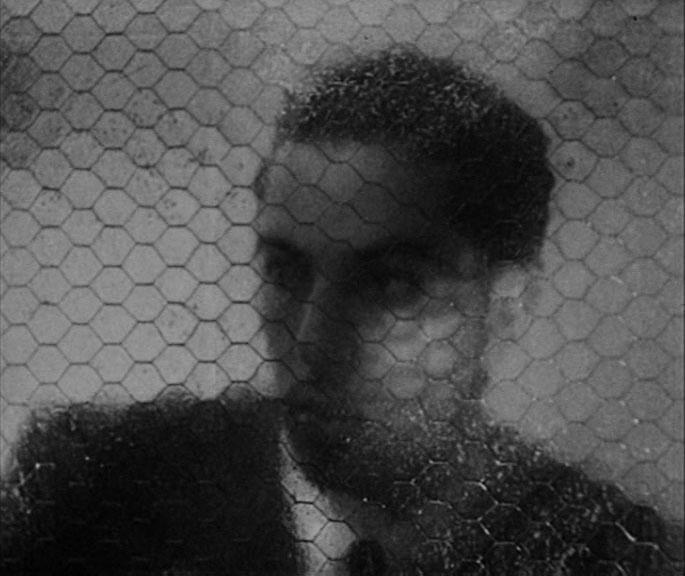
Carl Theodor Dreyer's Vampyr is often described as a horror film, which is accurate and still not quite enough. It has a vampire, a sick young woman, a book of occult rules, a grave opened at dawn, a body in a coffin, and a doctor punished in a mill. But the plot is not where the fear really lives. The movie frightens by making the apparatus of cinema feel porous: focus will not settle, sound seems to come from somewhere slightly displaced, shadows detach from bodies, and rooms refuse to explain how they connect.
That is why Vampyr still feels less like a story about supernatural invasion than a story about perception under stress. BFI's 90th-anniversary essay emphasizes the film's gauze-softened images, its unstable spatial layout, and the way its camera glides like an untethered presence rather than a neutral observer.[1] Caspar Tybjerg's Sight and Sound account is useful for the same reason: he frames Dreyer's horror as psychological indirection, a waking dream in which the spectator has to reconstruct fragments rather than receive a clean chain of cause and effect.[2] The craft is not decoration. It is the monster's operating system.
The Blur Is A Decision
The most important technical fact about Vampyr is also one of the easiest to romanticize: Dreyer and cinematographer Rudolph Mate did not simply inherit a degraded image. They pursued a hazy, diffused look as a method. BFI describes the effect as a glow achieved by shooting through gauze held before the camera, while also noting that Dreyer and Mate avoid clear establishment of space, so figures can appear from directions the viewer has not fully mapped.[1] The result is not soft focus in the flattering sense. It is soft focus as suspicion.
That matters because horror usually asks darkness to hide things. Vampyr often does the opposite. It lets light wash the image until boundaries weaken. Walls, faces, corridors, and fields are visible, but visibility no longer feels like knowledge. The image has the pallor of evidence left too long in the sun. Gray's world is not blacked out; it is overexposed to the point where ordinary edges lose authority.
This is why the film's blur is more radical than a mood effect. It changes the viewer's contract with the frame. In a classical suspense scene, the frame withholds a threat until the reveal. In Vampyr, the frame itself seems unsure what kind of reality it is recording. A face behind mesh, a figure by a doorway, a distant scythe carrier, or a wall crossed by an impossible shadow all arrive as if the image has developed wrong. Dreyer turns photography into a haunted material.
Location Makes Unreality Heavier
The strange thing is that Vampyr is not built from theatrical fantasy in the obvious way. It was shot on location, with the BFI essay pointing to the small French village of Courtempierre as a key source of its uncanny power.[1] The consolidated film record also notes the location shooting and the production's France-Germany context, with Dreyer working outside ordinary studio security after The Passion of Joan of Arc had failed commercially.[3] The real world is therefore not cancelled by style. It is contaminated by it.
That contamination gives the film its physical weight. A studio castle can announce itself as Gothic. A real wall, road, mill, or river has to be persuaded to misbehave. Dreyer does that by refusing the usual stabilizers. He withholds the comforting geography that would tell us where Gray has entered, how far one room sits from another, or whether a movement belongs to a body, a dream, or a delayed clue. The film's village is not imaginary. It is worse: it looks as if an ordinary place has begun to follow dream logic without changing its surface.
The mill sequence is the best example. On paper, the doctor's death by flour could sound like a grotesque punishment device. On screen, it feels industrial and spectral at once. The machinery is real enough to grind and choke; the moral force that sets it against the doctor feels almost impersonal. Location gives the supernatural a working address.
Shadows Get Their Own Labor
In many vampire films, the creature's body supplies the main image. Vampyr is more interested in delegated agency. Shadows move, hands gesture, doorways breathe, and reflections seem to know more than people. BFI's anniversary essay singles out the film's autonomous shadows and reflections, as well as the camera movement that glides with a ghostlike freedom.[1] That observation goes to the center of the film's technique: horror has been distributed across the visible world.
The dancing shadows in the factory are not simply eerie because they are supernatural. They are eerie because they expose the fragility of cinematic evidence. Film already turns bodies into projected light. Dreyer takes that basic fact and makes it narratively active. A shadow can act before a body explains it. A reflected or screened face can feel more present than the person who casts it. The vampire's power is therefore not only in biting; it is in reorganizing what counts as a trustworthy image.
This gives Vampyr a craft logic that feels close to experimental cinema without abandoning horror. The viewer still wants to know who is threatened, who is guilty, and how the curse can be broken. But every answer has to pass through a world where images are not obedient. The supernatural is not added to the film. It is discovered inside cinema's normal ability to separate body, light, sound, and time.
Sound Arrives From Elsewhere
The film's sound is just as unstable as its image. Vampyr was made during the transition from silent cinema to talking pictures, and BFI notes that the film was shot mute, with voices and other sounds added afterward.[1] The production record explains the practical reason more fully: Dreyer used very little dialogue, actors mouthed lines for multiple language versions, and the soundtrack was created later in Berlin.[3] The Internet Archive's record for an original-German-intertitles copy is a useful reminder that the film still circulates through versions and access copies rather than one self-evident object.[4]
That hybrid quality is not a defect the film barely survives. It is one reason the film works. The voices do not settle naturally into rooms. The score by Wolfgang Zeller presses against scenes like weather. Animal sounds, footfalls, doors, and short lines of dialogue seem less like captured location sound than like signals laid onto the image from a neighboring state of consciousness.
The restoration history sharpens this point. The surviving versions of Vampyr are complicated by lost original elements, multiple language tracks, damaged nitrate prints, censorship cuts, and post-synchronization problems, as Martin Koerber's restoration notes detail.[3][5] That does not mean a viewer should treat every uncanny sound as a restoration artifact. It means the film's material history rhymes with its aesthetic. Vampyr was always a film about bodies, voices, and images not lining up with ordinary confidence.
The Coffin Shot Makes Viewpoint Physical
The most famous sequence is Gray's vision of himself inside a coffin. The shot is powerful because it converts point of view into entrapment. The camera does not merely show a man imagining death. It places the viewer under the coffin window, looking up at faces, sky, branches, and bearers from the position of a body being carried toward burial. BFI connects the buried-alive motif to Le Fanu's "The Room in the Dragon Volant," one of the sources within the larger In a Glass Darkly orbit.[1] The Wikimedia frame reference also preserves the image's central shock: Gray sees his own body sealed in the coffin, turning spectatorship into a kind of premature burial.[5]
The sequence matters because it makes the film's whole method explicit. Earlier, space was uncertain. Now viewpoint is physically trapped. Earlier, bodies and shadows separated. Now Gray is divided from himself. Earlier, sound and image seemed post-synchronized in a slightly ghostly way. Now life and death are synchronized badly: the living consciousness watches its own corpse ride forward.
This is not merely a clever subjective shot. It is the film's craft thesis in miniature. Cinema can detach sight from body. It can make us occupy a position no ordinary person could occupy. It can turn the act of watching into helpless forward motion. Dreyer uses that power without spectacle. The coffin's small window becomes a screen within the screen, and the viewer learns that a frame can be a prison.
Why It Still Feels Modern
The modernity of Vampyr is not that it predicts later vampire lore cleanly. In some ways it refuses that path. It is less interested in rules than in states: fever, trance, sleep, delayed understanding, and the feeling that every object has become overcharged. Tybjerg's essay quotes Dreyer's own interest in presenting events fragmentarily, forcing the mind to reconstruct them.[2] That principle is still bracing because so much contemporary horror depends on explanation as reward. Vampyr offers explanation, but it never lets explanation own the experience.
The vampire can be named. The grave can be opened. The doctor can be punished. Gray and Gisele can cross toward dawn. Yet the film's disturbance remains in the craft: light that will not harden, shadows that have found work, sound that seems attached after the fact, a camera that drifts like something not fully alive, and a coffin shot that turns looking into burial.
That is why Vampyr endures as more than an eccentric early sound horror film. It makes form feel infected. The fog is not only in the village. It is in the lens, the soundtrack, the edit, the surviving print history, and the viewer's attempt to assemble a world that keeps refusing to become cleanly visible.
Sources
- Alex Barrett, "Vampyr at 90: how Carl Dreyer conjured a waking nightmare," BFI, May 6, 2022 - anniversary essay on gauze photography, location shooting, silent/sound transition, autonomous shadows, and the BFI still used for the cover image.
- Caspar Tybjerg, "Waking life: the psychological horror of Carl Theodor Dreyer's Vampyr," BFI Sight and Sound, October 29, 2021 - archive feature on production context, delayed horror timing, psychological indirection, and Dreyer's waking-dream method.
- Wikipedia, "Vampyr" - consolidated film record for credits, production history, location shooting, post-synchronized sound, release history, and reception notes.
- Internet Archive, "Vampyr (Original German)" - access record for a copy with original German intertitles, useful for the film's version and circulation history.
- Wikipedia, "File:Vampyrcoffin.jpg" - archival frame reference for the film's coffin-point-of-view sequence.