Elaine May's film career is often introduced through scarcity: four directed features, decades of script work, long pauses, studio battles, and a reputation that kept arriving after the damage had already been done.[1][2][4] That frame is accurate enough, but it risks making her cinema sound like a missing career instead of a working method. May did not direct many films. The ones she made are dense with a recognizably directorial idea: conversation is not decoration around the plot. It is where power first shows itself.
In May's movies, people talk because silence would expose them too quickly. They improvise status, flirtation, apology, competence, injury, and friendship while the scene quietly measures what each performance costs. BFI's Carrie Rickey describes May's career as a long practice of skewering male vanity, while BAMPFA's retrospective note ties the films to an unsentimental intelligence shaped by comedy, writing, acting, and a difficult Hollywood path.[1][2] The profile that emerges is not "comedian turns filmmaker." It is more exact: an improviser understood that talk is behavior under pressure, then built movies in which the pressure keeps rising before anyone admits what the scene is about.
Improv Becomes Structure
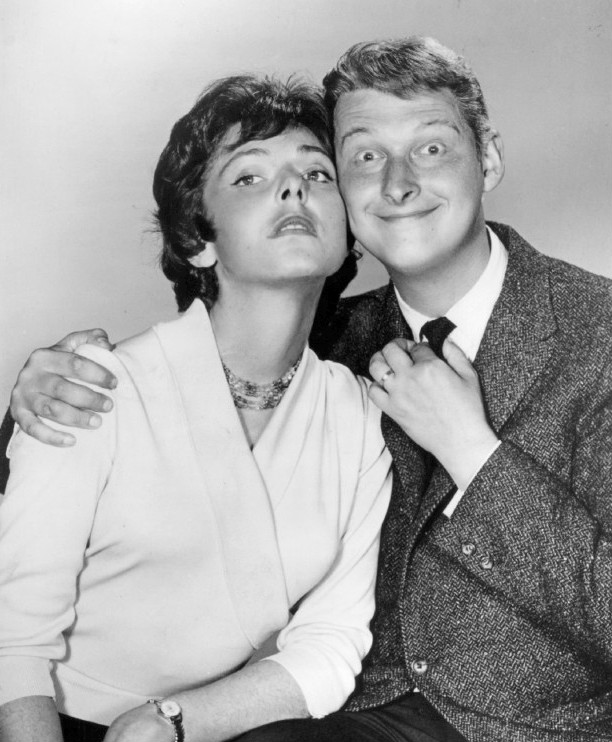
The photograph from 1960 catches May beside Mike Nichols in publicity mode, already performing a two-person imbalance: her face lifted and guarded, his grin bright and eager, both bodies compressed into one comic frame.[6] It is not a movie still, but it belongs to a movie profile because the films keep returning to that kind of asymmetry. One person pushes charm forward; another person lets the push hang in the air; the audience feels the power shift before the dialogue says it aloud.
BAMPFA's account places May's Nichols-and-May fame in the Chicago and New York improvisational world, before the Hollywood directing years that began with A New Leaf in 1971.[2] The important carryover is not looseness. May's film scenes often feel unstable, but their instability is arranged. The rhythm of interruption, delay, repetition, and sudden cruelty is too pointed to be casual. The people onscreen seem to be discovering their lines because the characters are discovering what they can get away with.
That is why May's authorship can hide in plain sight. She does not announce style with a single signature camera move. Her style lives in the patience to let a bad explanation keep talking. A man starts by excusing himself, then flatters, then revises, then turns injured, then discovers that the woman across from him has understood more than he planned to reveal. The scene does not need a confession. It needs enough time for self-protection to become self-exposure.
Courtesy As A Weapon
A New Leaf gives the method a comic shape. BAMPFA identifies May's 1971 debut as a black screwball comedy, while Anderson's 4Columns survey emphasizes the lethal absurdity of its central couple: a bankrupt elegant parasite and a wealthy botanist whose guilelessness is never merely cute.[2][3] The premise sounds like farce, but May's interest is colder. What does predation sound like when it uses good manners?
Walter Matthau's Henry Graham does not behave like a conventional villain because conventional villainy would be too honest. He is fastidious, articulate, irritated by incompetence, and often very funny. May's Henrietta Lowell is not stupid; she is socially unarmored. Their scenes work because politeness creates cover. Henry can mock, correct, direct, and plan while maintaining the formal surface of courtship. Henrietta can miss one layer of danger while sensing another layer of contempt. The comedy comes from timing, but the timing exposes a hierarchy.
May's next feature, The Heartbreak Kid, sharpens that hierarchy into romantic cruelty. BAMPFA calls it a bitter satire, and Rickey's BFI essay places May's work inside a recurring assault on inflated male ego.[1][2] The key is that May does not need to turn selfish men into monsters. She lets them stay socially fluent. Their talk is quick enough to look like intelligence, smooth enough to look like sincerity, and flexible enough to turn a promise into an inconvenience as soon as a better fantasy appears.
This is May's anti-sentimental gift. She understands that cruelty often arrives with plausible grammar. Her men do not simply lie; they narrate themselves into temporary innocence. Her women are not always able to stop the damage, but the films usually know what the damage is before the men do. The camera listens with them.
Friendship As Delay
Mikey and Nicky is the fullest version of May's conversation system because almost the whole film is a night of talking under threat. The Guardian's 2026 reappraisal centers the film's long history of studio conflict and belated recognition, while Senses of Cinema describes its two small-time criminals as locked in a night-long tug of war between fear, reassurance, betrayal, and dependency.[4][5] Anderson's 4Columns essay frames the same film as a downbeat anti-buddy movie, with Peter Falk and John Cassavetes's improvisatory gifts feeding a drama of old resentments and unstable allegiance.[3]
That controlled looseness is central. The point is not that May simply captured spontaneous masculine chaos. It is that she shaped chaos with behavioral precision. Nicky speaks because he is terrified. Mikey speaks because delay has become his task. Their friendship survives as long as language can keep changing the shape of what is happening: reassurance, accusation, memory, insult, begging, old jokes, new grievance, and one more promise that might not mean anything by the time the sentence ends.
The film's violence is therefore not only the offscreen threat of a hitman. It is the violence of conversation used to postpone truth. Two men who know each other's childhoods cannot use intimacy to save each other because intimacy has become part of the trap. They have too much history to speak cleanly and too much fear to stop speaking. May's direction keeps the night moving through rooms, buses, bars, streets, and apartments, but the real geography is verbal. Every place becomes another chamber where friendship tries to talk its way out of betrayal.
This is where the director profile becomes larger than the standard production legend. The battles over production, control, and release are real.[2][4] They are also easy to let dominate the reading. Mikey and Nicky matters because its form is inseparable from its subject: a film about men losing control was made by a director who insisted on control over hesitation, mess, overlap, and moral drift.
Failure As Performance
The usual shorthand for Ishtar is disaster, but May's filmography looks stranger and more coherent if the film is read as another conversation machine. BFI's retrospective defense calls it a startlingly original allegory of blundering Americans in the Middle East, while 4Columns reads its awful singer-songwriters as part of the film's enduring comic and political intelligence.[1][3] The surface joke is incompetence: two terrible singer-songwriters stumble toward geopolitical danger. The deeper joke is performance without self-knowledge.
In May's earlier films, men weaponize fluency. In Ishtar, the men lack even that. Their songs are bad, their plans are worse, and their sense of themselves floats free from evidence. But the film is not merely laughing at failure. It studies the political danger of people who can mistake sincerity for capacity. The bad song becomes a model of bad judgment: rhythm without thought, confidence without relation to the room, partnership built from mutual delusion.
That helps explain why May's work can look tonally slippery. She is not loyal to genre mood. A New Leaf is a murder comedy with moments of tenderness. The Heartbreak Kid uses romantic comedy grammar to expose abandonment. Mikey and Nicky lets gangster danger become an anatomy of friendship. Ishtar turns show-business failure into a foreign-policy farce. The through-line is not genre. It is the way performance protects people from what they are doing.
Why The Reappraisal Still Matters
May's late institutional recognition can feel like a correction finally catching up. BFI's long-view essay, BAMPFA's retrospective framing, 4Columns's survey of the directed features, and The Guardian's 2026 account of renewed attention all point toward the same belated adjustment: May's films now read less like a small, interrupted side career and more like one of American cinema's sharpest studies of talk as social force.[1][2][3][4]
But the best reason to watch her is not because history undercounted her, though it did. The best reason is that the films remain unusually alert to how people perform themselves in real time. May catches the second before charm curdles into entitlement, the pause before reassurance becomes betrayal, the apology that is really a maneuver, the joke that reveals a hierarchy, the love scene that has already become a negotiation.
That is the director's signature. Conversation moves first. Plot catches up later. By then, in a May film, the damage has usually introduced itself in perfect grammar.
Sources
- Carrie Rickey, "Elaine May: laughing matters," Sight and Sound / BFI, updated 18 April 2024 - career overview on May's comedy, directing, screenwriting, and recurring attack on male vanity.
- BAMPFA, "Elaine May: Age of Irony" - retrospective note on May's improvisational origins, Hollywood directing path, first studio deal since Ida Lupino, and later reevaluation.
- Melissa Anderson, "Elaine May," 4Columns, 18 January 2019 - critical survey of May's directed features, male vanity, Mikey and Nicky, and Ishtar's later reappraisal.
- Adrian Horton, "Marginalized for her 'immense ambition', the genius of director Elaine May is finally being recognized," The Guardian, 25 June 2026 - recent account of May's renewed recognition, production conflicts, and Mikey and Nicky anniversary context.
- Leigh Singer, "Open the Door: Access and Dominance in Mikey and Nicky (Elaine May, 1976)," Senses of Cinema, April 2019 - close reading of access, dominance, friendship, fear, and betrayal across the film's long night.
- Wikimedia Commons, "File:Elaine May and Mike Nichols 1960.JPG" - 1960 CBS publicity photograph used as the article image.