Robert Bresson's Au hasard Balthazar can sound simple when reduced to a premise: a donkey passes from owner to owner in rural France, absorbing kindness, cruelty, work, neglect, spectacle, and finally death. Janus frames the 1966 film around that chain of possession, while BFI calls it a stark vision of humanity as experienced by a maltreated beast of burden.[1][2] Those descriptions are accurate, but the film's power lies in how little it explains. Balthazar does not narrate. He does not become a cute witness, a moral commentator, or a human personality in animal costume.
That refusal is the whole achievement. Bresson makes the donkey central without translating him into our language. The film asks the viewer to read a bell, a bray, a hand on a flank, a bridle, a gate, a wagon, a motorcycle, a pile of contraband, and a hillside full of sheep. Its close reading has to begin there: not with "what Balthazar means" as a fixed allegory, but with how the movie makes meaning accumulate around a creature who cannot argue back.[3][4]
Hands Do The Moral Accounting
Bresson is often described as austere, but Au hasard Balthazar is packed with contact. Children stroke the young donkey. Marie garlands him. Men load him, pull him, sell him, beat him, hitch him to work, and pass him on. The film's moral ledger is not written in speeches. It is written in what hands do before people justify themselves.
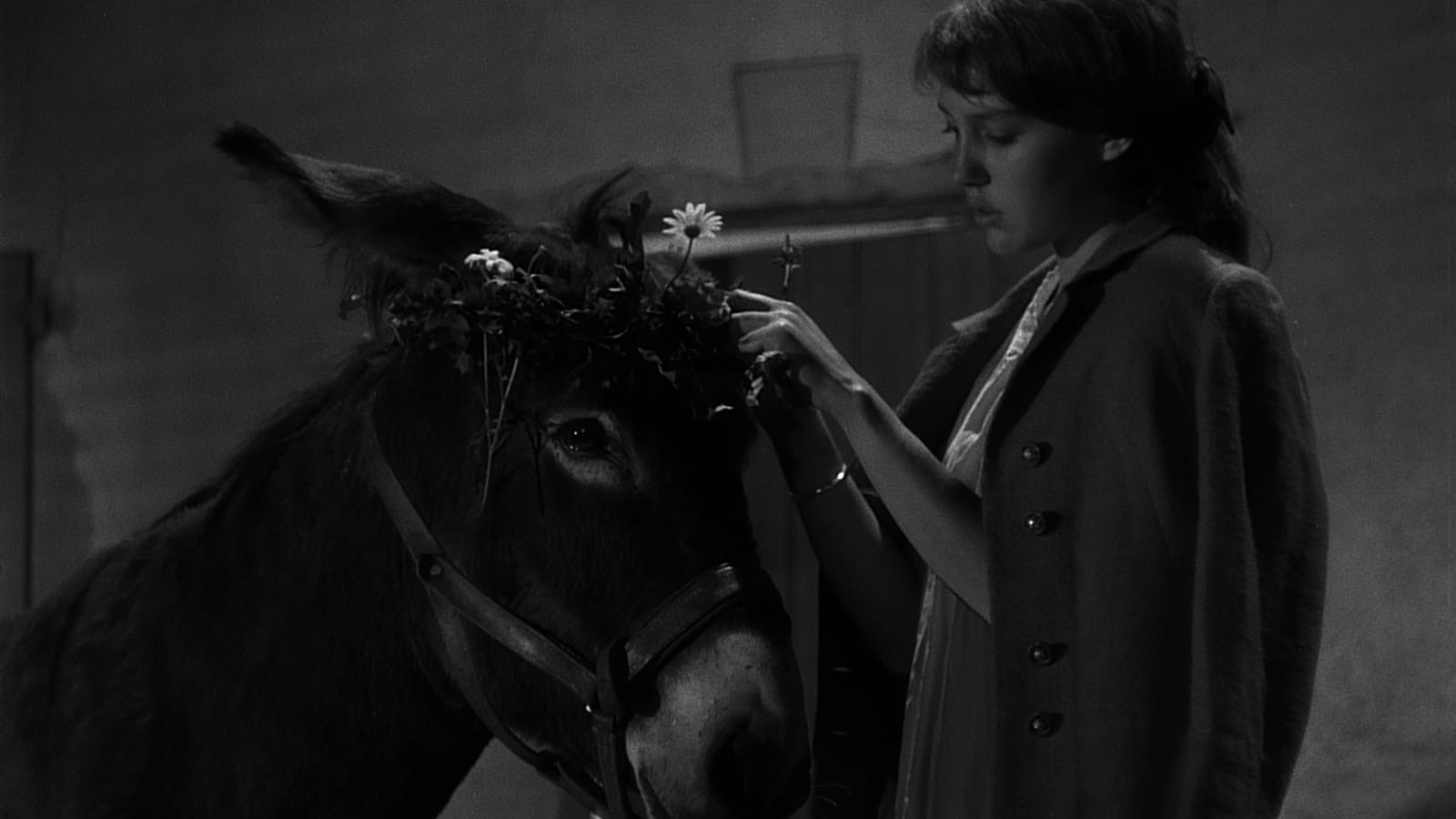
That is why the image of Marie placing flowers on Balthazar matters so much. It is tender, but not pure escape. The bridle is still there. Her hand is gentle, but the animal remains harnessed. BFI's programme notes emphasize the parallel between Marie and Balthazar: she chooses and he does not, yet both are drawn into misery by a world of coercion, desire, possession, and routine violence.[3] The garland scene briefly lets care and captivity occupy the same frame.
The mistake would be to turn that parallel into a neat equation. Marie is not simply "like" Balthazar. She has agency, however compromised. She is tempted, pressured, bored, ashamed, defiant, and damaged. Balthazar does not get that interior drama. He is moved through human systems as property and labor. The film's severity comes from holding both facts together. Marie can make bad choices in a narrowed world; Balthazar is treated as an object in a world where humans keep mistaking use for knowledge.
Sound Keeps The Animal Opaque
The bell is the film's cruelest musical instrument. It makes Balthazar locatable, useful, almost ceremonially marked, but it also turns his movement into sound before it turns into story. We hear him before we can explain him. Senses of Cinema's recent essay on the film argues that Bresson's sound and gaze give Balthazar an aesthetic and ethical presence without reducing him to a mere placeholder for human ideas.[4] That is exactly what the bell does. It announces a life that remains partly withheld.
The bray works differently. It is not pretty, and Bresson does not make it expressive in the sentimental sense. Reverse Shot's sound essay is useful here because it treats Balthazar's vocalizations as carefully arranged events rather than random animal noise.[6] A bray interrupts the human world with something unassimilated. People can ignore it, exploit the body that produces it, or interpret it after the fact. They cannot make it speak their language.
That opacity saves the film from the easiest kind of pity. Bresson does not ask us to imagine that the donkey secretly thinks like us. He asks us to notice how much of the world becomes morally legible without that fantasy. A chain rattles. Hooves move. A gate squeaks. A bell crosses a field. The soundtrack is not a decoration around suffering. It is the way suffering gets registered before it is made into a concept.[4][6]
The Film Is Material Before It Is Holy
The sacred readings of Au hasard Balthazar are hard to avoid: the name, the childhood baptism, the stations of suffering, the burden, the wound, the final sheep, the bells. BFI notes that some critics have read the film as Christian allegory, and Janus describes a parable of purity and transcendence.[1][2] The film invites those readings, but it also resists becoming comfortable inside them.
Dana Polan's Senses of Cinema essay makes the needed corrective: Bresson's world is intensely material, full of mud, dust, money, tools, roads, labor, and exchange.[5] In that world, Balthazar's passage from owner to owner is not only a spiritual itinerary. It is an economic and physical transfer. Each keeper extracts something: work, status, entertainment, convenience, profit, cruelty, escape. The donkey is innocent, but innocence does not protect him from being useful.
This is why the movie feels harsher than a religious illustration. If Balthazar were only a Christ figure, the film could become a puzzle of correspondences. Instead, Bresson keeps dragging interpretation back to weight. A load must be carried. A body gets tired. A field has to be crossed. A young man on a motorcycle can make old rural labor look suddenly modern and more brutal, not less. BFI's programme notes point to the film's scooters, transistors, cars, jukeboxes, and casual violence as signs of a hard contemporary world pressing against older village life.[3] Modernity does not rescue Balthazar. It finds new ways to use him.
Marie And Balthazar Do Not Redeem Each Other
Marie gives the film one of its deepest emotional traps. Because she is closest to Balthazar, the viewer wants their bond to become a refuge. It cannot. Their lives touch, echo, and wound each other, but neither can save the other from the social arrangements around them.
Bresson makes this clear through structure rather than declaration. Marie's attraction to Gerard, her strained relation to Jacques, her father's humiliations, and her exposure to male possession do not unfold as a psychological case study with neat causes. They arrive in clipped scenes, fragments, gestures, exits, and returns. Balthazar's journey is even more fragmentary: one owner, one task, one injury, one interval of temporary care, then another transfer. The editing makes harm feel less like a single villain's plan than a climate.
That climate is why the film's compassion is so unnerving. It does not flatter the viewer with moral distance. The grain merchant, Gerard, the drunk Arnold, the practical adults, the religious voices, the amused bystanders: each belongs to a community that can recognize suffering without organizing itself around mercy. Balthazar's silence exposes that failure because it does not compete with it. He cannot denounce anyone. He can only keep bearing the evidence.
The Circus Scene Changes The Scale
One of the strangest passages comes when Balthazar enters the circus and looks at other captive animals. The scene could have become whimsical, exotic, or symbolic in a heavy-handed way. Instead, it widens the movie's field of perception. Polan reads the sequence as a chain of looks that lets viewers either project meaning onto the animals or simply watch an indifferent world pass across the screen.[5] Senses of Cinema's animal-agency essay similarly argues that the film's animal optics and acoustics matter because they keep Balthazar's creaturely presence from dissolving into human allegory.[4]
The result is not a sentimental community of animals. It is something cooler and more disturbing. Balthazar's eye meets other eyes, but the film does not tell us what has been understood. A tiger, an elephant, a chimp, a bear, and the donkey become presences with their own opacity. The human world has made a spectacle of them, yet Bresson briefly removes humans from the center of perception. We are no longer watching an animal in a human story. We are watching human story become only one enclosure among others.
That shift matters for the ending. By the time Balthazar reaches the hillside, the film has trained us to stop asking for verbal explanation. The world is wider than human motives, but not kinder because of that width. Grass, bells, sheep, blood, and exhaustion do the final work.
The Ending Refuses Consolation
The last scene is famous because it feels both devastating and serene. Balthazar, wounded and still carrying contraband, lies down among sheep as bells fill the soundtrack. It is easy to call the image holy. It is harder, and more faithful to the film, to say that holiness here does not cancel damage. The body is still broken. The burden was still real. The people who used him are not magically acquitted by the beauty of the frame.
The caution against a too-simple redemptive reading is already available through the sources here: BFI acknowledges the Christian-allegory tradition while stressing cruelty and animal suffering, and Polan emphasizes Bresson's material world over easy transcendence.[2][5] That is the balance the ending holds. The sheep and bells make the scene luminous; the wound and exhaustion keep it from becoming sentimental.
So the bell is heavier than a plot because it carries more than narrative information. It carries ownership, labor, location, ritual, beauty, and finality. It tells us where Balthazar is, but never who he is in a way humans can possess. Bresson's close reading of the world depends on that limit. The film's greatness is not that it solves the donkey into a symbol. It is that it makes every human system around him visible by showing how much those systems demand from a creature who owes them no explanation.
Sources
- Janus Films, "Au hasard Balthazar" film page and official stills - distributor synopsis, format details, and source page for the downloaded Janus still used as the article image.
- British Film Institute, "Au hasard Balthazar (1966)" - film record, Sight and Sound poll context, credits, and critical framing of the film's animal point of view and sound.
- BFI Southbank Programme Notes, "Au hasard Balthazar" - July 2024 programme notes, contemporary review excerpts, credits, and discussion of Marie/Balthazar parallels, modernity, and Bresson's style.
- Senses of Cinema, "Being Animal in Robert Bresson's Au Hasard Balthazar" - 2024 essay on animal agency, sound, gaze, and the risk of reducing Balthazar to symbolic shorthand.
- Dana Polan, "Au hasard Balthazar," Senses of Cinema, February 2007 - close reading of the film's materialism, chance, exploitation, circus-gaze sequence, and resistance to easy spiritual solution.
- Reverse Shot, "Au hasard Balthazar" - sound-focused archive essay on Balthazar's brays, bells, and the ethical work of hearing in the film.