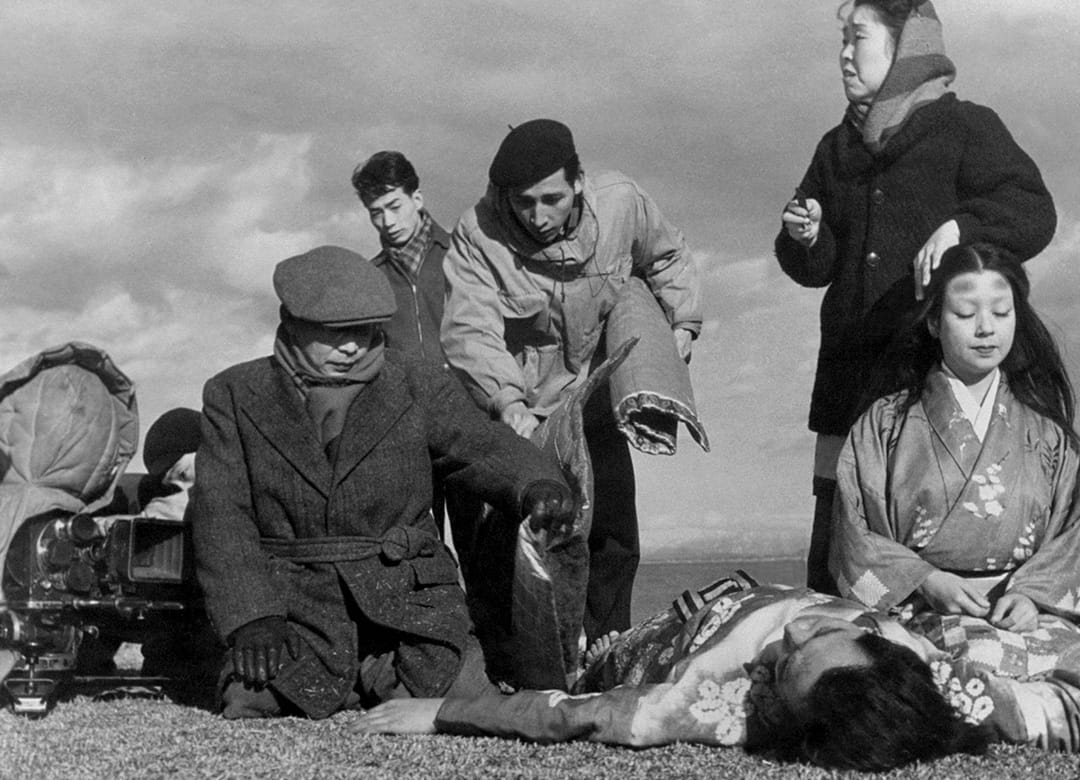
Kenji Mizoguchi's Ugetsu is often introduced as a ghost story, and the label is accurate as far as it goes. BFI calls the 1953 film a bewitching period ghost story that turns civil war into a parable of heedless male greed, while its Mizoguchi guide frames it as a karmic morality tale adapted from Ueda Akinari and set during late-sixteenth-century conflict.[1][2] Yet the movie's power does not come from shocks, revelations, or an easy split between the living and the dead. Its ghostliness is slower. It works like an economy: men pursue money, rank, sex, and artistic recognition; women absorb the cost; objects keep circulating; the camera glides as though consequence has a current of its own.
That is why the behind-the-scenes photograph used here matters. It shows Mizoguchi directing from a camera crane during production, a practical image of a film whose emotional logic depends on movement.[5] Chicago Film Society notes cinematographer Kazuo Miyagawa's claim that roughly 70 percent of the film was shot with a camera crane, and that the film's long, gravity-loosened shots help transform ordinary spaces into something otherworldly.[3] The crane is not a technical footnote. It is the film's moral instrument.
The lake makes commerce feel like a border crossing
The first great transformation in Ugetsu happens before the viewer can comfortably name it as supernatural. Genjuro the potter and Tobei the would-be samurai enter a wartime market economy where pots, armor, ferry passage, women, reputation, and survival all become negotiable.[1][2] The men do not start as villains in the theatrical sense. They begin with needs that can be understood: money, status, escape from the limits of village life. Mizoguchi's severity lies in showing how quickly those understandable needs become permissions.
The lake passage is the film's hinge because it makes that permission visible. Fog removes ordinary coordinates. Water turns travel into suspension. A boat should be a practical vehicle between village and market, but Mizoguchi lets it become a threshold where the living world is already losing its hard edges.[1][3] The characters have not entered a monster's lair. They have entered a system in which greed has made perception unreliable.
That is the first major difference between Ugetsu and a simpler ghost narrative. The supernatural does not interrupt a stable world from outside. The world is already unstable because war has loosened every moral fastening. Civil disorder creates opportunity for men who can sell quickly, boast loudly, or wear stolen symbols of rank. It also creates exposure for women whose labor and bodies are treated as background infrastructure. The ghostly atmosphere grows out of that material imbalance.[1][2][4]
The camera refuses clean ownership of action
Mizoguchi's long takes matter because they refuse to let action become private property. A shorter, more emphatic editing style might isolate a decision, underline a betrayal, and assign guilt in hard cuts. Ugetsu often does the opposite. It lets rooms, thresholds, streets, boats, and fields continue breathing around the characters, so that one person's wish never feels sealed off from the social space that will carry its damage outward.[3][4]
This is where the crane logic becomes moral. The camera can follow, withdraw, drift, or rise without turning movement into spectacle alone.[3][5] It watches Genjuro's seduction into fantasy and Tobei's comic hunger for samurai identity, but it also keeps reminding us that their desires need material support. Someone fires the kiln. Someone protects the house. Someone carries goods. Someone waits. Someone is left exposed when male ambition moves on.
Senses of Cinema's director essay is useful here because it resists flattening Mizoguchi into one easy auteur formula while still recognizing the centrality of women, feudal pressure, and social contradiction in his films.[4] In Ugetsu, those contradictions become spatial. The men imagine mobility as freedom: go to market, go to the city, go to battle, go toward the mansion, go toward rank. The women experience mobility as vulnerability: being displaced, chased, abandoned, forced into labor, or made to hold domestic continuity together while men convert absence into adventure.
The ghost house is a fantasy of costless art
Genjuro's encounter with Lady Wakasa is often remembered as the film's most overtly supernatural thread, but its sharper function is economic and aesthetic. She does not merely tempt him with erotic mystery. She offers a fantasy in which his pottery can be admired without the dirt, smoke, bargaining, domestic dependence, and wartime danger that made it possible. The artist receives refinement detached from the production chain that sustained him.
That fantasy is why the ghost house feels so seductive. It is not just spooky. It is curated. The space seems to remove Genjuro from contingency. Pots become art objects. Desire becomes ritual. A man who was recently calculating profit can imagine himself received as a maker of beauty. The ghostly deception therefore depends on a very human wish: to enjoy recognition without being answerable to the conditions that produced it.[1][2]
Mizoguchi does not mock art by showing this. He makes art more accountable. The pottery matters; Genjuro's craft is real. But the film will not let craft become an alibi. Beauty can travel away from the person who paid for its making. A bowl can enter a noble room while the wife who helped keep the kiln economy alive is placed in danger elsewhere. In this sense, Ugetsu is less suspicious of art than of the dream that art can float free of obligation.
Tobei's armor is another kind of haunting
Tobei's plot can look broader and more comic, but it is not lighter. His obsession with becoming a samurai turns status into costume first and violence second. The joke is that he wants the sign before he has the substance; the wound is that wartime society is disordered enough for signs to circulate strangely. Armor, heads, credit, and story can be detached from the actual labor or courage they are supposed to signify.[1][2]
That makes Tobei's ascent a worldly version of haunting. No ghost has to appear for identity to become unreal. The dead and the defeated have already left behind tokens that the living can misread, steal, or trade. Tobei's borrowed martial image exposes a society where symbolic rank has become dangerously portable. His fantasy is ridiculous, but the conditions that make it briefly plausible are not ridiculous at all.
The parallel with Genjuro is exact. One man wants his pots to be received as refined art without the full chain of responsibility. The other wants martial status without the full chain of discipline and duty. Both men enter worlds where signs detach from sources. That detachment is the film's deepest ghost effect.
Miyagi is where the film refuses consolation
The emotional center of Ugetsu lies in the cost borne by Miyagi. The film's final movement is famous for the way it seems to restore home and expose loss at the same time. This is where Mizoguchi's restraint becomes devastating. He does not need a violent revelation to make the domestic space uncanny. He lets care itself arrive from beyond the boundary that male ambition has already crossed.
If the lake sequence makes commerce feel like a border crossing, the return home makes domestic life feel like a debt that can no longer be fully paid. Genjuro can recognize too late what the viewer has been watching all along: the home he treated as a base of operations was actually a living system of labor, attachment, and risk. Once that system has been damaged, remorse cannot simply rebuild it.
This is why the movie's ending avoids the comfort of moral bookkeeping. Genjuro learns, but learning does not reverse the economy of harm. Tobei is humbled, but humiliation does not cancel what his ambition exposed. The village can continue, but continuation is not restoration. Mizoguchi's camera gives these facts room to settle. It does not rush them into a verdict.
The ghost story is a social form
The durability of Ugetsu comes from this fusion: supernatural feeling, historical violence, craft technique, and domestic ethics all occupy the same frame.[1][2][3][4] The ghost story is not a decorative layer on top of a war tale. It is the form that lets Mizoguchi show how desire survives by displacing its costs. Money moves. Pots move. Armor moves. Men move. Women's suffering is made to hold the world together after movement has done its damage.
That is why the film still feels modern. Its apparitions are memorable, but the true haunting is structural. Ugetsu understands that people can be possessed by markets, fantasies of rank, dreams of artistic purity, and stories they tell about their own deservingness. The crane, the lake, the mansion, the kiln, and the emptied home all belong to one system. Mizoguchi makes a ghost story in which the dead are not the only ones who drift. Consequences drift too, and the whole tragedy lies in who is left to receive them.
Sources
- BFI, "Ugetsu Monogatari (1953)" film page, with credits and capsule description of Mizoguchi's period ghost story.
- BFI, "Kenji Mizoguchi: 10 essential films," including its entry on Ugetsu Monogatari and its Ueda Akinari, civil-war, and karmic-tale context.
- Chicago Film Society, "Ugetsu" program note, June 28, 2023, including the crane-shot claim and 35mm presentation context.
- Senses of Cinema, "Kenji Mizoguchi" Great Directors essay, with critical context on Mizoguchi's style, politics, and treatment of women.
- Wikimedia Commons, "File:Ugetsu-filmshooting.jpg," 1953 production photograph of Mizoguchi directing Ugetsu from a camera crane.