Spoiler note: this essay discusses the projection-screen sequence, the dream detective plot, and several major gags in Sherlock Jr.
Buster Keaton's Sherlock Jr. lasts only about three-quarters of an hour, but it behaves like a whole theory of cinema under physical stress.[1][2] The premise is simple enough: a theater projectionist, falsely accused of stealing a pocket watch, falls asleep in the booth and imagines himself stepping into the movie on the screen.[2][3][4] That synopsis can make the film sound like an early meta-cinema joke, a charming fantasy about wanting to live inside pictures. The craft is sharper than that. Keaton turns the wish to enter the movies into a chain of technical problems: where the body stands, how a cut changes space, how a trick can be staged in camera, how a stunt can prove that an illusion still has weight.
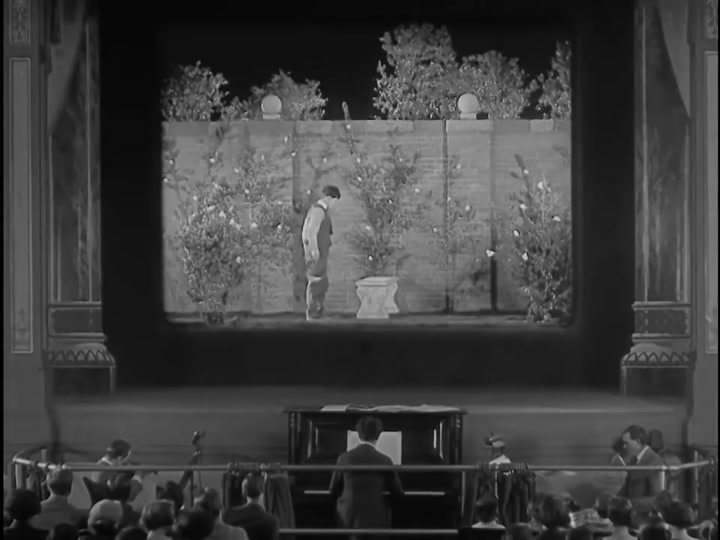
The lead image belongs here because it shows the film's joke before the film has finished explaining it.[5] Keaton is small against the theater, the audience, and the screen. The garden image in front of him is not just scenery. It is a moving contract. The screen can become a parlor, a cliff, a street, a garden, or a pile of rocks, and Keaton's body has to keep negotiating the new rules without losing its balance. In Sherlock Jr., projection is not escape from mechanics. Projection is the place where mechanics become visible.
The booth turns fantasy into labor
The movie begins with work rather than wonder. Keaton's projectionist cleans, sweeps, runs the booth, studies a detective manual, and dreams of a larger competence than his job grants him.[2][3][4] That matters because the fantasy never floats free of apparatus. The dream starts inside a workplace built from reels, light, timing, stairs, doors, and a paying audience. The theater is not merely a frame around the real movie. It is the machine that makes the later dream legible.
Criterion's page calls the film one of Keaton's most formally innovative features and describes the projectionist walking through the screen into the movie he is showing.[2] The important word is "projectionist." Keaton does not choose a poet, painter, critic, or idle spectator as the dreamer. He chooses the worker who keeps the image moving but normally stays hidden from it. The gag therefore begins with a social and technical reversal: the invisible operator becomes visible inside the system he usually serves.
That reversal gives the film its unusually modern feel. Many later films about cinema treat the screen as a metaphor for desire, memory, or illusion. Sherlock Jr. starts lower and more materially. The screen is a surface, a threshold, a timing device, and a problem of alignment. A body can want to cross it, but desire alone does not solve the cut.
The screen crossing makes editing behave like weather
The famous screen-entry sequence is funny because it takes continuity, cinema's usual promise of smooth spatial flow, and turns it against the body. Keaton enters the projected film and tries to stand still while the shot behind him keeps changing. A garden becomes a street, then surf, then snow, then a desert, and each cut produces a new physical hazard. BFI singles out this moment as a technical marvel in which the projectionist dreams himself into the screen and is then flummoxed by the film's editing.[1]
The joke depends on an exact mismatch. The cinema cut is instant; Keaton's body is continuous. Editing can move from one location to another without paying the travel cost. A human figure cannot. The sequence makes that difference visible with comic cruelty. Each cut is a tiny weather event. It changes ground, temperature, danger, and expectation before the body can prepare.
This is why the sequence still feels so fresh a century later. It is not just "a man enters a movie." It is a practical demonstration of what montage does to bodies when the smoothing conventions are stripped away. Cinema can pretend that space is coherent because the viewer cooperates with the cut. Keaton refuses that cooperation for a few minutes and lets the body become the witness against seamlessness.
The body is Keaton's second camera
The Library of Congress essay by Jeffrey Vance is especially useful because it treats the film's magic as both cinematic and theatrical. Vance notes that Sherlock Jr. translates Keaton's vaudeville illusions into cinema, names Elgin Lessley and Byron Houck as cinematographers, and describes how the effects were executed so precisely that technicians of the era watched the film repeatedly to puzzle out the methods.[3] That precision matters because Keaton's tricks often sit between two contracts: the camera can conceal, but the body must still commit.
Some gags are openly cinematic, depending on framing, substitution, matching, and screen space. Others insist on the older credibility of performance. Vance points to the peddler-woman gag as a reworking of a stage trick rather than a simple camera deception.[3] BFI also notes the film's dangerous stunt work, including the water-tower gag that injured Keaton's neck, a damage he did not discover until years later.[1] The film's comic intelligence comes from holding these modes together. A trick can be an optical construction and still require a body that can absorb the consequences.
That is the deep craft lesson of Sherlock Jr.. Keaton does not separate special effects from stunt performance. He treats both as ways of testing whether cinema can keep faith with physical reality while bending it. When he drops, dives, rides, balances, or vanishes, the laugh comes from the interval between impossible design and visible exertion. The body becomes a measuring instrument. It tells the viewer how far the image has stretched the world.
Detection is another editing problem
The detective plot looks light beside the formal invention, but it is not filler. AFI's catalog summary identifies the young man's dream movement from projection booth to screen and toward becoming "the world's greatest detective--Sherlock Jr.," while also noting the film's landmarks in special effects, stunts, and the play between illusion and reality.[4] Detection gives the dream a grammar. To be a detective is to connect fragments, follow traces, separate false appearance from usable evidence, and make a sequence out of scattered signs. That is also what editing does.
The watch theft plot depends on misdirection. The projectionist is framed because a small object changes hands and the wrong narrative attaches itself to him.[3][4] In the dream, he answers that humiliation by becoming a figure who can read the world faster than it can deceive him. The joke is that the world keeps changing faster still. The detective wants stable clues; cinema gives him shifting frames. The result is not a defeat of cinema by reason. It is reason forced to become cinematic.
That is why the romance resolution in the booth has a delicate craft function. The real-world girl uncovers the truth while the boy sleeps, and the projectionist then looks to the movie screen for instructions on how to behave romantically.[3] The gag is gentle, but it completes the circuit. He has entered the movie, been battered by its cuts, borrowed its detective authority, and then returned to ordinary life still needing the screen as a manual. Cinema has not replaced life. It has become one of the awkward tools with which life is rehearsed.
Why the film still feels new
The durable modernity of Sherlock Jr. comes from its refusal to treat meta-cinema as a purely intellectual trick.[1][2][3][4] The film knows that moving pictures are dreams, but it keeps asking what dreams are made of: booths, projectors, screen surfaces, editing joins, stage mechanics, camera alignment, stunt risk, audience attention, and a worker's exhausted body. Its self-reflexivity has grease and bruises on it.
This is why the film can feel more contemporary than many later, more talkative movies about movies. It does not need a lecture on illusion. It stages illusion as a workload. A cut arrives and the ground changes. A screen opens and the body has to cross. A trick succeeds because technicians, performers, and camera positions meet at the right instant. A detective fantasy solves a moral injury by borrowing the grammar of shots and clues.
Keaton's face remains famously still, but the film around it is restlessly analytical. Every gag asks what cinema can do to continuity, space, labor, and risk. The answer keeps arriving through motion rather than explanation. Sherlock Jr. is funny because its inventions are exact. It is great because those inventions never stop thinking. Projection becomes a stunt machine, and the machine teaches the viewer how fragile, physical, and wondrous the dream of cinema has always been.
Sources
- BFI, "Sherlock Jr. (1924)" film page, with credits, running time, and notes on Keaton's screen-entry sequence, camera trickery, and stunt risk.
- The Criterion Channel, "Sherlock Jr." film page, including its description of reality and movie fantasy merging through optical tricks and meta-cinematic invention.
- Library of Congress, Jeffrey Vance, "Sherlock Jr. (1924)" National Film Registry essay, covering the film's dream premise, technical innovation, vaudeville mechanics, and production collaborators.
- AFI Catalog, "Sherlock Jr. (1924)" entry, with production credits, cast, plot summary, source citations, locations, and historical note on illusion, stunts, and special effects.
- Internet Archive, "Sherlock Jr. - Buster Keaton (1924) HD (720p)" public-domain access copy, used as the source for the article's still frame.