Dziga Vertov's Man with a Movie Camera is often placed inside the city-symphony tradition, beside films that turn the modern metropolis into rhythm, surface, transit, labor, and crowd movement. That label is useful only if it stays under pressure. Vertov does not merely make a day-in-the-life portrait of Soviet urban modernity. He makes a film about how such a portrait gets built: by a camera climbing, hiding, racing, splitting, slowing, reversing, and then being cut into a form that teaches viewers to notice construction as part of reality.[1][2][3]
The result is one of cinema's strangest genre objects. It has no fictional plot, no actors, no intertitles in the usual explanatory sense, and no single stable city. BFI describes the film as a dawn-to-dusk city portrait driven by unexpected angles and collision editing; ACMI frames it as a work linked to city symphonies while also reflecting on the camera's power over reality.[1][2] That difference matters. A conventional city symphony can make urban life feel musical. Man with a Movie Camera asks who is conducting, where the instrument is placed, and what happens when the instrument keeps appearing inside its own music.
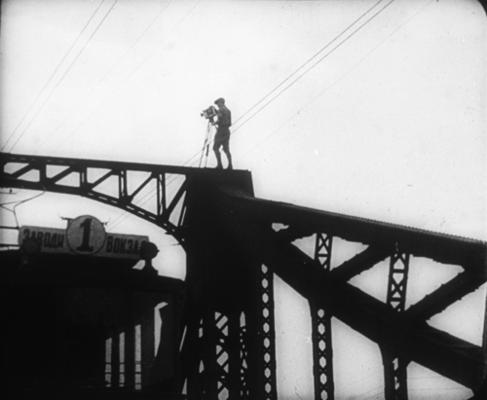
Image context: the cover uses a 1929 archival still from Man with a Movie Camera. It fits this essay because the film's most durable image is not a single building, star, or skyline, but a fused apparatus: eye, camera, operator, film strip, editor, projector, and audience. The still is a fragment of that argument rather than a decorative illustration.[5]
The genre begins with a day, then Vertov breaks the clock
The city-symphony form liked the day as a structuring device. Morning, work, traffic, leisure, evening, spectacle: the sequence gave modern life a readable pulse. Vertov uses that skeleton, yet he refuses to let it settle into urban postcard logic. The film moves through waking bodies, trains, trams, factories, offices, sports grounds, beaches, cinemas, and streets, but the itinerary is less important than the act of making movement comparable.[1][2][4]
A loom, an eyelid, a tram, a lens, a typewriter, a crowd, and a film editor's hand can all enter the same rhythmic system. The point is not that machines and people are identical. The point is that cinema can discover temporary relations among them. A city becomes readable as patterned energy, and the camera becomes the tool that can cross scales faster than ordinary looking can. It jumps from a private face to a public street, from industrial repetition to leisure, from bodily motion to mechanical motion, then asks the edit to make the jump meaningful.
This is where Vertov's film changes the genre. It does not treat urban modernity as scenery. It treats it as a production system. Workplaces, transportation, sports, courtship, childbirth, moviegoing, and factory rhythm all become parts of a social machine, but the film also includes its own machine in that social field. The cameraman is watched while watching. The editor is shown making images. The audience is shown watching a film. The city symphony therefore stops being only a portrait and becomes a loop.
The camera is a worker, a character, and a problem
BFI's page names Mikhail Kaufman as the featured cameraman and notes the importance of Vertov's collaborators, including editor Elizaveta Svilova.[1] That matters because the film's authorship is visibly distributed. The camera is not an invisible window. It is a body in the street, an operator at risk, a machine that can perch above traffic or press into crowds. The film keeps turning the means of production into screen action.
That choice gives the movie an unusual kind of suspense. There is no detective question, no romance plot, no battlefield objective. Instead, suspense comes from whether cinema can keep up with the city and whether the viewer can keep up with cinema. The camera mounts cars, peers from tracks, looks up from low angles, watches labor at speed, and then appears as a little animated machine that seems to walk on its tripod. These effects are playful, but they are not ornamental. They make the camera a participant in modern life rather than a neutral recorder of it.
ACMI's collection note is especially useful here because it identifies the double movement: Vertov favors unstaged reality, yet he constantly reminds viewers of the camera, editing, and screening process.[2] The film does not pretend that nonfiction equals untouched truth. It proposes a harder idea: reality becomes newly visible through apparatus, selection, montage, and self-exposure. The camera's honesty comes partly from refusing to disappear.
Montage turns observation into argument
BFI's account of unexpected angles and clashing juxtapositions, together with Flicker Alley's restoration notes on montage, visual effects, and self-exposure, points toward the film's real genre position.[1][3] Man with a Movie Camera is a city symphony, an avant-garde documentary, a production diary, a spectator-training exercise, and a manifesto for montage.
The cuts do not simply decorate urban life. They create propositions. When movement in one space answers movement in another, the film asks viewers to compare. When a camera lens and a human eye are joined, the film asks whether modern vision has become partly mechanical. When an editor's hand interrupts the city, the film asks whether the city we are seeing is discovered, manufactured, or both. The answer is not a neat choice. Vertov's method depends on both claims being active at once.
That is why the film still feels fast even when its individual images are nearly a century old. The speed is not only a matter of cutting rate. It is intellectual speed. The film keeps changing the level on which an image works: a street scene becomes evidence of urban life, then evidence of camerawork, then evidence of editing, then evidence of spectatorship. A viewer is constantly moved from object to process.
The city is real, but it is also a composite
One trap in watching the film is to hunt for a single city as though the work were a travel document. BFI and other institutional descriptions emphasize the film's composite Soviet urban setting rather than a single named location.[1] Guardian critic Jonathan Romney points toward Odessa while also describing the film as an evocation of life across several cities.[4] The composite quality is not a weakness in the city-symphony frame. It is Vertov's way of turning the city into a cinematic category.
In that sense, Man with a Movie Camera is less about Moscow, Kyiv, Odessa, or Kharkiv as separate civic identities than about the modern city as a field of relations. It shows transport, labor, leisure, public display, private grooming, sports, marriage, divorce, birth, death, and spectatorship as pieces of a shared system. The city is not a backdrop. It is a set of rhythms through which bodies and machines learn each other.
This also keeps the film from becoming simple propaganda for motion and industry. The work can be exuberant, and it clearly believes in cinema's ability to remake perception. Yet it is more curious than smooth. It includes awkwardness, interruption, risk, fatigue, waiting, and the comedy of apparatus. The modern city is not presented as a finished triumph. It is a place being assembled in front of us, just as the film is being assembled in front of us.
Restoration makes the apparatus visible again
The history of the film's restoration reinforces its own argument. Flicker Alley's press kit says the 2014 restoration drew on a 35mm print at EYE Film Institute and presented the film in a fuller form than widely circulated versions, while BFI also foregrounds the problem of version, speed, rhythm, and restoration context.[1][3] This is more than release-note trivia. A film about apparatus depends on apparatus for its survival.
Every version of Man with a Movie Camera carries choices about speed, frame, score, print source, and digital repair. That does not make the film unstable in a dismissive sense. It makes the viewing situation part of the work's afterlife. Vertov made a film that tells viewers to inspect mediation, and later preservation history gives viewers another layer of mediation to inspect.
This is why the movie remains alive inside film culture rather than merely admired as a historical milestone. It keeps renewing the basic question of the moving image: what changes when the world is not only seen but organized for seeing? For a modern viewer surrounded by cameras, feeds, edits, loops, and replayable daily life, Vertov's answer is still uncomfortable. The camera expands perception, but it also builds perception. The city appears, and so does the machine that taught us how to see it.
Sources
- BFI, "Man with a Movie Camera (1929)" film page, including credits, running time, city-symphony context, and 2022 poll placement.
- Australian Centre for the Moving Image, "The Man with a movie camera: fragments from a cameraman's diary" collection record, including genre, holdings, and interpretive notes.
- Flicker Alley, The Man with the Movie Camera theatrical press kit, including restoration notes, credits, and contextual essay.
- Jonathan Romney, "Man With a Movie Camera review - pure cinema, still unparalleled," The Guardian, August 2, 2015.
- Wikimedia Commons, "Man with a movie camera 1929 1.png," archival still file page and image metadata.