The most honest thing in a rubble film is the rubble. A wall really has been opened to the sky; a stair really does stop above empty air. Yet destruction cannot explain itself. A camera pointed at a broken city still has to decide where to stand, whom to follow, and whether the damage signifies defeat, punishment, victimhood, liberation, or a foundation cleared for something new.
That uncertainty is the force of Trümmerfilm, the loose cycle of German “rubble films” made during the Allied occupation after 1945. The term sounds like a movement with a manifesto and a shared look. It was neither. Its boundaries remain debatable, and the films borrow from romance, family melodrama, crime, satire, and children’s adventure rather than forming a classical genre.[2][3] What joins them is not style but pressure: filmmakers had to put stories into a landscape that already looked like history’s verdict.
The ruins supplied production space, present-tense texture, and instant metaphor. They also supplied an alibi. The same shattered street could make Germans look responsible for a catastrophe, trapped inside it, or nobly busy overcoming it. Trümmerfilm matters because its images are true at the level of place and fiercely contestable at the level of meaning.
Spoiler note: this essay discusses the endings of several films from the 1946–49 cycle.
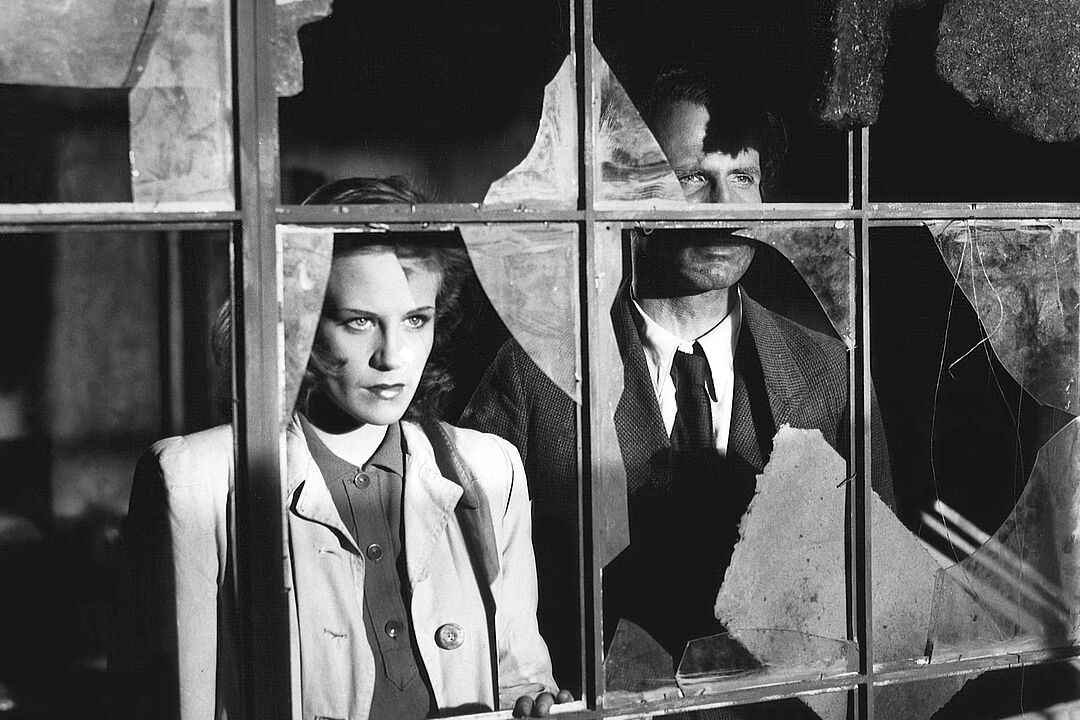
Image context: the lead image is an official archival still from Wolfgang Staudte’s The Murderers Are Among Us, not a later reconstruction. Susanne and Mertens do not stand before a picturesque panorama; a broken window divides their faces from the view. The photograph makes the cycle’s central problem tactile: damage is at once evidence, obstruction, and frame.[1]
A location became an argument
“Year zero” implied a clean break after the Nazi state’s collapse, but cinema could not begin from zero. Surviving workers, actors, equipment, genre habits, and studio practices crossed 1945. Allied authorities controlled new production licenses, while damaged facilities and scarce resources shaped what could be made. The postwar industry was being reorganized, not invented from nothing; even attempts to dismantle the old Ufa system left continuities behind.[3]
The visual break nevertheless felt immediate. Most of The Murderers Are Among Us was filmed in damaged Berlin, including Bernauer Strasse, the area around Stettiner Bahnhof, and Andreasplatz; only a small portion was made in a studio.[1] Location shooting placed fiction beside surfaces no designer had weathered. Dust, exposed rooms, and amputated façades could interrupt a polished composition with a fact the story had not manufactured.
But a photographed fact is not a transparent historical document. Film scholar Bernhard Gross distinguishes a ruin—the unusable remainder of a “no longer”—from rubble, material suspended in a “not yet” because it might be cleared and reused. Early postwar films can shift a building between those meanings within a single sequence. A wall may first dwarf a returning soldier as proof of paralysis, then become bricks for a collective future.[2]
That flexibility explains why the label is useful only if it stays loose. Trümmerfilm is less a shelf of matching objects than a dispute conducted on common ground.
The Murderers Are Among Us frames guilt, then narrows it
Staudte’s 1946 film begins with two people carrying radically unequal histories into the same Berlin apartment. Susanne Wallner returns from a concentration camp determined to live. Dr. Hans Mertens, a former army surgeon, drinks to suppress his memory of civilians murdered on the orders of his captain, Ferdinand Brückner. Brückner, meanwhile, has converted wartime authority into postwar prosperity. The wrecked city makes their coexistence visible before the plot sorts them into survivor, witness, and perpetrator.[1]
Staudte began writing the project in 1945. Filming started on May 4, 1946, before DEFA’s official founding on May 17, and ended in August. He had failed to secure support in the three western zones; Soviet cultural officers financed the film and largely left it alone, but required a change to the ending. In Staudte’s original version Mertens kills Brückner. In the finished film Susanne stops him, and the demand becomes public justice rather than private revenge.[1]
The change gives the rubble a civic function. If a court can judge Brückner, destruction need not be the final tribunal. Law can replace the pistol, and a society can distinguish culpability rather than surrender to indiscriminate vengeance. A contemporary review published during the premiere week understood the task as more than clearing streets: the film was also trying to remove “psychic rubble.” That reviewer admired its seriousness while faulting its shortage of ordinary signs of rebuilding and Berlin life.[4]
The film’s courage is real. It puts a flourishing war criminal inside the new economy and refuses to let military defeat count as moral settlement. Its limits are just as structural. Susanne’s imprisonment and camp experience remain unexplained. She returns composed and quickly takes on the domestic and emotional work of restoring Mertens, while the murdered millions appear largely as an abstract moral constituency. DEFA-Stiftung’s own current account notes that Jewish and Soviet victims are not distinctly represented in the film’s postwar society.[1]
The result is a reckoning narrowed to exemplary individuals. Brückner carries criminal guilt; Mertens carries traumatic knowledge; Susanne supplies renewal. That arrangement makes justice imaginable, but it can also isolate guilt in one monstrous captain and turn a survivor’s history into therapy for a compromised man. The film’s accusation and its evasion occupy the same frame.
Children turn debris into a future tense
Gerhard Lamprecht’s Somewhere in Berlin, released later in 1946, asks the ruins to do different work. For its children, the broken city is an adventure ground where war games continue after the war. Gustav waits for his father to return from captivity and restart the family garage. The man who comes home is physically and psychologically depleted. Only after a boy dies in the dangerous rubble do the children abandon martial play and help the father begin again.[5]
Here debris is less a crime scene than an inheritance whose use must be relearned. The adults cannot simply command the future because they arrive damaged or discredited. Children first repeat the recent past as play, then redirect their collective energy toward construction. A ruined garage becomes useful space again.
Ute Wölfel identifies this as part of an emerging occupation-zone pattern, not a rigid formula. In Soviet-zone films, children often embody innocent, public, collective productivity while the parent generation is implicitly marked by guilt. Western-zone films more often cast damaged youth as a danger whose reintegration restores parental and nuclear-family authority.[6] Somewhere in Berlin makes the eastern pattern unusually concrete: the children’s changed behavior gives the returned father a route back into social life.
The movement from war game to work is hopeful, but it changes the question. The Murderers Are Among Us asks who must answer for a massacre. Somewhere in Berlin asks who will clear the site. Both questions matter; they are not interchangeable. Reconstruction becomes an evasion when productive labor is allowed to settle an account that only history and justice can name.
Western rubble could salvage an “other Germany”
Helmut Käutner’s In Those Days (1947), the first rubble film produced in the western occupation zones, begins with two workers dismantling an old car. Seven objects found in or on the vehicle call up seven stories it “witnessed” from the Nazi seizure of power in 1933 through the war. A date scratched into the windshield, a comb, and a hatpin turn a machine into an archive. The film was shot from June 1946 to March 1947 around Hamburg and Hitzacker and in a makeshift Hamburg studio—material scarcity surrounding a story about material salvage.[1][7]
The car’s limited viewpoint is the design’s strength and its political boundary. It cannot narrate a total history. It remembers owners who retain or recover humane conduct under dictatorship, including a couple in a so-called mixed marriage who refuse the safety of divorce. The episodes preserve ethical choices worth preserving. At the same time, their melodramatic pattern can relocate attention from a criminal society to the survival of an ethically intact “other Germany,” making decency the usable part pulled from the wreck.[3][7]
Rudolf Jugert’s Film Without a Title (1948) turns that uncertainty into comedy about moviemaking. An author, a director, and an actor debate what story can follow “year zero.” They know what they do not want: no rubble film, no political film, no returning-soldier film. They then build a class-crossing romance across the end of the war—precisely the kind of work later histories place inside the rubble-film cycle.[8]
The joke exposes the category’s retrospective instability. Filmmakers did not necessarily wake up intending to contribute to Trümmerfilm. They wanted to recover popular storytelling without pretending that the visible present was normal. Romance, satire, crime, and family melodrama were not contaminants in a realist movement; they were the available languages through which the ruins could be made bearable, accusatory, or evasive.
Rossellini denies the clean zero
Roberto Rossellini’s Germany Year Zero (1948) is best treated as a transnational counter-image rather than automatically folded into a strict corpus of German-company films. An Italian neorealist production shot in Berlin in 1947, it follows twelve-year-old Edmund through black markets, crowded rooms, and the lingering influence of a Nazi former teacher. Original locations and nonprofessional performers initially promise documentary access, yet the film steadily reveals its parable-like construction.[9]
That tension is crucial. The streets verify that Berlin was destroyed; they do not make Edmund’s story an objective report. During his final wandering, the city empties and becomes increasingly unreal. Ruined architecture no longer waits to be cleared by a productive collective. It encloses a child who has absorbed the defeated regime’s contempt for lives deemed burdensome. Military collapse has occurred, but moral time has not reset.[9]
Rossellini therefore makes “zero” feel like a dangerous fiction. A date can announce a new beginning while old ideas remain active in speech, family pressure, and a child’s judgment. Against the reparative turns of several German rubble films, Germany Year Zero withholds the comforting conversion of debris into building material. Its ruins remain a trap because the ideology that helped produce them has not become safely past.
Damage cannot assign responsibility
The rubble image contains an ethical asymmetry it cannot solve. German civilians experienced bombing, hunger, displacement, and bereavement; Germany had also initiated a war of annihilation and genocide. A broken apartment can testify to the first reality without explaining the second. When the camera descends to eye level and attaches the devastated street to a familiar protagonist, it humanizes German suffering. Gross argues that this humanized rubble sat uneasily beside contemporary atrocity images that often reduced concentration-camp victims to anonymous, dehumanized bodies.[2]
That does not make every low-angle wall or returning soldier an apology. It means point of view carries historical weight. The Murderers Are Among Us uses damage to demand that a perpetrator be named, then leaves many victims indistinct. Somewhere in Berlin converts debris into shared work, risking the substitution of effort for accountability. In Those Days salvages examples of decency, risking a nation imagined chiefly through exceptions. Germany Year Zero refuses the salvage operation and shows a defeated doctrine surviving inside a child.
Seen together, these films do not provide one postwar German attitude. They reveal a culture testing stories against material that resisted closure. Real ruins could authenticate a setting, but they could not authenticate an interpretation. The wall did not tell the camera whether it was looking at consequence or innocence. Genre, character, framing, and ending did that work.
Return to the shattered window in the lead image. Its jagged panes deny Susanne and Mertens a clean view, but the composition is not neutral: it chooses these two faces, this intimacy, this damage. That is Trümmerfilm at its most revealing. The broken city enters the image as evidence; the film around it turns the evidence into an argument.
Sources
- DEFA-Stiftung, “Die Mörder sind unter uns” — official film history, production chronology, Berlin locations, ending change, contemporary and present-day reception, and source of the Eugen Klagemann lead still.
- Bernhard Gross, “The Relationship between Film and History in Early German Postwar Cinema.” Research in Film and History 1 (2018) — open-access study of rubble as an aesthetic matrix, the ruin/rubble distinction, and the perpetrator-victim problem of postwar images.
- Robert R. Shandley, Rubble Films: German Cinema in the Shadow of the Third Reich. Temple University Press, 2001 — publisher page for the study’s account of Allied occupation, east and west studios, cultural reconstruction, and cinema’s borrowings from the Nazi past.
- German History in Documents and Images, “Trümmerfilm: Murderers Among Us (October 17, 1946)” — English translation of Werner Fiedler’s contemporary Neue Zeit review and its account of the film’s moral and aesthetic task.
- filmportal.de, “Irgendwo in Berlin” — German film archive record, synopsis, production context, release data, and critical note on Lamprecht’s reconstruction narrative.
- Ute Wölfel, “Not Just Death and Ruins: The Young and New Beginnings in German ‘Rubble Films.’” German Life and Letters 69, no. 4 (2016) — peer-reviewed comparison of children and intergenerational authority across occupation-zone films.
- filmportal.de, “In jenen Tagen” — German film archive record with the seven-part car narrative, crew, production dates, makeshift-studio note, and release history.
- Deutsches Historisches Museum, “Film ohne Titel” — program essay on the film’s self-reflexive rejection of rubble, political, and returning-soldier categories while constructing a postwar story.
- Bundeszentrale für politische Bildung, “Deutschland im Jahre Null” — institutional close reading of Rossellini’s Berlin locations, nonprofessional casting, documentary-fiction tension, and false “year zero.”