The famous shots in I Am Cuba look as if the camera has stopped belonging to gravity. It leaves the roof of a Havana hotel, descends to a lower terrace, threads through a poolside crowd, and follows a swimmer beneath the water. Later, it rises beside a funeral procession, enters a cigar workshop, passes through a window, and sails over the street. The surprise is not simply that Mikhail Kalatozov's 1964 film refuses to cut. It is that one uninterrupted viewpoint survives repeated changes of custody.[1][4]
What appears to be one impossible camera move is a relay. An operator hands the camera to another operator; a body gives way to a wooden elevator; handheld motion becomes cable-borne flight; dry equipment enters a waterproof covering. The image remains continuous while the machine carrying it, the person holding it, and the social scale in front of it all change.
That distinction is the key to the film's craft. A long take is often admired as a feat of individual endurance or directorial control. I Am Cuba makes continuity collective. Its gaze can feel strangely alive because many people and improvised devices keep taking responsibility for it without asking the viewer to start over at a cut.
The Cuban-Soviet production began filming on February 26, 1963, in the unsettled aftermath of the Cuban Missile Crisis. Kalatozov and cinematographer Sergei Urusevsky shaped four stories set before the Cuban Revolution with camera operators including Alexander Calzatti and B. Brozhovsky. The finished black-and-white film runs 141 minutes in its current Criterion edition, and its visual language joins extreme wide angles, handheld movement, infrared stock, cranes, and unusually elaborate sequence shots.[2][3][5]
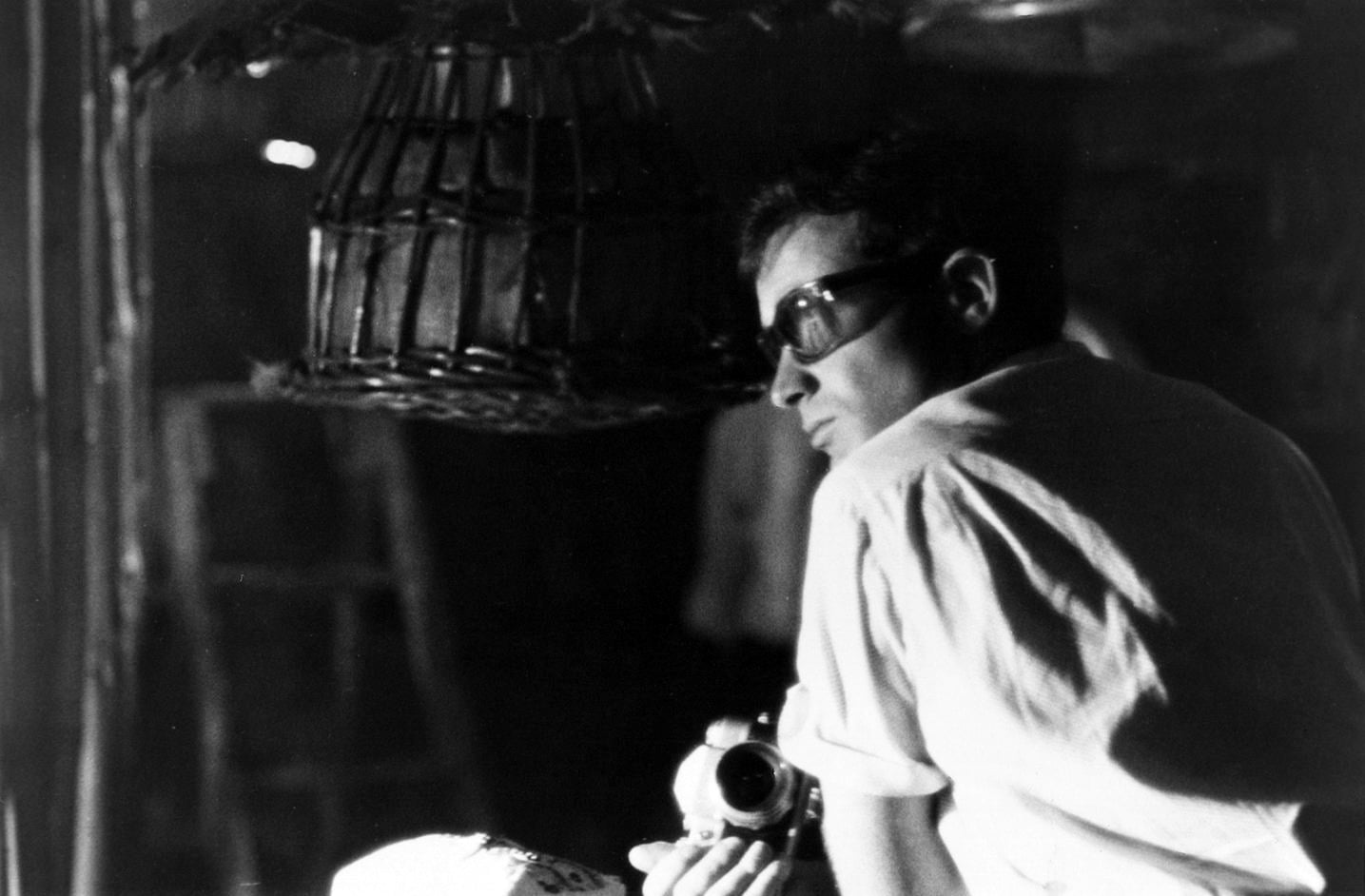
Image context: the lead image is a real production photograph of Calzatti on set, not a frame enlargement or later reconstruction. He is crouched around the small camera that had to move with performers, survive handoffs, and attach to handmade rigs. The picture returns the film's floating eye to the body and equipment that carried it.[1]
One camera became a team instrument
Calzatti recalled that the production relied on a compact Éclair CM3 Camiflex with a 400-foot magazine because so much of the work was handheld. He said a 9.8 mm Kinoptic lens was used for roughly 90 percent of the film, with an 18 mm lens serving as the much less common alternative. Dialogue was post-synchronized rather than recorded with the images, separating the moving camera from the immediate demands of synchronous production sound.[1]
The technical economy was radical: one principal camera, one dominant lens, and a great deal of human coordination. A very wide lens can stay close to a face while retaining the room, crowd, or landscape around it. That lets a single shot move between intimacy and overview without changing optics. It also bends straight lines near the edge and exaggerates the distance between foreground and background. The Irish Film Institute identifies that combination of wide-angle distortion, close-ups, infrared photography, and complicated tracking shots as the film's defining visual language.[5]
But the camera's freedom was never the freedom of a lone operator. Tropical heat made the work punishing, and Urusevsky's plans required a team. Calzatti described the method through basketball: one person would begin a scene and pass the camera to another. He also recalled that the crew built dozens of custom systems to convert Urusevsky's visual ideas into physical routes.[1]
That comparison is more than a colorful production anecdote. A successful pass in a game preserves motion while changing possession. I Am Cuba does the same with point of view. The receiving operator must inherit speed, direction, framing, and dramatic attention at exactly the right moment. If the pass works, the viewer registers one continuous intention rather than a chain of separate jobs.
The method also moves editing into the set. Calzatti estimated that the finished film contained only about one hundred splices because so many scenes were organized as long takes, and he said that changing between subjective and objective viewpoints was a central goal.[1] The cut has not vanished; its selecting work has migrated into choreography. Approaching a face, circling a body, climbing above a crowd, or letting a foreground object erase part of the frame can redirect attention as decisively as an edit.
The pool shot hides a change of custody
The hotel sequence begins on an upper roof among musicians, models, and tourists. The camera crosses that social performance, reaches the edge, descends to the lower pool terrace, travels through the crowd, and enters the water after a swimmer. BFI's account emphasizes the astonishing change in level and environment, but the shot's real engineering is concealed inside the flow.[4]
According to Calzatti, the crew built a primitive wooden elevator and lowered it by hand. The first operator passed the camera to a person waiting in the elevator; after the descent, a third operator received it and carried it across the lower level and into the pool. Calzatti's account says the camera entered the water inside an improvised plastic covering.[1]
Each transfer could have exposed the construction. A hand might enter the wrong place, the horizon might jump, the receiver might inherit the wrong pace, or the waterproofing might turn the camera into an awkward dead weight. Instead, the route uses people and architecture as cover. The viewer's attention keeps arriving at a fresh event just as the camera changes hands.
That continuity does not make the camera neutral. The 9.8 mm lens brings it close enough to brush past bodies while keeping luxury, architecture, and crowd behavior visible together. Its path is both seduced by the party and suspicious of it. The image samples the roof's spectacle, then crosses a literal class display arranged for tourists, but its buoyant curiosity can make the condemned world look exhilarating. The shot's political ambiguity begins in this mismatch: the narration and story accuse, while the camera visibly enjoys its own powers of access.
Urusevsky connected this sequence to the preceding river journey through water. The film cuts between the poor settlement and the hotel, but the visual motif continues: first the camera rides behind a boatman, then it descends into a recreational pool.[1] A conventional edit separates the locations; fluid camera movement makes their inequality feel like two uses of the same element. The long take is therefore not the whole design. Its force depends on how it inherits an idea from the cut before it.
Infrared turns sugar into surface
The film's mobility attracts the most attention, yet its black and white are engineered just as aggressively. Urusevsky and Calzatti used infrared-sensitive stock for selected passages, including the opening landscape and the farmer Pedro's sugarcane field. Foliage that would sit in ordinary gray values reflects strongly in infrared and records pale, while skies can darken. In I Am Cuba, palms become white feathers against heavy air and sugarcane flashes around Pedro like a field of blades.[1]
Calzatti remembered the infrared stock as extremely slow and high-contrast, around 30 ASA, with neither a dedicated meter nor infrared focus marks to make exposure predictable. He said scenes were repeated many times and the usable results selected afterward. For the normal negative, the production used Orwo Superpan rated at ASA 64, combined with filters and homemade black-and-white nets.[1]
Those details complicate any myth that the movie's ecstasy was spontaneous. The handheld image looks responsive, but responsiveness was rehearsed. The stock looks elemental, but its extremes required testing, repetition, filtering, and selection. Even the apparent wildness of the cane field is a designed collision between botany, emulsion, lens, labor, and political metaphor.
The infrared image does something prose alone could not. Sugar is the farmer's crop, the commodity taken from him, and the economic substance of the episode. By making the cane almost white, the cinematography writes that meaning onto the plant's surface. The field does not merely contain sugar; visually, it has already become sugar. When Pedro swings his machete, the pale leaves crowd the wide lens and turn an economic system into physical pressure.
The funeral shot changes social scale
The film's other legendary relay follows the funeral of the murdered student Enrique. It begins close to the procession, rises along a building, crosses balconies, enters a room where workers roll cigars, and exits through a window above the mourners. BFI describes the final movement as flight, and that is how it feels: the camera has slipped free of the building that gave it height.[3][4]
The mechanism was concrete. Calzatti said he had designed a cable device in Moscow. At the end of the handheld portion, the camera was placed on a small eight-wheeled cart suspended from two cables; a magnet joined camera and cart. The rig then traveled about one hundred feet out from the window over the street.[1]
The handoff converts engineering into an argument about scale. At street level, the funeral belongs to faces, shoulders, flowers, and the effort of carrying a coffin. The climb discovers workers and spectators occupying the architecture around it. When the camera leaves the workshop window, one student's death has become a city event. No explanatory montage is needed because the viewpoint physically grows from participant distance to collective overview.
Yet the shot does not abandon the individual for an impersonal map. Its passage through the cigar room matters. Laboring bodies briefly take custody of the image before the cable does. The procession is seen through a workplace, and the camera's route binds mourning, labor, building, and street into the same duration. The crew's relay and the scene's imagined solidarity share a form: many hands sustain one movement.
The tremor is part of the meaning
Modern viewers accustomed to stabilized tracking may notice the slight rolls, surges, and tremors in I Am Cuba. Treating them as defects misses Urusevsky's stated intent. In a 1965 reflection excerpted by American Cinematographer, he argued that an uneven handheld movement could carry inner agitation and make the viewer experience an event with the actor rather than observe it passively. A tripod, for this film, made the image feel inert.[1]
The roughness is therefore information. A perfectly frictionless move might make the camera seem sovereign, as though it owned every room before entering. I Am Cuba lets us feel discovery: a body leans, regains balance, squeezes between people, and finds the next angle. Even when a crane or cable takes over, the movement retains the memory of having been carried.
This is why “one take” is an incomplete description. The achievement is not numerical purity. It is controlled heterogeneity: handheld and suspended, intimate and panoramic, stable enough to remain legible and unstable enough to feel risk. The film does not preserve time from interference. It fills time with changes of support and point of view, then makes those changes read as one accumulating gesture.
Virtuosity cannot certify the politics
The relay offers a powerful image of collectivity, but it does not prove that the film speaks for a whole country. I Am Cuba was a large Soviet-Cuban coproduction built around four exemplary stories and a personified national voice. Its camera can move among people; authorship still decides which people become symbols, where the movement leads, and what history is supposed to mean.[2][3]
Juan Antonio García Borrero's account of the 1964 reception is valuable because it resists the easy claim that Cuba simply rejected the film. Responses were divided. ICAIC president Alfredo Guevara praised its photography, music, dignity, and recognizably Cuban images in a contemporary letter, while the critic Luis M. López dismissed it under the title “I Am Not Cuba.” The scale and technical perfection of the production also sat uneasily beside the more materially modest, politically different “imperfect cinema” that would soon shape debate across Latin America.[3]
That tension belongs inside a craft reading, not outside it. The hotel shot can condemn tourist privilege and luxuriate in spectacle at once. The funeral can translate grief into solidarity and turn political death into breathtaking choreography. A long take preserves spatial continuity, but continuity is not truth; a moving camera still frames, excludes, rehearses, and persuades.
Calzatti himself treated the film's images as selections rather than transparent reality and called the work explicitly political.[1] His caution helps name the boundary. The camera relay gives the rhetoric a collective sensation, not collective consent. Its technical brilliance explains why the film can exceed a schematic script; it does not erase the distance between cinematic Cuba and the island's many lived perspectives.
What survived was the relay
The film circulated briefly in Cuba and the Soviet Union, then disappeared from broad international view. It resurfaced at Telluride in 1992 and San Francisco in 1993 before a subtitled release presented under the auspices of Francis Ford Coppola and Martin Scorsese. Milestone later remastered it in 4K, and Criterion's current edition uses a 4K digital restoration.[1][2]
Rediscovery changed the film's place in cinema history, but the recovered object still points back to handmade logistics. The pool shot is not only an ancestor of later virtuoso long takes. It is a record of three operators, a wooden elevator, a waterproof covering, a wide lens, and a precisely timed series of passes. The funeral shot is not merely “flying camera” style. It is a magnetic connection between a human hand and an eight-wheeled cable cart.
That is why I Am Cuba still feels alive. Its camera does not conquer space alone. It keeps becoming portable at the exact moment one way of carrying it reaches its limit. Each handoff expands what the image can know: roof to pool, street to workshop, body to crowd. The cut stays away, but change never stops.
Sources
- American Cinematographer, “The Astonishing Images of I Am Cuba” — archival technical feature with Sergei Urusevsky's 1965 reflections, Alexander Calzatti's production account, equipment and rig details, rediscovery history, and the lead-image source.
- The Criterion Collection, “I Am Cuba (1964)” — official film page with runtime, format, restoration details, principal credits, and edition information.
- Juan Antonio García Borrero, “I Am Cuba: The Filmmakers Who Came In from the Cold.” The Criterion Collection, April 23, 2024 — production history, political context, contemporary Cuban reception, and the funeral shot's place in the film's afterlife.
- British Film Institute, “16 incredible long takes” — description of the hotel-pool and funeral procession sequence shots and their changes in height, setting, and visual scale.
- Irish Film Institute, “I Am Cuba” — institutional program note on Kalatozov and Urusevsky's collaboration and the film's wide-angle, close-up, infrared, and tracking-shot language.