A museum crate is built to produce certainty. Its object is measured, wrapped, immobilized, numbered, and sealed; by the time the lid closes, everything seems accounted for. Early in Mati Diop’s Dahomey, that procedure becomes strangely funerary. Conservators at the Musée du quai Branly in Paris prepare royal treasures for their journey to the Republic of Benin, yet the film does not treat packing as neutral transit. Darkness gathers around the object catalogued as No. 26, and a deep, metallic voice begins to speak from inside it.[2][4]
The historical event at the film’s center has the clean grammar of an accomplished act. Twenty-six works seized by French troops from the royal city of Abomey in 1892 were transferred to Beninese ownership on November 9, 2021, and arrived in Cotonou the following day.[3] An official record can therefore end with decisive verbs: returned, received, exhibited. Diop’s 68-minute documentary begins where those verbs become inadequate. It asks what “home” can mean to objects removed before the present nation existed, and what a return changes when most of a dispersed heritage remains elsewhere.[1][2]
That question determines the film’s shape. Dahomey moves from the controlled hush of museum labor to the uncanny first-person speech of No. 26, then to an argument among students at the University of Abomey-Calavi. Each movement loosens someone else’s authority over the story. The crate opens, but the film refuses the more reassuring idea that history opens with it.
The crate becomes a sound chamber
Diop films the Paris museum after hours as a system of corridors, surveillance images, checklists, foam supports, and practiced hands. Human speech is sparse. The treasures are discussed through condition, mass, inventory number, and handling requirement—the vocabulary that makes singular things administratively movable. No. 26, a sculpture associated with King Ghézo, weighs 220 kilograms; the measurement is exact even as the history attached to the figure remains violently unsettled.[2][4]
Then the numbered object speaks. The change is not simply from silence to exposition. Its voice sounds too resonant, layered, and electronically altered to belong to an invisible conventional narrator. It seems to come both from the crate and from a temporal distance the crate cannot contain. Subtitles make the utterance legible, while the soundtrack keeps its source unstable. In a film full of institutions naming, classifying, and moving objects, No. 26 abruptly acquires the grammatical power to say “I.”
The device could easily have become a claim of recovered authenticity: the film pretending to channel an intact precolonial consciousness. Diop constructs the voice so that it cannot honestly be heard that way. She wrote the text with Haitian novelist Makenzy Orcel; it was translated into an older form of Fon, then recorded across several masculine and feminine voices and transformed into a genderless, metallic texture.[2] The result is historically situated but openly synthetic. It grants the sculpture subjectivity without suggesting that cinema has magically restored an original voice.
That distinction is the sequence’s ethical hinge. No. 26 does not cease to be an object in a contemporary logistical system: drills still whine, straps tighten, labels remain attached. But the sound refuses to let the system exhaust what the figure can be. Restitution first appears here as a change in sentence structure. The thing handled as it speaks as I, while the artificiality of that speech reminds us that return cannot reverse the years of enforced silence. The film can make absence audible; it cannot make absence disappear.
The museum crosses the ocean too
The voyage from Paris to Cotonou looks, on paper, like a clean reversal of the colonial route. Diop complicates that symmetry through repetition. On both shores there are gloves, security cameras, controlled thresholds, condition checks, glass cases, and officials monitoring where bodies may stand. The Paris sequences can feel mortuary; the Beninese installation has color, anticipation, and a different political charge. Still, the technologies of preservation and display travel with the objects.[2][4]
This is not an argument that location makes no difference. Legal ownership, public access, language, and proximity matter profoundly. It is an argument that sovereignty does not by itself settle the relationship between a society and objects once captured by museum logic. A treasure can cross a national border while remaining behind glass. The camera keeps returning to edges—crate walls, vitrines, doorways, barriers—as if testing how much the celebrated movement has actually freed.
It also watches the labor that ceremonial accounts tend to compress. Conservators cushion protruding forms. Handlers guide enormous crates through narrow spaces. Technicians and guards make the official arrival possible. Diop has said that emphasizing these workers helped counter both French narratives that frame restitution as enlightened generosity and Beninese state efforts to instrumentalize the event.[5] Her camera does not discover an unmediated homecoming behind the protocol; it shows the protocol being built, lifted, checked, and staged by people.
The result is a productive friction between the museum record and the film. The institution can document provenance, legislation, transfer, and arrival with necessary precision.[3] Dahomey supplies the intervals that such a record cannot hold: the blackness inside the crate, the suspense of a customs hall, the difference between possessing a work and encountering it. Diop does not refute the fact of return. She makes the fact feel incomplete.
A microphone replaces the podium
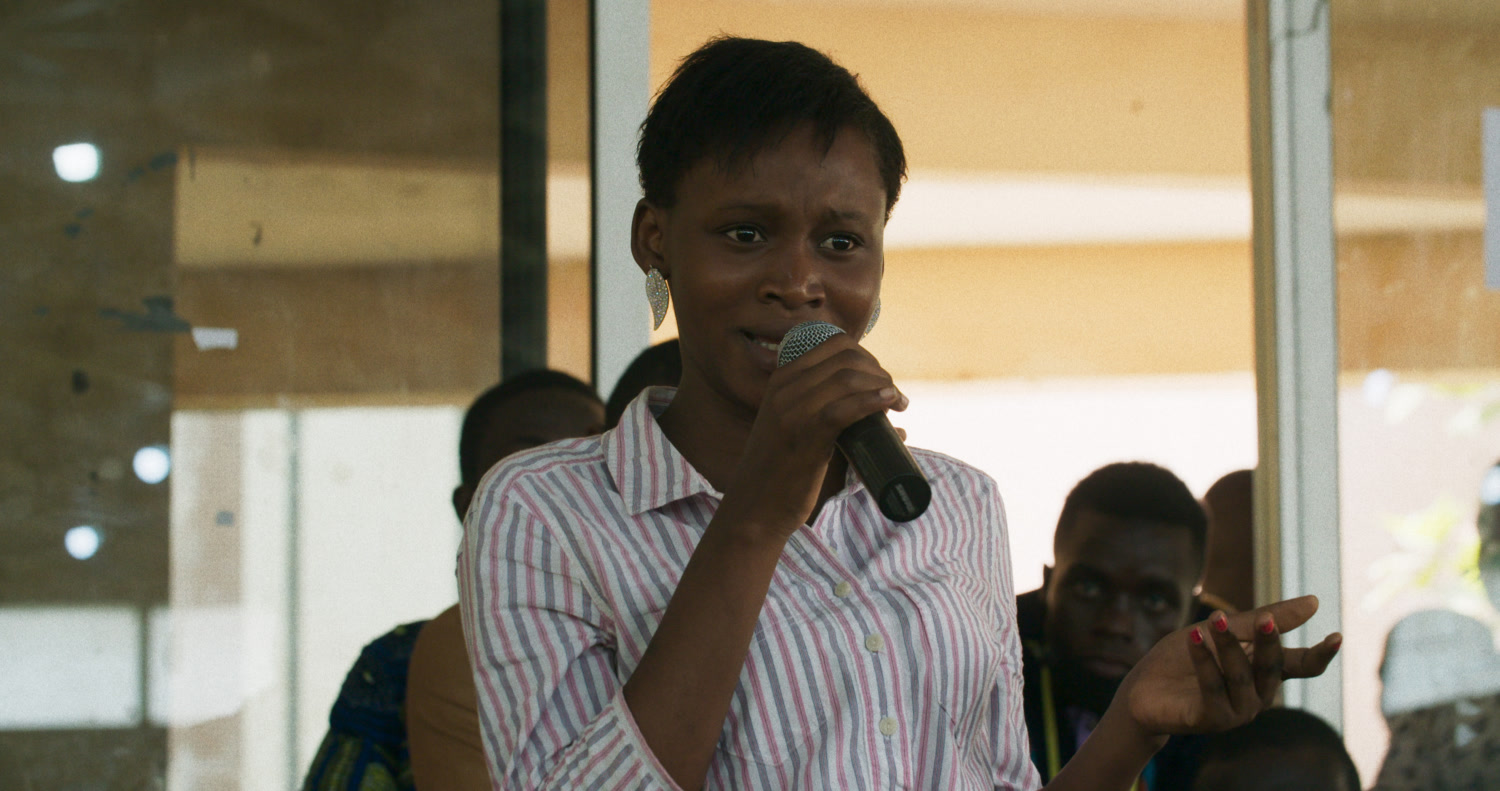
The most consequential formal turn arrives at the University of Abomey-Calavi. The solitary, disembodied voice of No. 26 gives way to young Beninese speakers passing a handheld microphone. Some describe the 26 works as a source of pride or a necessary beginning. Others regard the small number against the scale of what remains in France as an insult. The discussion opens further questions: whether a Western-style museum can decolonize what it displays, whether students will actually gain access, whether living practices matter more than royal objects, and whether material hardship changes the urgency of cultural repair.[2][5]
Diop does not film these positions as a ladder toward the correct answer. A claim gathers force, then another speaker exposes what it leaves out. Pride can coexist with suspicion; gratitude can sound uncomfortably close to accepting France as the final judge of what Benin receives. Even the word “return” divides the room. For one person it names reconnection. For another it advertises the disproportion between 26 arrivals and thousands of absences.
The debate looks spontaneous, but its construction matters. Diop and her Beninese collaborators selected participants with different backgrounds and positions, arranged the raked seating as a kind of agora, recorded the exchange with three cameras, and had it broadcast on campus radio. The opinions were the students’ own, but the occasion was deliberately produced.[2][5] That disclosure does not weaken the sequence. It clarifies what the film is doing: not harvesting an untouched public opinion, but creating a temporary public in which disagreement can become visible and circulate.
The staging also answers the problem posed by No. 26’s invented voice. The sculpture speaks in a composite register that no living person can authenticate; the students speak from particular lives and interrupt one another. Neither mode is presented as sufficient. Without the uncanny monologue, the objects risk remaining mute evidence inside somebody else’s account. Without the debate, the monologue could harden into a single majestic version of collective memory. Placed together, the two sequences turn voice into a field of competing claims.
This is where Dahomey most sharply departs from the official homecoming ceremony. A ceremony gathers many people around a settled meaning. The debate gathers them around a question whose meaning is still being made. The microphone, unlike the podium, has to move.
The ending returns no verdict
Late in the film, attention shifts repeatedly from the treasures to the people looking at them. Faces and bodies hold focus while royal figures soften behind glass; movement and music press against the stillness of the display.[4] The visual hierarchy is significant. The returned works matter, but they do not receive the final privilege of being complete, self-explanatory symbols. Their meanings now depend on encounters that the state, the museum, and the filmmaker can influence but not fully command.
Nor does Diop place herself outside that struggle. She chose the spectral text, the students, the camera positions, and the duration of every response. Her film redistributes authority without pretending to abolish authorship. That tension is one reason the university sequence feels more convincing than a closing declaration would: the documentary makes room for objections to the very triumph it records.
The homecoming in Dahomey is therefore real and unfinished at once. Objects taken through colonial violence are physically and legally present in Benin; that is not symbolic nothing. But arrival does not repair the missing years, resolve the fate of what remains abroad, guarantee access, or decide which past should organize contemporary life. Restitution is less a delivery completed than a relationship reopened.
Diop’s boldest choice is to end without converting that openness into uplift or despair. A crate has crossed the ocean. An object has become a speaking subject. A room of students has refused to speak as one. The film’s deepest act of return is not the recovery of consensus, but the recovery of an argument that no institution gets to close.
Sources
- Les Films du Losange, Dahomey — official synopsis, credits, and film stills
- Les Films du Losange, Dahomey English press kit — Mati Diop interview and production notes
- Musée du quai Branly–Jacques Chirac, “Restitution of 26 works to the Republic of Benin”
- Laura Staab, “A Botany of Life: Mati Diop’s Dahomey,” MUBI Notebook
- Pat Mullen, “Mati Diop on Dahomey and Decolonial Documentary,” POV Magazine