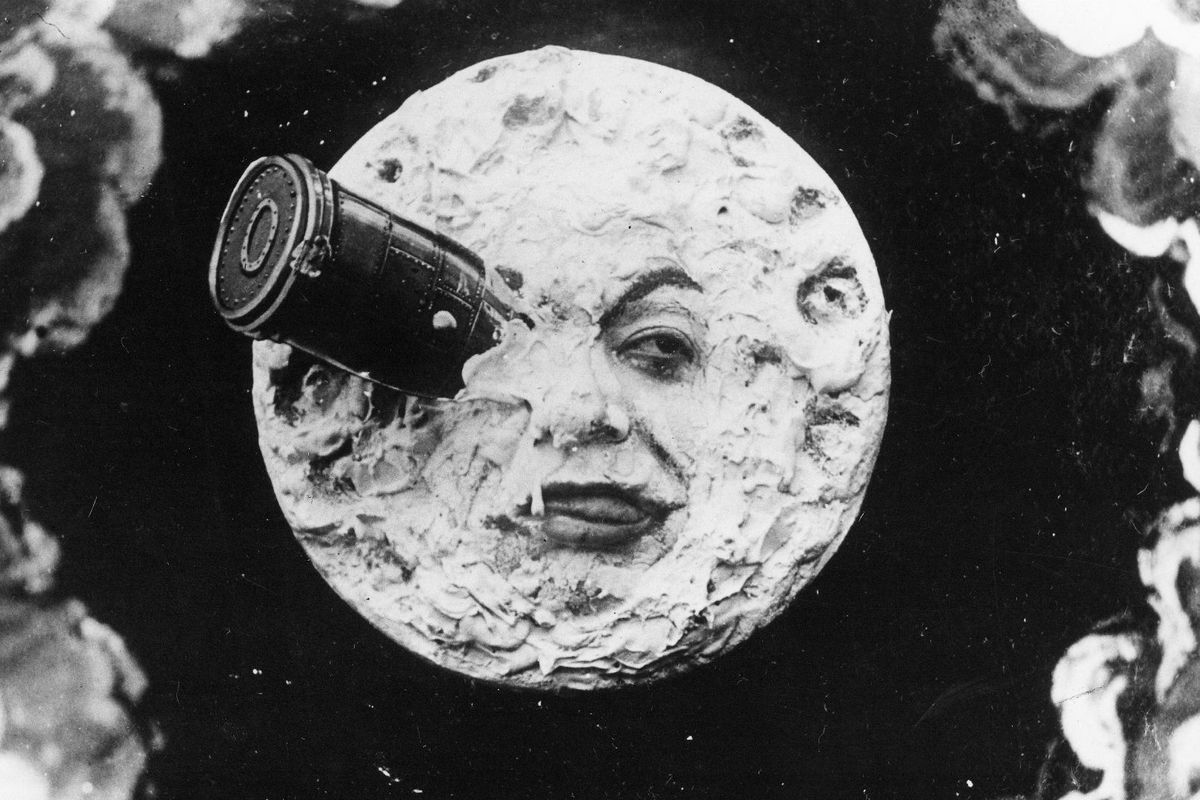
Georges Melies's A Trip to the Moon is so familiar as an icon that its strangeness can disappear. The rocket in the moon's eye has become a shorthand for early cinema, science fiction, movie magic, and handcrafted fantasy, which means it is easy to treat the image as a mascot instead of a working scene.[1][3][6] Look at the film again from inside the logic of 1902, though, and it feels less like a primitive ancestor of later space films than like a complete machine for making impossibility public.
The film runs only about 11 to 13 minutes in the modern institutional listings, depending on version and speed, yet it behaves like an entire entertainment economy compressed into a reel: learned men in robes, a giant gun, chorus-line launch labor, painted lunar surfaces, acrobatic Selenites, a sea landing, a parade, and a captive brought home as proof of adventure.[1][2][3] BFI classifies it as both science fiction and trick film, which is the key pairing. It is a genre seed, but it is also a demonstration of method. Before science fiction cinema had stable rules about spaceships, world-building, scientific seriousness, or special-effects realism, Melies built a form around display: here is the impossible; here is the apparatus that makes it delightful; here is the audience invited to enjoy the trick without forgetting that it is a trick.[1][2][4]
Image context: the lead image uses ESA's 2024 publication of the famous moon-impact frame, credited to BFI/public domain. The frame is the right image for this article because it does not merely illustrate the film; it condenses the whole argument. The moon is a face, a surface, a target, a comic victim, and a stage prop. The rocket is travel, technology, aggression, punchline, and editing cue in one object.[6]
The film belongs to the trick-film lineage before it belongs to space realism
Modern viewers often meet A Trip to the Moon through the later prestige of science fiction. Public Domain Review calls it Melies's most famous film and treats it as an early landmark in cinematic science fiction, while BFI describes it through early sci-fi, fantasy cinema, H. G. Wells, Jules Verne, and the moon mission imagery that still charms viewers.[1][3] Those labels are useful, but they arrive after the fact. In the film itself, the stronger organizing principle is trick-film showmanship.
That matters because the moon voyage does not ask to be believed as plausible engineering. The astronomers' meeting is comic ceremony. The cannon launch is a theatrical gag scaled up to cosmic size. The lunar surface is painted, populated, and choreographed as a place where every discovery can turn into a transformation or a burst of stage action. The Selenites explode into smoke when struck. Telescopes, robes, umbrellas, stars, shells, and bodies all behave as properties in a magician's workspace.[1][3][4] The film's power comes from showing the universe as a sequence of visible effects rather than hiding those effects under realism.
Senses of Cinema's Melies profile is helpful here because it pushes against the lazy dismissal of his cinema as merely static or theatrical. It points to editing, deep-space staging, artificial lighting, studio control, film-stock manipulation, rhythm, choreography, and the wider cultural forms that fed his imagery: conjuring, magic lanterns, theater, operetta, circus, advertising, newspapers, postcards, and exhibition spectacle.[4] A Trip to the Moon draws energy from precisely that mixed culture. It is not a neutral window onto an imagined moon. It is a stage, an attraction, a comic lecture, a parade, and a special-effects catalogue fused into one confident surface.
Tableau staging gives the film its rhythm
The common complaint against early tableau cinema is that it lacks the mobility and intimacy later viewers expect from film. A Trip to the Moon turns that limitation into structure. The camera looks frontally, the scenes unfold in full view, and the action is arranged for legibility across the frame. That does not make the film inert. It makes the frame behave like a stage machine in which every area can suddenly become active.[4]
The astronomers' room works this way first. The scene is not psychologically complex, but it is full of social motion: gesturing, arguing, chalking, refusing, accepting, and crowding around an idea. The launch site then broadens the same logic. The cannon is not hidden inside technical procedure; it is framed as public spectacle, with rows of attendants and a ceremonial sense of labor. The film is teaching its genre from the beginning: space travel is not private interiority or engineering suspense. It is performance before an audience.[1][3]
On the moon, tableau becomes even more productive. Clouds part, stars display bodies, lunar geography deepens into a cave, and the Selenites arrive as acrobatic interruptions. Because the film does not chase naturalistic continuity, it can treat each scene as a new cabinet of effects. The cut is not there only to advance a plot. It opens the next decorated condition of wonder. This is why the film remains fast despite its fixed camera style. Movement is carried by scenic replacement, entrances, transformations, and sudden changes in scale.
The moon's eye is a joke about cinema's own violence
The rocket-in-eye image is famous because it is instantly readable. A cylindrical projectile enters a round face. The moon grimaces. The gag is simple enough to survive reproduction on posters, book covers, museum pages, and space-agency image galleries.[4][6] But the image lasts because it also carries several contradictory pleasures at once.
First, it makes cosmic travel tactile. The film does not show a sleek craft slipping into orbital abstraction. It gives us a blunt object hitting a face. Space becomes a body. Second, it makes technology comic. The rocket succeeds, but success looks rude, foolish, and physically invasive. Third, it makes cinema itself feel a little guilty. The audience is laughing at a spectacular wound produced for its pleasure.[1][3][6]
That is where the film's genre importance becomes sharper. Later science fiction often tries to dignify technological ambition through scale, awe, or procedural detail. Melies does something less solemn. He makes technological desire theatrical, absurd, and aggressive. The astronomers do reach the moon, but the moment of arrival is an assaulting joke. The film's fantasy of exploration is inseparable from an image of collision.
Public Domain Review's note that the film can be read alongside colonial fantasy is useful in this respect.[3] The expedition goes out, encounters strange lunar inhabitants, fights them, captures one, and returns to public celebration. The tone is playful, but the structure is not innocent. A Trip to the Moon belongs to a Europe of exhibitions, colonial display, popular science, travel spectacle, and comic exoticism. The film's charm does not erase that context; it gives the context a bright surface. Its moon is a fantasy territory built for the pleasure of arrival, conquest, escape, and proof.
Its restoration history is part of the meaning now
The film's modern life is also a preservation story. Flicker Alley's restoration release describes the 1902 film as having circulated in black-and-white and hand-painted color, then explains how a severely damaged color print was found in Barcelona in 1993, digitized after painstaking physical work, and restored through a project involving Lobster Films, Groupama Gan Foundation for Cinema, and the Technicolor Foundation for Cinema Heritage.[5] That history matters because A Trip to the Moon has always been about the material conditions of wonder.
The color version especially complicates the casual idea that early cinema was simply black, white, and technically naive. Hand coloring was labor. Restoration was labor. Projection speed, source prints, missing frames, nitrate damage, institutional custody, and soundtrack choices all shape what a viewer now thinks the film is.[2][5] The object survives not as a pure origin but as a layered reconstruction, which fits Melies better than a cleaner myth would. His cinema was already made from layering: painted flats, staged bodies, edited substitutions, hand craft, theatrical timing, and commercial circulation.
BFI's film record and player pages place Le voyage dans la lune inside an institutional film context while also making it watchable as an early sci-fi and trick-film object.[1][2] Those institutional homes do more than preserve an old title. They tell us that the film's history now spans several kinds of spectatorship: fairground-style attraction, film archive, online player, restored color event, and instantly recognizable image file. The movie became canonical partly because it can survive all those forms while still declaring its handmade nature.
The genre lesson is visible invention
If A Trip to the Moon still matters to movie history, it is not because it predicted modern science fiction in a straight line. It did not invent the later grammar of immersive worlds, detailed spacecraft, scientific accuracy, or psychological isolation in space. Its lasting lesson is more basic and more durable: a genre can begin by making invention visible.[1][3][4]
Melies shows the viewer a fantasy and lets the seams remain pleasurable. The moon is an actor's face and a celestial body. The rocket is a drawing, a prop, a sexual joke, a travel machine, and a projectile. The expedition is a mock-scientific lecture, a circus turn, a colonial adventure, and a return parade. The film is full of artifice, but the artifice is not a defect waiting for later cinema to correct. It is the experience.
That is why the film's frontal staging still feels alive. It invites the viewer to stand before an impossible event as if standing before a magic act, a fairground exhibit, or a painted theater set suddenly granted motion. Later cinema would learn to hide the trick more smoothly. A Trip to the Moon reminds us that hiding was never the only path. Sometimes the deepest genre pleasure lies in watching the impossible announce itself, step into the light, and wink through the wound it has just made in the moon.
Sources
- BFI Player, A Trip to the Moon film page, with genre, runtime, director, and film description.
- BFI, Le Voyage dans la Lune film record, with release year, country, director, featuring credit, and running time.
- The Public Domain Review, "Le Voyage Dans la Lune (1902)" collection note.
- Senses of Cinema, "Melies, Georges" Great Directors profile.
- Flicker Alley, A Trip to the Moon in Its Original 1902 Colors press release PDF, restoration background.
- European Space Agency, "'A Trip to the Moon' (1902)" image page, credited to BFI/public domain.