Spoiler warning: this essay discusses the film's escape plan and ending.
Robert Bresson's A Man Escaped begins with a title that seems to remove the ordinary suspense question. The man escaped. The film tells us the outcome before it teaches us the method. What remains is not whether Fontaine will get out, but what kind of discipline could make escape imaginable inside a place designed to crush action into waiting.[1][2][3]
That is why the film still feels severe rather than merely efficient. Janus describes it as one of cinema's tautest jailbreak films, built from a simple concept and spare technique, while BFI emphasizes how incarceration transforms every object and sound into potential information.[1][2] Both descriptions are accurate, but the deeper force lies in the relation between them. Bresson does not turn prison life into a spectacle of deprivation. He turns it into a system of work. A spoon, a door plank, a wire bed frame, a blanket, a pin, a cough, a train outside the wall: each ordinary thing becomes charged because Fontaine must decide what use, risk, and meaning it can bear.
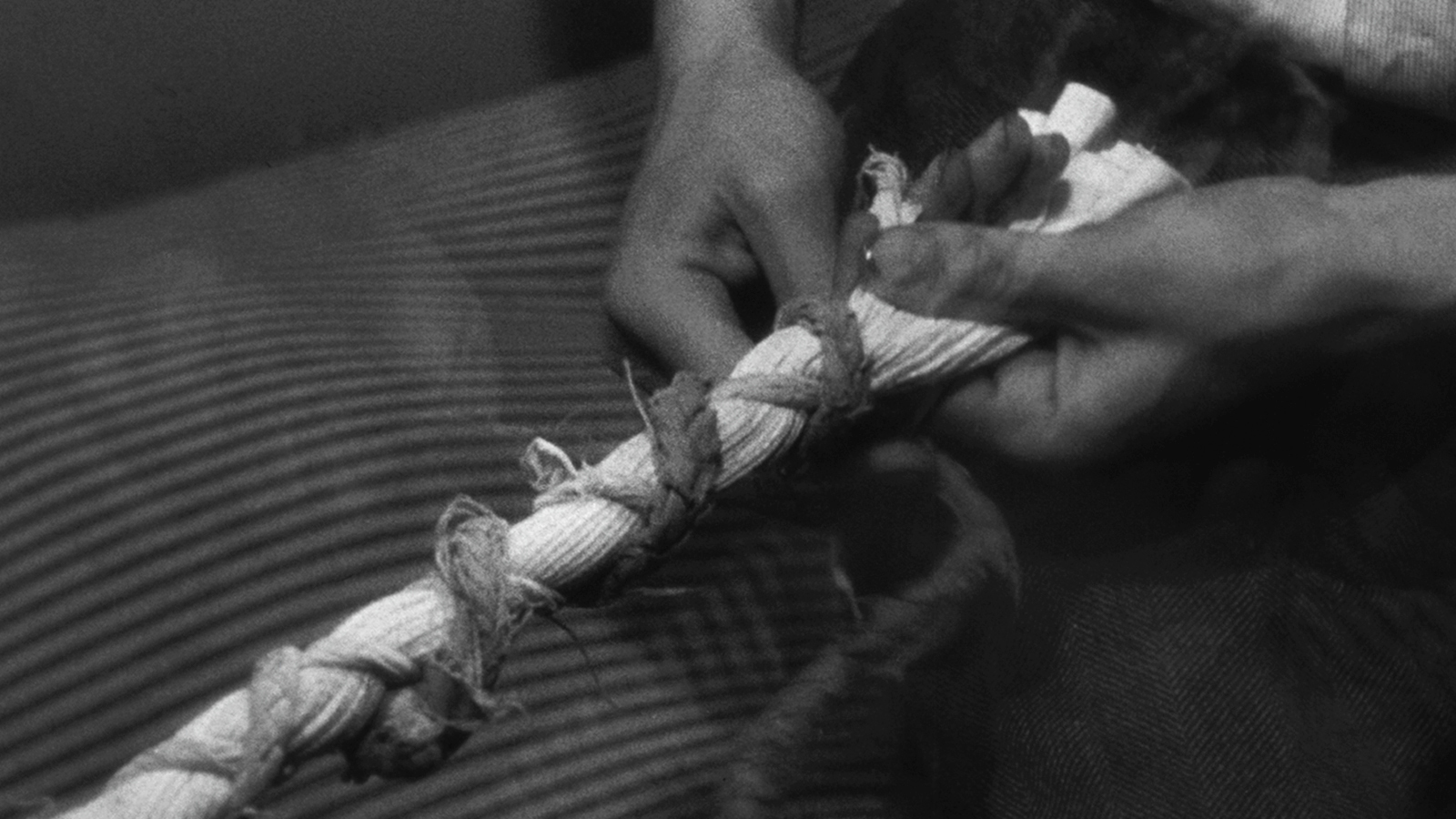
The cover image, sourced from Janus's official stills for the film, shows the article's core argument in one small action: Fontaine's hands braiding the materials of escape.[5] It is not a heroic image in the conventional sense. No wide horizon opens. No guard is defeated. The frame stays with preparation. That restraint matters because A Man Escaped is a film about freedom as accumulated attention before it is a film about flight.
Work Before Miracle
The historical basis gives the movie its first pressure. The story comes from Andre Devigny's wartime escape from Montluc prison in German-occupied Lyon, and both Janus and BFI frame Bresson's 1956 film around a condemned Resistance prisoner whose execution is near.[1][2] Yet Bresson strips away much of the usual biographical expansion. Fontaine is not presented through a full private life, a romance, or a political lecture. He is presented through tasks.
This narrowing can sound reductive until the film begins moving. The cell door is not merely a barrier. It is a surface to be studied, sounded, weakened, disguised, and finally passed through. The bed is not merely furniture. Its wire can become a hook. A blanket is not merely warmth. It can become rope. A spoon is not merely a utensil. It can become a chisel. Bresson makes the prison legible as a field of latent uses, and that field changes Fontaine's body. He survives by becoming exact.
TCM's note on the film is useful because it names the pleasure of watching competence: Fontaine is compelling because he is so good at the job of escaping.[4] But the film does not treat competence as glamour. Fontaine's work is repetitive, constrained, and almost humiliating in scale. He scratches, twists, listens, hides debris, tests weight, starts again. The movie's moral seriousness begins there. Freedom is not an idea he declares. It is something he earns a few millimeters at a time.
Bresson's religious title subtitle, taken from the Gospel of John, can make the film sound as though grace simply descends from above. The film is subtler than that.[1][3] Fontaine prays, but he also works. He depends on chance, but he prepares the body to receive chance. The mystery in the film is not opposed to labor; it is carried by labor. If a miracle enters A Man Escaped, it enters through the precision of repeated acts.
A Cell That Teaches Listening
The most radical part of the film may be its treatment of sound. David Bordwell and Kristin Thompson's sound-analysis excerpt is direct on this point: the film compels the viewer to listen, and at times sound partially replaces image as the main carrier of information.[3] That is not a stylistic flourish. It is the condition of Fontaine's imprisonment. He cannot see enough, so hearing becomes survival.
The cell therefore becomes a school for attention. A bolt, a hinge, footsteps, a guard's voice, a cough, a streetcar, a train, a bell, the scrape of metal against wood: each sound has practical value.[3] Fontaine listens because he has to know whether work can continue, whether danger is near, whether another prisoner is present, whether the outside world still exists as more than memory. Bresson lets the audience enter that discipline. We become anxious not because the film shouts at us, but because it makes small sounds enormous.
This changes the emotional temperature of suspense. In many prison-break films, suspense comes from escalation: a chase, a spotlight, a shouted alarm, a plan going visibly wrong. In A Man Escaped, suspense often comes from negative space. Fontaine stands still. The image goes dark. A sound arrives before its source. A train outside the wall may cover the noise of escape, or a stray noise may expose it.[3] The film teaches the viewer to measure threat by what cannot be seen.
That is also why the voice-over matters. Fontaine narrates from after the events, so the film's title and narration both imply survival.[3] The result is a paradox: certainty about the ending intensifies attention to process. Since the outcome is known, the viewer is pushed toward causes. How does a man make a tool? How does he know when to stop scraping? How does he decide whom to trust? The suspense becomes ethical and procedural rather than merely informational.
Objects Become Relations
For all its concentration on solitary work, A Man Escaped is not finally a fantasy of self-sufficiency. The deeper pattern is interdependence. Bordwell and Thompson point out that Fontaine receives aid from other prisoners: information, material help, contact, encouragement, and finally the demand that he decide what to do with Jost, the young cellmate placed beside him just as the escape is ready.[3] BFI's framing of the film as a fable of chance and redemption is persuasive because chance in this movie rarely remains abstract.[2] It arrives through other people.
This is where the film's title becomes more complicated. A man escaped, yes, but not as an isolated will floating above circumstance. Fontaine taps walls, trades messages, listens to voices, receives a blanket, learns from a failed attempt, and must decide whether Jost is a threat or a companion.[3] Every stage of the plan that seems private eventually reveals a social dependency. The rope in his hand carries other prisoners' risks.
The drama around Jost is especially severe because it turns the escape from engineering into moral exposure. Fontaine has built a plan through suspicion, secrecy, and control. Then another body enters the cell. To preserve the plan, he can treat Jost as an obstacle. To complete the meaning of the plan, he must consider him as a person. Bresson makes that decision feel practical before it feels symbolic. Trust is not a decorative virtue here. It changes the weight, noise, timing, and danger of the escape.
The film's famous austerity serves that problem. Bresson avoids the sentimental shortcuts that would make trust feel easy. Fontaine's choice does not arrive with theatrical warmth. It arrives as a hard adjustment to reality. The escape must now include two people, two bodies, two rhythms, two chances of error. Grace, in this film, has logistics.
Freedom as a Change in Scale
The ending works because Bresson has spent the whole film reducing freedom to tiny actions. By the final sequence, the viewer has learned to care about rope strength, hand placement, footsteps, walls, shadows, and train noise.[3] The outside world is not a sudden landscape. It has been present for the whole film as sound: streetcars, trains, children, bells, movements beyond the cell.[3] Freedom first reaches Fontaine's room as evidence that the world continues outside the prison's frame.
When Fontaine and Jost finally move into the night, the release is powerful because it does not cancel the discipline that preceded it. They do not become larger-than-life fugitives. They remain bodies negotiating surfaces, timing, silence, and one another's vulnerability. The escape is less a burst than a transfer: the same attention Fontaine learned in captivity now carries him through the wall.
That transfer is the film's theme. A Man Escaped is not only about a prisoner defeating a prison. It is about a human being remaking the meaning of time under coercion. Prison time is designed to empty action out of the day. Fontaine reverses that design. He converts waiting into preparation, objects into tools, sounds into maps, and isolation into a test that can only be completed through trust.[2][3]
This is why the film remains so alive after its plot has been known for decades. The title gives away the destination, but the destination was never the main secret. The secret is the work by which a condemned man refuses to let the world become inert. Bresson's greatness lies in making that refusal visible without inflation. A hand twists cloth. A spoon scrapes wood. A man listens. Another man is trusted. Freedom, when it arrives, has already been practiced.
Sources
- Janus Films, "A Man Escaped" film page, with synopsis, format details, and official stills.
- BFI, "A Man Escaped (1956)" film page, with Sight and Sound poll context and capsule description.
- David Bordwell and Kristin Thompson, "Functions of Film Sound: A Man Escaped" PDF excerpt from Film Art.
- Turner Classic Movies, Ben Mankiewicz, "A Man Escaped (1956)" article.
- Janus Films / Criterion production still file, "27848id1500074primaryw1600.jpg," source image used for the cover.