The Odessa Steps sequence in Sergei Eisenstein's Battleship Potemkin is so often quoted, parodied, and taught that it can look like a museum label before it looks like cinema. A mother falls, a pram rolls, soldiers descend in a hard diagonal, and the crowd breaks into fragments of terror. BFI's film note calls the 1925 work an agit-drama of mutiny and repression whose montage effects still carry force, while Britannica places the steps sequence at the center of the film's historical fame.[1][2] Those summaries are accurate, but the scene's power comes from a more exact operation: Eisenstein does not simply show public violence. He makes public violence into a system of rhythm.
That is why the film remains difficult to reduce to propaganda alone. It was made for the twentieth anniversary of the 1905 revolution, and TCM's production history notes that Eisenstein's project expanded from a larger commemorative series into a feature built around the Potemkin mutiny after weather and logistics pushed the production toward Odessa.[3] The political assignment is visible everywhere: rotten meat, officers, sailors, mourning citizens, martyrdom, and revolutionary solidarity all have explicit places in the design. Yet the film's lasting charge comes from the way those elements are arranged. The argument is not only in what the characters believe; it is in cuts, diagonals, stair treads, faces, hands, boots, smoke, and repeated motion.
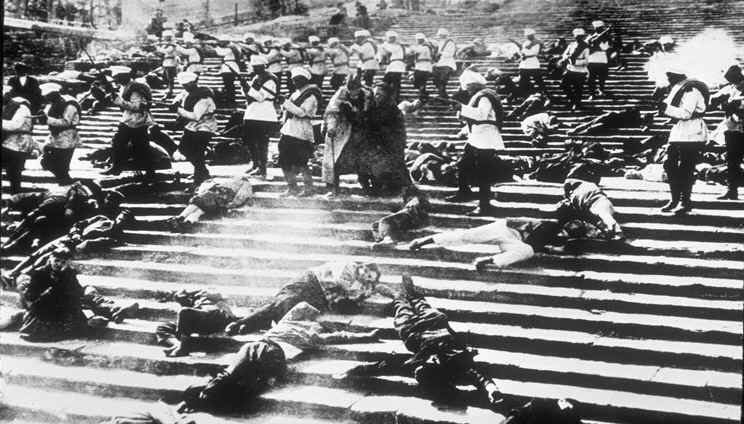
Image context: the lead image is a public-domain Wikimedia Commons still from the Odessa Steps passage, described there as Tsarist soldiers marching down the steps in the 1925 Goskino film.[5] It is the right still for this essay because it catches the sequence before the most famous pram image. The frame shows the machine before the wound: identical uniforms, lowered rifles, synchronized bodies, and the long stairway turning human movement into an apparatus.
The five-part structure makes revolt feel ceremonial
Battleship Potemkin is often remembered through one set piece, but its larger shape matters. Britannica describes the film as arranged in five movements or acts, beginning with "Men and Maggots," moving through the quarterdeck mutiny and the display of Vakulinchuk's body, then reaching "The Odessa Steps" before the concluding squadron encounter.[2] TCM makes the same structural point, noting that the five acts recall classical tragedy.[3] The film therefore approaches the steps through a ceremonial sequence of causes, not as a sudden insert of cruelty.
The first act turns disgust into political matter. The maggot-infested meat is not just a prop of bad ship management. It gives oppression a texture: something wet, spoiled, edible, and refused. The officers' authority then becomes visible through ritualized command. Men are assembled, threatened, covered, counted, and sorted. Eisenstein's camera does not ask viewers to settle inside one sailor's psychology for long. It builds pressure from groups. A sailor's body matters, but the body belongs to a larger arrangement of deck, line, order, and command.
By the time the film reaches Odessa, the dead sailor Vakulinchuk has become a public object of mourning. The city does not merely receive news; it receives a body. That shift is crucial. The crowd on the steps is not a decorative mass standing behind the plot. It is the film's new instrument. Sympathy becomes spatial. People gather, look, gesture, climb, descend, and occupy the city as if public grief could create a temporary political architecture.
The steps turn location into pressure
The historical relationship between film and place is complicated. TCM notes that civilian massacres by police were part of the unrest in Odessa, while the film compresses and shapes events, leaving out other significant incidents such as the major fire at the port.[3] BFI's Robin Baker, writing about the Potemkin Steps' later cinematic afterlife, describes the scene as one that helped make the Odessa stairway one of cinema's iconic locations.[4] The sequence therefore works in two directions. It uses a real urban site, and then it remakes that site as film memory.
Eisenstein understands the stairway as a machine for unequal movement. The crowd is scattered across landings and steps, climbing and pausing in many directions. The soldiers, by contrast, descend as a single line of force. Their bodies are less individualized than their rhythm. Boots, rifles, shadows, and the diagonal angle of the formation produce a terrifying regularity. The steps make that regularity visible because each tread measures the descent. Power becomes countable.
The civilians cannot answer that rhythm with a matching rhythm. They run, stumble, look back, fall, carry children, shield faces, and collide with one another. Their movement is plural, desperate, and discontinuous. Eisenstein cuts among them so that panic becomes social rather than private. The effect is not simply that many people are afraid. The effect is that fear loses its stable location. It moves from face to face, from mother to child, from spectacles to wound, from hand to railing, from body to empty step.
Montage makes the viewer complete the violence
Britannica summarizes Eisenstein's montage theory around the collision of opposing shots and says the force of the steps sequence arises as viewers combine independent images into a larger impression.[2] That description gets close to the sequence's actual engine. Eisenstein does not rely on continuous spatial mapping. He gives viewers pieces sharp enough to strike one another.
The soldiers' descent is one piece. The crowd's shattering is another. A close view of suffering is followed by a more abstract view of order. A body drops; the line keeps coming. A face cries out; the boots continue. The sequence repeatedly denies the comfort of a single complete view. The viewer has to assemble the catastrophe from fragments, and that act of assembly becomes part of the scene's cruelty. We do not simply witness a massacre from a safe distance. We are made to perform the connections that give it scale.
The famous pram intensifies this logic because it turns helpless motion into pure cinematic suspense. A baby carriage has no political intention and no ability to resist; once released, it belongs to gravity, steps, and cutting. This is why the image has been remade and echoed so often. Britannica mentions later recreations, including Brian De Palma's The Untouchables, while BFI's Odessa feature tracks the steps as a living cinematic location rather than a dead historical reference.[2][4] The pram survives in film memory because it condenses Eisenstein's larger method. Human disaster is transferred into an object whose movement the viewer cannot stop.
The crowd is the protagonist
One reason Battleship Potemkin still feels strange beside many later political films is that it refuses a comfortable hero structure. BFI lists actors and roles, and the film certainly has named figures, but its deeper protagonist is collective motion.[1] The sailors matter as a group before they matter as individual personalities. The citizens matter as a crowd before they settle into isolated characters. Even state violence appears through formation rather than through a single villain's psychology.
This choice keeps the film from becoming a simple illustration of noble victims and brutal officers. It makes the viewer watch how groups become legible. The sailors are first disciplined as crew, then reconstituted as mutineers. The people of Odessa are first mourners, then witnesses, then targets. The soldiers are almost entirely absorbed into mechanical descent. Every social body is edited into a different rhythm.
That rhythmic difference is the film's politics at the level of form. Revolutionary solidarity is shown as sudden recognitions across bodies: a glance, a lifted hand, a crowd moving toward the harbor, sailors receiving the city's sympathy. Repression is shown as repetition without recognition. The soldiers descend because the formation descends. The face of power is a pattern.
Its afterlife can hide the original shock
Canonization can dull a film. BFI notes that Battleship Potemkin has appeared across Sight and Sound critics' polls from 1952 to 2022 and that it has been quoted and parodied endlessly.[1] That kind of prestige can make the movie feel pre-approved, as if viewers are expected to admire it for historical reasons before watching what it actually does. The better way back into the film is to treat the Odessa Steps sequence as an event of perception.
The scene is not powerful because it tells us that repression is bad. That conclusion arrives before the sequence begins. It is powerful because it changes how a viewer experiences public space. A stairway becomes a measuring device. A crowd becomes a nervous system. A marching line becomes a machine. A baby carriage becomes a little vessel for helpless momentum. A city becomes an editing table.
This is why the film remains alive even under the weight of classroom familiarity. Eisenstein's montage does not merely decorate an argument already made by the story. It creates the feeling of political violence as something produced by arrangement: bodies placed in relation, movements forced into conflict, images colliding until thought and shock arrive together. Battleship Potemkin endures because the Odessa Steps do not only show history. They teach the eye how history can be manufactured into pressure, one cut at a time.
Sources
- BFI, Battleship Potemkin film page, with synopsis, production credits, runtime, and Sight and Sound poll context.
- Encyclopaedia Britannica, "Battleship Potemkin," with plot structure, Odessa Steps discussion, and montage context.
- TCM, James Steffen, "Battleship Potemkin (1925)," with production history, five-act structure, and historical-compression notes.
- BFI, Robin Baker, "Hitchcock on the Potemkin steps," on the Odessa Steps sequence and the location's cinematic afterlife.
- Wikimedia Commons, "File:Potemkinmarch.jpg," public-domain archival frame from the Odessa Steps sequence.