Spoiler note: this article discusses the ending of the film.
Djibril Diop Mambety's Touki Bouki (1973) is often described through its surface electricity: a horned motorcycle, jagged edits, slaughterhouse shock, Josephine Baker on the soundtrack, lovers who want Paris with the hunger of a fever dream.[1][2][4] All of that is true, but the film lands hardest when you notice that it never lets motion become smooth. It borrows the appetite of a road movie, the swagger of outlaw romance, and the glamour of departure, then keeps interrupting each promise with something abrasive, comic, or ominously material.[2][3][4] The result is not a simple story about leaving Senegal for Europe. It is a close study of what happens when desire moves faster than history, and when cinema itself has to register that mismatch as rhythm.
That is why the film still feels so contemporary.[3][4] Criterion's film note emphasizes its fractured portrait of postindependence Senegal, while BFI highlights its vivid imagery, discontinuous editing, and audacious soundscapes.[1][4] Those formal choices are not decorative signs of modernism. They are the argument. Mambety builds a movie in which aspiration is always being snagged by residue: animal death, colonial glamour, family pressure, sonic repetition, and finally the body's refusal to step onto the gangplank.[2][3] The film's most durable insight is that escape, in Touki Bouki, is never a clean line from here to there. It is a broken rhythm the movie keeps replaying until its fantasy gives way.
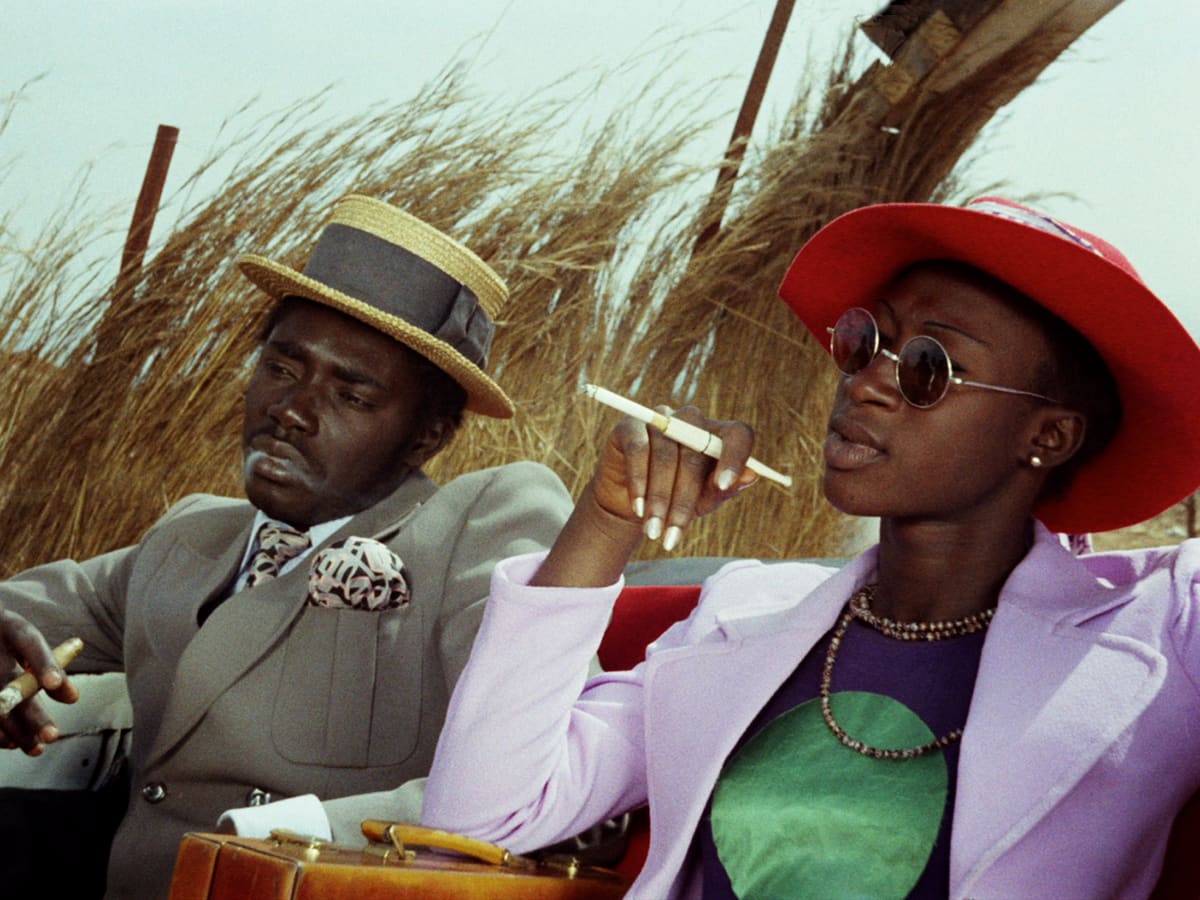
Image context: the lead image uses an official still from the Criterion release page.[1] It suits this reading because the clothes, the sunglasses, and the open car already look like an improvised advertisement for another life, one the film keeps showing and then destabilizing.
The zebu skull keeps the road attached to the slaughterhouse
The film opens with cattle being driven to slaughter, and Mambety never lets that beginning drop away as mere provocation.[2] Ashley Clark notes that the abattoir sequence functions as a symbolic harbinger, and the point becomes clearer once Mory appears on his motorcycle with a zebu skull mounted on the front.[2] In another movie, the vehicle would announce youth, speed, and urban cool. Here it does that, but only after dragging the animal world, rural labor, and death directly into the frame of modern mobility. Mory rides forward with a trophy that is also a burden.
That contradiction is central to the film's method.[2][3][4] BFI describes Mory and Anta as lovers desperate to escape postcolonial Dakar, but Mory's chosen emblem means he never appears as a neutral modern subject simply heading toward a future.[4] The motorcycle is not a clean machine. It is a hybrid object, part fashion statement and part moving relic. Clark also notes the Dogon cross attached to the bike, another sign that Mory carries layered symbolic cargo rather than pure forward momentum.[2] The famous swagger of the image comes from excess, not freedom.
Porton is useful here because he frames the film as a startling recontextualization of familiar tensions between tradition and modernity, rural and urban, colonial inheritance and postcolonial bad faith.[3] The zebu skull condenses those tensions into one unforgettable prop. It makes every ride look partly ceremonial, partly comic, and partly doomed. The road is open, but the film refuses to pretend that openness erases what the road is built over. That is why Touki Bouki does not feel like a liberation narrative in transit. The transit object itself is already arguing back.[2][3]
The "Paris, Paris" loop makes Europe sound like a damaged recording
If the motorcycle gives the film its visual totem, the repeated recording of Josephine Baker singing "Paris, Paris" gives it its sonic logic.[2] Clark's essay describes the track as catching in the same spot, and that tiny formal decision matters enormously.[2] Paris is the couple's fantasy destination, but Mambety refuses to let the fantasy play in a smooth, triumphant line. Europe arrives as a loop, a replay, a snagged piece of imported sound. The city they long for is already mediated before they reach it.
That loop turns longing into something stranger than hope.[2][4] The film clearly understands the glamour attached to France, and BFI rightly calls the movie a stylish and poetic expression of postcolonial fantasies.[4] Yet the song's repetition keeps draining fantasy of completion. Instead of opening a horizon, it behaves like a needle caught in a groove. We hear not arrival but recurrence. Paris becomes less a place than an audio effect that keeps intruding on Dakar's present.
This is one reason the film's dress-up passages feel so uncanny rather than merely playful.[2][3] The still used above captures Mory and Anta inside that performance: elegant clothes, composed poses, a fabricated sense of ease.[1] They can look like they already belong to the world they want. They can even stage motion toward it. But Mambety cuts and layers sound in ways that keep exposing the performance as a construction. Porton argues that the bare-bones outlaw-couple plot is only a departure point for a harsher reading of Senegalese modernity and its discontents.[3] The Baker loop is one of the tools that makes that harsher reading audible. Desire is real, but the soundtrack tells us it has been prerecorded by somebody else's prestige.
The gangplank ending splits desire from movement
The film's last great stroke is brutally simple. After all the hustling, theft, costume, and momentum, the final test is only whether Mory can board the ship.[2] He cannot. Clark describes the freeze directly: Mory stops on the gangplank while Anta sails away alone.[2] A conventional departure story would treat this as a failure of nerve, or as a tragic betrayal of the couple's pact. Touki Bouki makes it much more revealing than that. It turns the body's hesitation into the truth of the whole film.
By this point, the movie has trained us to see motion as unstable.[2][3] Cars, motorcycles, and fantasies all surge ahead, but the form keeps breaking their continuity. So when Mory stops, the ending does not feel like a random reversal. It feels like the point at which the film's broken rhythm finally becomes explicit. Clark, drawing on Manthia Diawara, suggests that Mory's refusal belongs to a griot logic that flirts with change while restoring an older order.[2] Whether one accepts that formulation completely or not, the crucial point is that the ending refuses the clean prestige of emigration as cinematic closure.
MoMA's note on the restoration is helpful in one indirect way.[5] Seen from the distance of preservation and canonization, Touki Bouki can look like a modern classic whose meanings have settled. The gangplank ending prevents that settling. Anta's departure does not redeem the fantasy, and Mory's refusal does not produce a noble return. What remains is an unresolved split between the life one wants to perform and the world one still inhabits. The final image of Mory with the skull makes that split concrete again.[2] He has not escaped the film's opening materials. He is still carrying them.
This is why Touki Bouki endures as more than a landmark of style.[1][3][4] It invents one of the great cinematic grammars of interrupted aspiration. The zebu skull keeps history strapped to velocity. The Baker refrain turns Europe into a glitching promise. The gangplank ending reveals that movement itself was never the same as transformation. Mambety made a film about escape that does not flatter escape, and a film about modern desire that never forgets the cost of the fantasies modernity imports.[2][3] That tension is what gives the movie its lasting charge.
Sources
- The Criterion Collection, Touki bouki (1973) film page with credits, restoration notes, and official stills.
- Ashley Clark, "Touki bouki: Word, Sound, and Power," The Criterion Collection.
- Richard Porton, "Touki bouki: Mambety and Modernity," The Criterion Collection.
- BFI, "Touki Bouki (1973)" film page from The Greatest Films of All Time.
- MoMA, "Touki Bouki. 1973. Written and directed by Djbril Diop Mambety" screening and restoration page.