Fritz Lang is often introduced through three or four enormous landmarks: Metropolis, M, the Dr. Mabuse films, and the American noirs.[1][3][6][7] That shorthand is useful, but it can make his career look like a string of separate achievements rather than one long investigation. What ties Lang together across silent spectacle, Weimar paranoia, exile, Hollywood genre work, and late-career media cynicism is his gift for making systems feel sentient. In his films, architecture does not merely hold action, and institutions do not merely regulate it. Buildings, bureaucracies, criminal networks, newspapers, police dragnets, and crowds all begin to behave as if they had their own hostile intelligence.[1][2][3]
That is why Lang still feels so modern.[1][2][6][7] Plenty of directors can stage fear inside a room or suspense across a chase. Lang does something colder. He makes the room itself seem accusatory, the city seem already mapped for pursuit, and the mechanism of order look perilously close to the mechanism of panic. BFI's overview is right to say he helped invent science fiction, serial-killer cinema, and film noir.[1] The common element is not genre surface. It is a worldview in which modern life builds ever more elaborate machines for sorting, watching, cornering, and judging the human beings moving inside them.
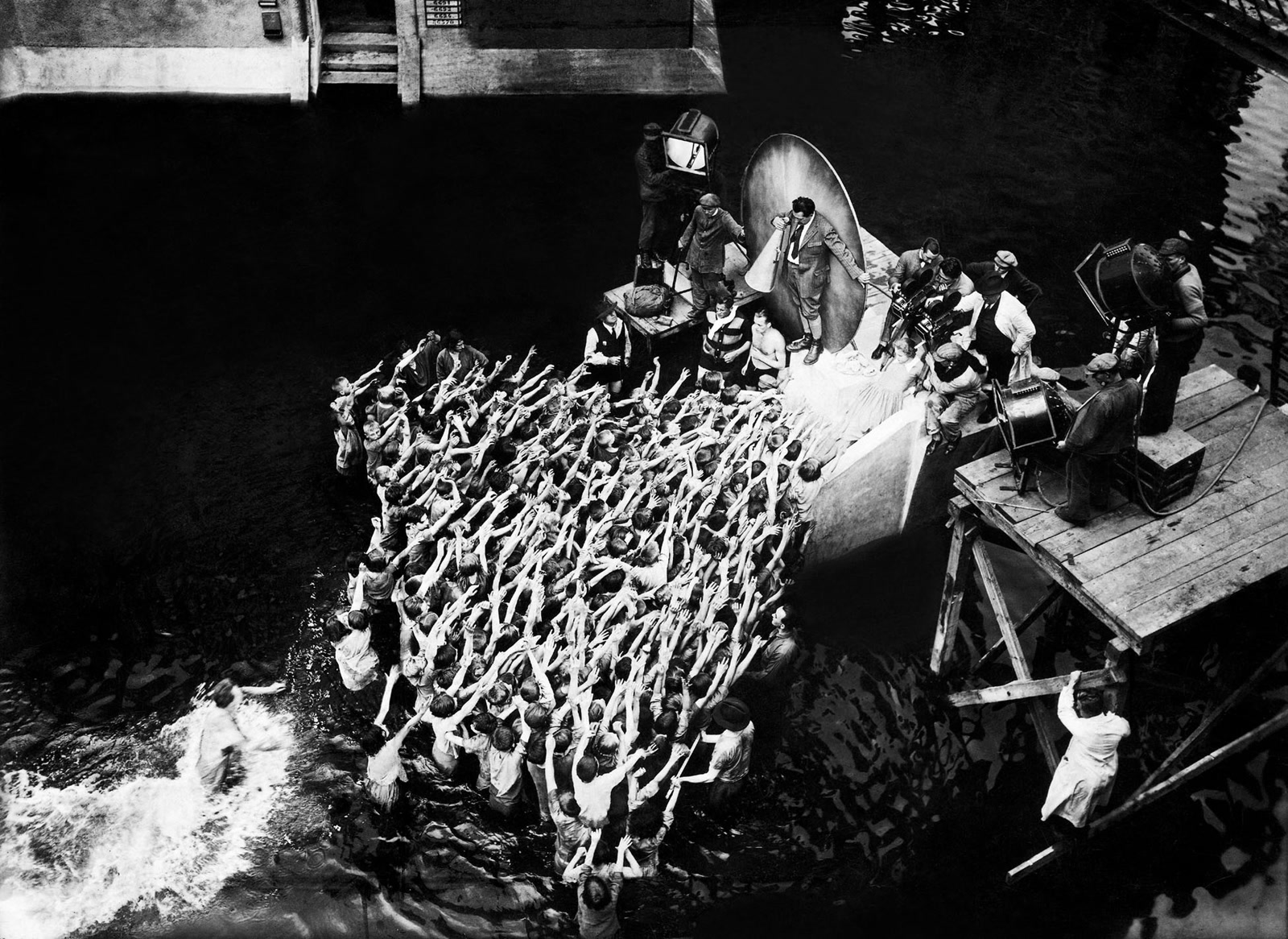
Image context: the cover uses a real 1926 set photograph from Metropolis, showing Lang with a megaphone beside the film's flood machinery.[8] It is the right image for this piece because Lang's cinema keeps translating constructed space into moral weather. Even before a performer enters the frame, a stairway, office, alley, chamber, or water tank has already begun deciding what kind of pressure the scene can carry.
Architecture is never neutral in a Lang film
The first thing Lang does, again and again, is turn space into social argument.[1][3][6] That is obvious in Metropolis, where towers, machine halls, and elevated roadways make class hierarchy physically legible before anyone explains it.[6] BFI's capsule calls it a stylized vision of profound inequality whose influence runs across generations of genre filmmaking, and that is exactly the point.[6] The city is not background. It is the active grammar of separation. Workers descend, planners look down, machinery swallows bodies, and every staircase behaves like a decision about who may inhabit the future.
But the same instinct is already visible in the earlier epics and criminal sagas.[1][3] BFI's essential-films list treats Dr. Mabuse, the Gambler as Lang's first masterpiece and highlights the whole Mabuse trilogy as uncannily persuasive studies of fascism and the surveillance state.[1] In those films, hotel suites, gaming rooms, offices, and back-channel meeting spaces do not simply host conspiracy; they formalize it. Lang liked spaces in which power could hide behind polish. A room might look luxurious or efficient, yet its real function is often extraction, coercion, or command.
This is one reason his supposedly bombastic silent cinema does not feel empty.[1][3][6] Even at his grandest, Lang thinks like an engineer of human vulnerability. The monument matters because it organizes sightlines, delays, chokepoints, and rank. A Lang set is never only decorative. It is a behavioral machine.
Surveillance lets the city edit itself
If Lang's spaces impose order, his systems of looking and listening keep re-editing that order under stress.[1][4][5][7] M remains the clearest example. Criterion's Stanley Kauffmann notes that the film's suspense lies less in discovering the murderer than in watching what the murders do to the structure of a large city.[4] BFI makes the same point from another angle, describing the film as a blueprint for serial-killer cinema but also as a clinical cross-section of Berlin society, where politicians, businessmen, police, and organized criminals all react once their routines are disturbed.[7]
Lang's own 1931 essay on M sharpens the method.[5] He says he wanted to reflect the rhythm and objectivity of his time through factual reports, and then to isolate the repeating social phenomena that follow major crimes: hysteria, denunciation, false leads, collective fear, and the desire to turn danger into a legible pattern.[5] That matters because it shows how little Lang was interested in the killer as an isolated monster. He wanted the whole city under examination. The murderer is terrible; the wider revelation is how quickly a metropolis begins surveilling itself.
This is where Lang's modernity becomes almost unnerving.[4][5][7] Sound, offscreen space, rumor, police paperwork, underworld intelligence, and crowd behavior all become pieces of one searching apparatus. Once panic starts, society begins generating its own editing system. Clues circulate, authority fragments, and everyone wants to move from uncertainty to identification as fast as possible. Lang sees the danger in that acceleration without ever denying its seductive efficiency. In his films, surveillance is rarely a mere police technique. It is a social appetite.
Exile changed the scale, not the pressure
The move to America did not soften Lang's worldview; it redistributed it.[1][2][3] The 1967 Sight and Sound interview describes him as a figure whose vision remained rooted in the atmosphere of a fallen Germany even after decades in the United States.[2] BFI's essential-films essay makes a related claim about Fury, arguing that Lang's indictments of fascism and groupthink knew no geographical boundaries and that his American films continued to carry both local and European socio-political pressure.[1]
You can feel that transfer almost immediately.[1][3] Fury takes mob justice and makes it look like a civic reflex. You Only Live Once turns social stigma into doom before the lovers have any real chance to revise their fate.[1] The Woman in the Window and Scarlet Street shrink the scale to middle-class apartments, parlors, and private fantasies, but the trap remains systemic: desire is routed through shame, money, evidence, and misrecognition. By the time Lang reaches The Big Heat or While the City Sleeps, telephones, newsrooms, city desks, crime circuits, and promotional ambition all seem to belong to the same wired organism.[1]
That continuity matters for a director profile because Lang is too often split into separate careers: German Expressionist visionary here, Hollywood noir craftsman there.[1][2][3] The films themselves resist the split. What changes is not the core logic but the casing. The monumental machine city becomes the office, the courthouse, the suburban home, the newsroom, the police precinct, the media ladder. Fate grows fluorescent. It learns how to wear an American suit.
Lang's fate is manufactured, not mystical
This is the deepest reason Lang lasts.[1][2][3][5] He is frequently described as fatalistic, and the description is fair, but it can sound too abstract, as though his films were mainly about cosmic doom. Lang's fatalism is more concrete than that. He keeps showing how modern systems manufacture the sensation of inevitability. A worker stands where the city has placed him. A suspect is processed through rumor before he is processed through law. A crowd mistakes speed for justice. A private fantasy becomes evidence. A newsroom converts murder into career traffic. In each case, "fate" is what a designed environment feels like from the inside.
That is why his films can be both severe and exciting.[1][4][6][7] Lang loved velocity, set-pieces, and visual force, but he rarely uses them to flatter spontaneity. Motion in his cinema usually reveals prior arrangement. The chase proves how much has already been organized. The panic proves how ready the structure was to absorb it. Even spectacle in Metropolis or the late-talking chaos of M is inseparable from an almost bureaucratic pleasure in process.[4][5][6][7]
Seen this way, Fritz Lang's career stops looking like a collection of canonical titles and starts reading as a single hard argument about the twentieth century.[1][2][3] Modern life does not only produce new freedoms, speeds, and images. It also produces new layouts for domination, new circuits of observation, and new ways of making human beings feel that the verdict was already waiting for them. Lang grasped that early, then kept finding fresh forms for it in every country and every genre he touched. Few directors have made systems feel so alive, or so dangerous.
Sources
- Matthew Thrift, "Fritz Lang: 10 essential films," BFI.
- Axel Madsen, "A man for all seasons: Fritz Lang interviewed in 1967," Sight and Sound / BFI.
- Dan Shaw, "Lang, Fritz," Senses of Cinema Great Directors.
- Stanley Kauffmann, "The Mark of M," The Criterion Collection.
- Fritz Lang, "My Film M: A Factual Report," The Criterion Collection.
- BFI, "Metropolis (1927)" film page.
- BFI, "M (1931)" film page.
- Wikimedia Commons, archival on-set photograph: "Fritz Lang am Set von Metropolis Ueberflutung (1926).jpg".