Barbara Loden is still often introduced as the woman who directed only one feature, which is factually true and critically misleading.[1][2][6] It reduces her to scarcity when the sharper point is precision. With Wanda (1970), Loden found a way to make drift feel specific to class, place, and gender rather than vague, bohemian, or mythic.[1][4][5] American movies had plenty of runaways, outlaws, and open-road fantasies. Loden made a film about leaving that does not feel triumphant for a single frame. Her great directorial move was to strip escape of romance and leave behind its residue: fatigue, thin money, bad rooms, dead time, and the social fact that a woman alone keeps being absorbed into other people's plans.
That is why Wanda has grown rather than faded.[1][2][6] Criterion's edition frames it as a groundbreaking work of American independent cinema, and BFI's page is just as clear about its unsentimental force.[1][4] The praise is deserved, but it can flatten the method if it turns the film into pure legend. Loden's achievement is technical before it is canonical. She works with an industrial landscape, a small crew, loose air around scenes, and her own inward performance to produce a drama in which freedom feels less like self-invention than like exposure without protection.[2][5]
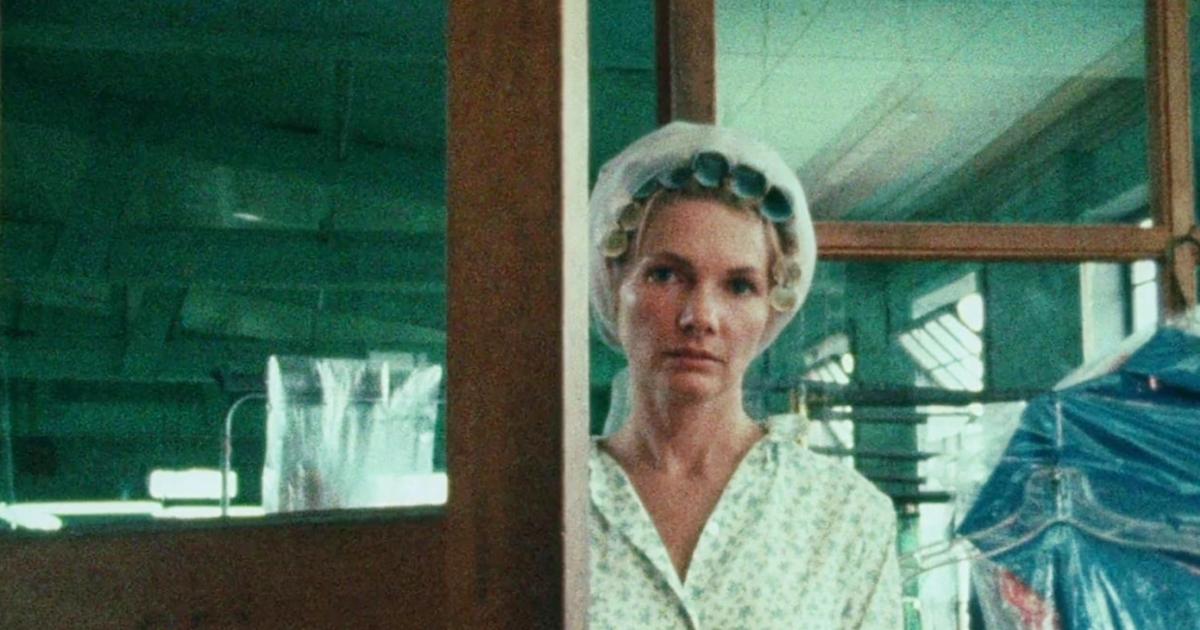
Image context: the cover still comes from Wanda itself. That matters here because a Loden profile should stay near the film's actual visual logic: doorways, side angles, drab interiors, and bodies that look as though they have arrived one beat too late to occupy the world securely.[4]
A performer misread by the system became a director who refused to flatter it
Before Wanda, Loden had already spent years inside American performance culture as someone other people thought they understood.[2][3] Amy Taubin's essay and Valeria Rotella's research both sketch the same problem from different angles: chorus-line glamour, Hollywood visibility, and stage acclaim all existed, but the industry kept reading Loden through ready-made categories that were smaller than her intelligence.[2][3] She could be cast, photographed, and praised, yet still remain mis-seen. That history matters because Wanda feels like an answer to a whole apparatus of misrecognition.
Loden does not retaliate by making her protagonist impressive.[2][3][5] She does something harder. She removes the usual protections that cinema gives women when it wants the audience to stay loyal: redemptive backstory, eloquent self-explanation, stylish rebellion, cathartic transformation.[2][5] In their place she offers recessive presence. Wanda Goronski drifts, waits, follows, misjudges, eats when food arrives, and keeps moving because stillness offers no better bargain.[1][4][5] The performance is exact because it never asks to be admired for its difficulty. Loden directs herself with an almost punitive plainness, as if glamour itself were one more lie the film has no use for.
Wanda turns drift from a mood into a social condition
The origin story matters because it already points toward Loden's real subject.[5][6] Both BFI and Criterion note that the film grew out of a newspaper item about a woman who thanked the judge after receiving a prison sentence.[5][6] Loden was drawn to the problem buried inside that fact: what kind of life makes punishment feel like relief? From there, Wanda becomes less a crime story than a study of depleted agency. The title character leaves her husband, relinquishes custody, wanders through coal-country Pennsylvania, and falls into the orbit of a petty criminal, yet the film never converts those actions into a clean line of empowerment or condemnation.[1][4][5]
This is where Loden separates herself from more glamorous road-movie traditions.[1][5] Movement in Wanda does not widen the self. It keeps showing how little room the self has been given. Cars, bars, motels, counters, dressing rooms, parking lots, and banks are not colorful stops on an antihero itinerary. They are temporary holding zones in which Wanda is alternately ignored, used, or briefly tolerated.[1][4][5] Loden's control is evident in the way each location feels concrete without becoming picturesque. The film's world has texture, but the texture does not console.
Becca Voelcker's essay on the ending is especially useful here because it names the refusal of closure as political, not decorative.[5] An unresolved finish in another film might play as chic ambiguity. In Wanda it feels structural. Loden has built a character whose life is never granted the narrative dignity of a solved problem. The wandering does not reveal a hidden sovereign self. It reveals how many people live in arrangements where choice arrives late, damaged, or already priced beyond reach.[5][6]
Thin 16 mm textures and industrial space are the method, not the backdrop
Loden's realism is often described as documentary-adjacent, which is accurate so long as the phrase does not make the film sound accidental.[1][2][5] Criterion emphasizes the intimate verite feel, and Voelcker adds the practical facts that matter: the shoot stretched across ten weeks in Pennsylvania and Connecticut, the crew numbered four, and the budget was meager.[1][5] Those constraints were not merely obstacles overcome in the name of authenticity. They became the form. The film's images hold onto dead air, awkward scale, and unattractive surfaces until social exhaustion stops being a theme and becomes a texture.
That texture is inseparable from place.[1][4][5] BFI's capsule description of Wanda as a portrait of a woman adrift in the industrial heartlands is exactly right because the industrial world does not sit behind the character as local color.[4] Coal country, service stations, shabby interiors, and the low commercial strip of motels and bars all keep pressing Wanda back into material reality. Loden never lets drift become abstract. Every episode has weight: a cheap meal, a hard bed, a silence in a car, a storefront, a room whose walls seem to have been rented by the hour. The result is a movie that looks stripped down without ever feeling empty.
This is also why Loden's plainness is so deceptive.[2][5] The compositions can seem casual on first encounter, but they are doing highly disciplined work. Wanda is repeatedly framed at the edge of rooms, beside doors, under flat light, or in positions that make her look less centered than provisionally placed. The visual world keeps asking whether she is occupying space or merely passing through it. Loden does not answer through dialogue. She lets posture, distance, and waiting carry the argument.
Loden's afterlife keeps expanding because she refused false uplift
The rediscovery story is now part of Loden's profile as well.[1][6] Criterion's release history notes the UCLA Film & Television Archive restoration with support from the Film Foundation and Gucci, while both Criterion and BFI point to a broader revival in which Wanda moved from hard-to-see outlier to enduring reference point.[1][6] The film won the International Critics Award at Venice, then spent years in a far smaller public conversation than its achievement warranted; its recent resurgence has corrected visibility, not altered the work.[6]
What later filmmakers and critics keep finding in Loden is not simply a lost woman auteur to rescue.[2][5][6] It is a director who understood that dignity on screen does not require heroic rhetoric, psychological overexplanation, or a redemptive arc. She made a movie in which a woman can be passive without becoming a symbol of nothingness, damaged without becoming a lesson, and mobile without becoming free.[2][5] That combination still feels rare because cinema so often wants to cash out suffering into moral clarity. Loden leaves the account unsettled.
Seen from that angle, Barbara Loden's one-feature career stops looking like an absence to apologize for.[1][2][6] It looks like a singular intervention. Wanda remains powerful because it refuses to turn drift into style or emancipation into slogan. Industrial plainness, recessed performance, and unfinished social time all keep tightening around the same insight: for some people, freedom first appears as a thinning of attachments before it appears as a new life. Loden saw that clearly, and she filmed it without decoration.[1][4][5]
Sources
- The Criterion Collection, "Wanda" film page with synopsis, restoration details, and credits.
- Amy Taubin, "Wanda: A Miracle," The Criterion Collection.
- Valeria Rotella, "Getting to Know Barbara Loden," The Criterion Collection.
- BFI, "Wanda (1970)" film page.
- Becca Voelcker, "Staying with the trouble: the ending of Wanda," Sight and Sound / BFI.
- Rachel Pronger, ""I wanted to approach the curation from a position of abundance": Wanda and Beyond curator Elena Gorfinkel on Barbara Loden," BFI.