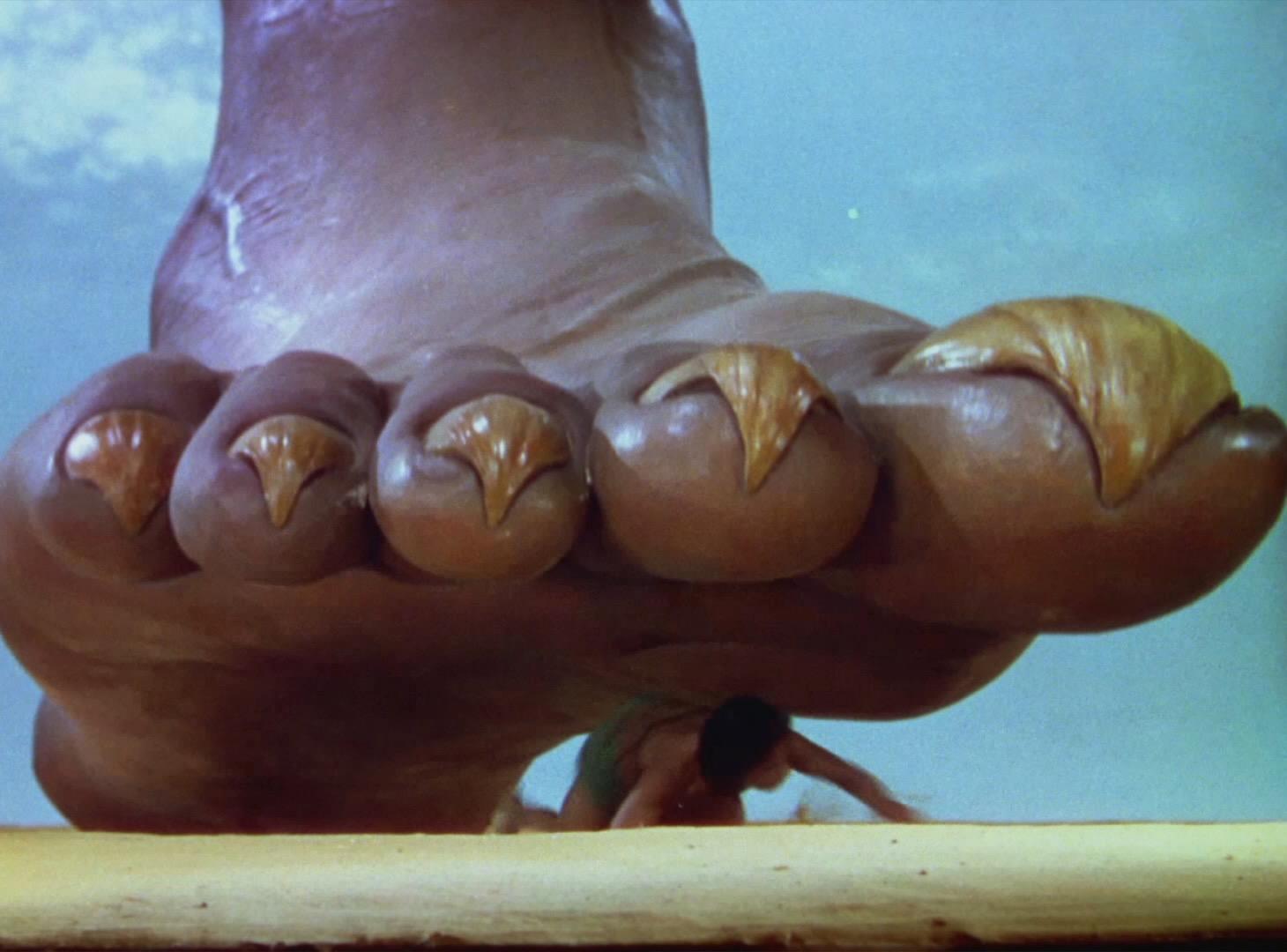
A foot fills almost the entire frame. Its polished gold toenails form a row of shields; its sole hangs over a ledge like a roof. Beneath it, Abu is not reduced to a speck. He is just large enough for us to read the crouch in Sabu's body and just small enough for the Djinni's next step to feel architectural.
Nothing here has to persuade us that an enormous human foot truly occupied the set. The shot only has to establish a lucid relation among four things: foot, boy, ledge, sky. Once those planes agree, scale becomes an event rather than a measurement.
That is the working principle behind The Thief of Bagdad (1940). The film is famous for pioneering color bluescreen, but bluescreen is only one member of a larger effects ensemble. Traveling mattes separate moving performers from one background and join them to another. Stationary mattes let a painted city begin exactly where a built set ends. Miniatures borrow weight from altered camera speed. Props, dissolves, and cuts carry the illusion whenever a composite would be less convincing. The fantasy holds because every technique answers a precise question about size, movement, or contact.[2][3][4]
Version note: this essay refers to the 106-minute British feature credited to directors Ludwig Berger, Michael Powell, and Tim Whelan, produced by Alexander Korda and photographed in Technicolor.[1] It discusses the film's visual craft, not the 1924 Douglas Fairbanks production with the same title.
A moving hole in the frame
Bluescreen is often described as though it simply replaces blue with a new picture. In a digital interface, that is a useful shorthand. In a three-strip Technicolor production, it was a chain of photographic separations. A performer or object was filmed against a carefully lit blue backing. The color records could then help produce complementary high-contrast mattes: one protected the foreground while the background was printed; the other protected the background while the foreground was added. Because the silhouette changed from frame to frame, the matte had to travel with it.[2]
The achievement was not cinema's first composite image. Earlier black-and-white processes had already combined separately photographed elements. What The Thief of Bagdad pushed forward was the use of a blue backing with color photography, making a moving actor available to a separately designed Technicolor world.[2] The distinction matters. This was not a neutral extraction tool dropped onto an otherwise finished film. Lighting, costume, movement, photography, processing, and background design all had to anticipate the join.
The film gives the method subjects with bold, readable edges: a flying carpet, a mechanical horse, a huge Djinni, a boy crossing an impossible temple. It also reveals what an edge costs. The German Federal Agency for Civic Education's technical account notes residual blue around the carpet's fringe and beneath feet in some shots. Fine fibers and fast motion are exactly where a clean silhouette becomes difficult.[2] Those traces are not proof that the idea failed. They show the idea working at its limit.
Look at what the carpet's fringe contributes even when it carries a faint halo. It quivers, drags, and catches air. A perfectly hard cutout would be cleaner but less carpet-like. The effect negotiates between two needs: isolate the moving object sharply enough to combine exposures, yet preserve enough unruly detail for the object to feel handled by weather. The seam is where those needs meet.
Give the giant something human to dwarf
BFI curator Ian Christie identifies The Thief of Bagdad as Powell's first chance to work with Technicolor and to explore fantasies of scale, from the giant Djinni leaving his bottle to Abu's ordeal in the cobwebbed temple.[6] The important word is not giant but scale. A giant is a design. Scale is a relationship the shot must continually renew.
The frame above renews it with ruthless economy. The foot enters from outside the picture, so the Djinni's full body cannot set a reassuring upper limit. Abu and the ledge occupy the same narrow strip at the bottom, giving them apparent contact. The open sky removes ordinary architecture that might expose conflicting perspectives. Rounded toes advance across the image while Abu folds inward. Volume, pose, and direction all deliver the same message before the viewer has time to inspect the join.
The sequence does not require every shot to contain both bodies. A close view can establish Rex Ingram's face and voice; a separate view can preserve Sabu's speed and comic alarm; a composite or oversized element can briefly lock their sizes together. Editing carries scale across the cuts. The viewer supplies a continuous encounter from images made under different physical conditions.
That division of labor explains why the film's magic rarely feels like a technical demonstration. An effect shot establishes the impossible fact. A performance shot gives the fact consequence. A prop supplies contact. A cut arrives before the most fragile illusion has to do everything at once. The spectacle is assembled, but the reaction remains human.
Paint only what the stage cannot hold
Bluescreen solves a moving-boundary problem. The film's cityscapes posed a different one: how to enlarge a finite studio set without asking a painted background to move around a performer. Here the useful device was the stationary matte.
The Walter Percy Day archive preserves the workflow through material from The Thief of Bagdad: photograph the live set while masking the region to be supplied later, create the painting for that reserved area, then combine the two into a final view.[3] The border stays fixed, which lets the artist devote attention to architecture, atmosphere, and depth rather than recalculating a silhouette for every frame.
Day, Peter Ellenshaw, and Wally Veevers worked on matte shots for the production at Denham Studios.[4] Their paintings did not merely place decorative domes behind actors. They decided where the built world stopped. A staircase could remain solid where feet touched it, then climb toward architecture that existed only as photographed paint. A courtyard could preserve enough floor for movement while walls, towers, and distance multiplied beyond the stage.
Much of the film's apparent geographical abundance was manufactured on bounded studio stages; painted extensions made those stages read as palaces and cities.[2] That fabrication should not be mistaken for historical evidence. The same institutional study notes that the architecture and costumes combine Indian and Arab references inside a European fantasy of “the East,” rather than reconstructing a specific place or period.[2] The effects are extraordinarily concrete, but the world they concretize is an orientalist invention.
This is where craft and interpretation meet. A matte painting can make fictional space continuous while making a cultural collage look natural. The smoother the spatial join, the easier it is to accept the imagined geography as a whole. Seeing the technique clearly should increase admiration for the artists without turning the fantasy into documentary truth.
A miniature needs the right kind of time
Not every problem in the film is solved by cutting one image out and placing it inside another. The sea storm uses model ships. Small models moving through ordinary tank water tend to betray themselves because ripples, splashes, and rocking happen too quickly for the mass being represented. The production filmed the action at a higher camera speed so that normal projection slowed the movement, lending the little ships and waves a heavier cadence.[2]
Inside the Sultan's mechanical theater, the calculation reverses. Dancers were filmed more slowly so that standard playback accelerated their motion and made human performers behave like clockwork miniatures.[2] Scale, in other words, is not only spatial. It lives in the time an object seems to need to start, stop, fall, or recover.
The giant spider is a puppet rather than a bluescreen triumph; Abu's transformation into a dog and the Djinni's escape from the bottle combine screen separation with the older grammar of the dissolve.[2] This variety is the film's real sophistication. It does not force every marvel through the newest process. It asks what material behavior a moment needs, then chooses the cheapest persuasive lie.
A puppet gives the spider a shared surface for physical struggle. A dissolve makes transformation feel continuous while allowing one body to replace another. A model permits water, light, and gravity to act on something in front of the camera. Bluescreen grants freedom of placement. Matte painting grants impossible extent. Each method preserves a different kind of evidence.
One design survives many production histories
The production itself was anything but seamless. BFI programme notes describe six directors contributing in all, with Berger, Powell, and Whelan receiving screen credit; work was divided as Korda rejected Berger's intimate conception in favor of an extravagant adventure.[5] The Second World War interrupted the British shoot, and completion shifted to the United States.[2] A film assembled across directors, units, countries, and effects methods had every reason to look episodic.
What holds it together is not an invisible house style so much as a repeated design discipline. Keep the silhouette strong. Give an impossible size one familiar comparison. Let a physical foreground receive the actor's weight. Use saturated color to separate enchanted objects from their surroundings. Cut from spectacle to a face before visual wonder becomes weightless.
That discipline is visible even when the technology is visible. Some blue edges remain; some models retain their miniature neatness; a painted horizon can look more polished than the set beneath it. Yet the film seldom seems embarrassed by these differences. Its world is a relay among materials, and the viewer's pleasure includes feeling each material take the baton.
Ray Harryhausen later recalled that seeing Korda's film convinced him fantasy should be shown on-screen with the fullness it has in storybooks, rather than left off-screen and merely discussed.[7] That inheritance is larger than bluescreen. The film demonstrates that an impossible world does not need one perfect illusion. It needs a series of specific, well-timed agreements.
The giant foot remains persuasive for the same reason. It is not a claim that every element shared one set. It is a contract among shape, position, performance, and duration. The Thief of Bagdad makes wonder by cutting the world apart, then giving every piece a reason to touch.
Sources
- British Film Institute, “The Thief of Bagdad: An Arabian Fantasy in Technicolor” — institutional film record for country, year, credited directors, producer, cast, runtime, and format.
- German Federal Agency for Civic Education, “The Thief of Bagdad” — production and film-education dossier covering three-strip bluescreen, visible edge artifacts, dissolves, puppetry, variable-speed miniature work, matte-painted sets, locations, and the film's mixed orientalist design vocabulary.
- Walter Percy Day Archive, “Biography” — archival demonstration of the stationary-matte workflow using The Thief of Bagdad material, alongside Day's account of developing matte practice.
- The Prop Gallery, “Painting in Pictures: The Lost Art of the Matte Shot” — archive of period Technicolor-laboratory photographs and production notes identifying Day, Peter Ellenshaw, and Wally Veevers's matte work on the film.
- British Film Institute, “The Thief of Bagdad” programme notes (2023) — account of the divided direction, Korda's production control, and the contrast between Berger's conception and the finished spectacle.
- Ian Christie, “A Weakness for Dragons: Michael Powell and the Cinema of Fantasy,” British Film Institute (2023) — discussion of Powell's first Technicolor fantasy, its experiments with scale, and the BFI-hosted film frame used as the article image.
- American Society of Cinematographers, “Ray Harryhausen Talks About His Cinematic Magic” — archival interview on the formative impact of The Thief of Bagdad and the imperative to show fantasy rather than merely describe it.