
The deliberately bad office scene in Vanity Fair's “Reverse Film School” is funny because it keeps changing under our eyes. A folder moves. Cups multiply and empty. A clock jumps. Sunglasses, a tie, and an entire jacket appear or vanish between angles. The mistakes are broad enough to turn continuity into a spot-the-difference game.[1]
Martha Pinson, a longtime script supervisor for directors including Sidney Lumet and Martin Scorsese, watches the scene once and then rewinds it. Her commentary begins with props, but the lesson quickly widens to time of day, eyelines, gestures, screen direction, blocking, and whether the editor has a usable way from one shot to another.[1][4] What looks like error detection is really a demonstration of how a film preserves decisions while its images are made out of order.
Watch the seven-minute video first for the joke. On a second pass, notice the order of Pinson's questions: What changed? What story fact does that change affect? Can the shots still be joined? Who needs to know before the next setup? Those questions reveal a creative role hidden inside the familiar language of “matching.”
0:56–2:12 — A prop is a map of the cut
Pinson's first rewind inventories conspicuous changes: the folder, the wall clock, the cups, and a little dragon on the desk.[1] It would be easy to reduce this to memory—put every object back where it was—but the cut is the real unit of analysis. Two separately photographed views are being asked to look like adjacent moments. A folder that has crossed the table without an action does not merely expose a production mistake; it breaks the causal bridge the edit is trying to build.
The clock and electronic devices raise a different problem. Their displayed times do not agree, even though the dialogue establishes one continuous encounter. A supervisor therefore has to track more than the frame. The relevant record includes the scene's position in the story, what the characters know, what time they think it is, and which details the camera can read. The Los Angeles Script Supervisors Network describes this as monitoring both daily and cumulative narrative developments—not just objects, but setups, dialogue, plot points, and coverage.[2]
Around the two-minute mark, Pinson turns from things to looks. The characters' eyelines do not consistently meet. That mismatch matters because a glance is an action: it locates one person relative to another and carries attention, suspicion, or intimacy across a cut. Continuity is already becoming performance.
2:12–4:37 — Matching protects the take you want
The middle passage piles on costume errors and then makes a subtler point. A character calls the meeting “morning,” although the scene's visible times place it later in the day.[1] That is dialogue continuity, but it is also story logic. The supervisor is simultaneously listening to the words, watching the body, reading the frame, and comparing all three with the script's chronology.
Pinson then asks which hand picked up the folder. A hand choice can seem trivial until an editor tries to cut from the wide shot into a close view of the action. If the actor reaches with opposite hands, the movement may lurch or reverse. If the action matches, the editor gains a clean bridge and can choose the close-up for its expression or timing rather than because it is the only mechanically possible take.
This is why “perfect sameness” is the wrong ideal. Performers alter rhythm, emphasis, and gesture from take to take; those variations may contain the best acting. The supervisor's work makes the variations legible. Pinson can flag the consequence of a changed hand or line, record what happened in the preferred take, and help the director obtain another piece when a mismatch would close off the cut. Film Independent's account of Aprill Winney's work describes detailed notes as the bridge from set to post and stresses that her favorite part is keeping track of the story.[3]
The transparent drinks offer a compact example of prevention. Pinson notices changing liquid levels, then proposes using opaque cups so the level cannot become a recurring visual trap.[1] That suggestion does not police the actor after every sip. It redesigns the setup so everyone has more freedom. Good continuity work often removes a fragile variable before it consumes takes.
4:37–6:26 — The editor's representative is already on set
In the final portion, the scene's geography starts to fail. Pinson identifies the 180-degree line, a blocking mismatch, and an inconsistent direction of turn.[1] These are not arbitrary classroom rules. Screen direction helps the audience maintain a mental model of where people are and how they move. If a cut reverses that model without a visual explanation, the characters can appear to swap sides or turn the long way around.
A director can cross the line deliberately. The supervisor's job is not to veto that decision; it is to distinguish an intended spatial rupture from an unnoticed one and to explain what the available coverage will permit. The same distinction applies to blocking. If an actor finishes the master shot beside the desk but starts the close-up elsewhere, the editor may lose the moment that connects those positions. The warning preserves a choice before the set is struck and the company moves on.
That responsibility explains why practitioner descriptions place the script supervisor between production and editorial. LASSN calls the role an on-set advocate for post-production and lists the documents delivered to editors each day: edit logs, facing pages, and a lined script showing what coverage exists.[2] Those records connect scene and take numbers to camera setups, dialogue changes, director-selected takes, timing, action, and anything still owed. They answer a future editor's practical questions: Where is the close coverage for this line? Did the director prefer the take with the pause? Was that alternate wording intentional? Is there a bridge shot, or should the scene be designed without one?
Coverage is therefore not a pile of angles. It is a set of relationships among shots. Pinson's quick diagnosis makes those relationships visible before post-production has to discover a missing link.
The “memory bank” is skilled labor
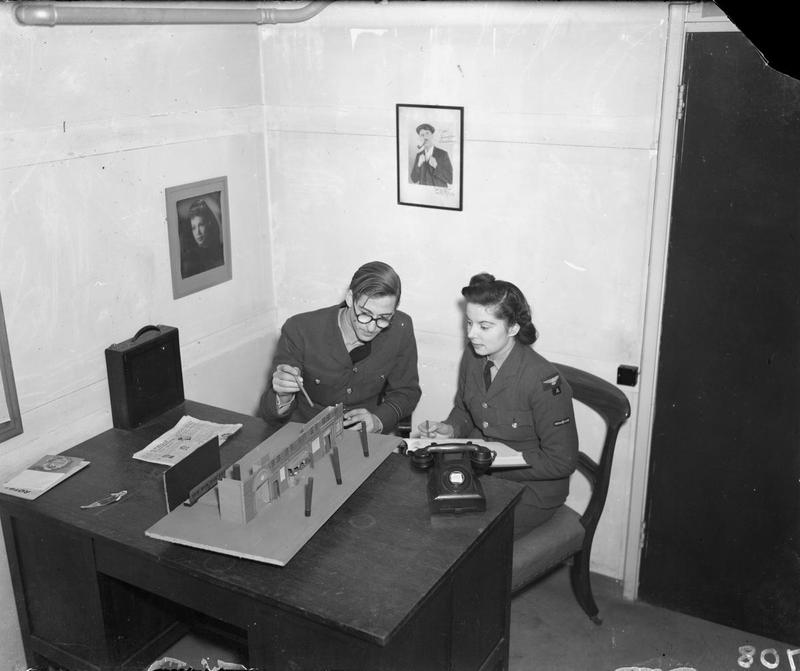
An RAF production photograph made during the Second World War shows director J. E. Boulting and Leading Aircraftwoman Doreen North seated together, discussing the setup of a railway-station scene for Journey Together.[5] The archive identifies North by the period label “continuity girl.” Whatever the limitations of that title, the image places her where the craft belongs: beside the director, looking at how a planned shot will work.
Melanie Williams's peer-reviewed roundtable with seven script supervisors describes the position as an on-set “memory bank,” but its participants repeatedly resist being mistaken for passive note-takers.[4] The information matters because someone has observed, interpreted, and communicated it. A report that says a cup was half full is useful; knowing that a changed eyeline weakens a reaction, that a missing setup limits a scene, or that an improvisation should be preserved for the editor requires filmmaking judgment.
The roundtable also gives the role's invisibility a labor history. Williams estimates that women make up about 85 percent of both the New York Script Supervisors Network and the relevant section of IATSE Local 161. She argues that continuity has long been feminized work, routinely noticed when a mistake survives but taken for granted when a scene cuts smoothly.[4] The historical photograph and the modern demonstration are separated by decades, yet both show a worker responsible for remembering the whole while each department concentrates on its part.
Digital capture has changed the tools, not the obligation to look. In Williams's discussion, practitioners value searchable documents and images but warn that filling a database or collecting monitor grabs can distract from the live action in front of them.[4] Pinson's performance in the video makes the distinction plain. She does not merely retrieve screenshots. She reconstructs what the scene is trying to say and tests whether its photographed pieces support that intention.
What remains when the mistakes are fixed
The comedy of the Vanity Fair scene depends on discontinuity being obvious. Professional script supervision usually aims for the opposite result: its labor disappears into a cut that feels clear. But invisibility should not obscure the creative stakes. The supervisor protects story time, performance, spatial logic, and the range of decisions still open to the director and editor.
That is why continuity is not simply a ban on change. A filmmaker may want a jarring cut, a violated axis, an altered gesture, or an impossible object. The useful question is whether the effect is chosen and supported, or accidental and expensive to repair. By recording what happened, identifying what is owed, and speaking before the next setup, the script supervisor turns memory into options. The cups and collars are only the visible edge of that work.
Sources
- Vanity Fair, “What Happens When A Movie Has No Script Supervisor? | Reverse Film School,” YouTube video featuring Martha Pinson, November 28, 2018.
- Los Angeles Script Supervisors Network, “What Is a Script Supervisor?” and department-by-department craft overview.
- Film Independent, “Know Your Crew: How the Script Supervisor Keeps It All On Track,” March 13, 2015.
- Melanie Williams, “‘A Film-maker Not A Note-Taker’: A Roundtable Discussion on the Craft of Script Supervision,” Open Screens 7, no. 1 (2024), UEA repository PDF.
- Wikimedia Commons, “Royal Air Force Film Production Units, 1941–1945. CH14182,” Royal Air Force official photograph by Henderson, from the Imperial War Museums collection.