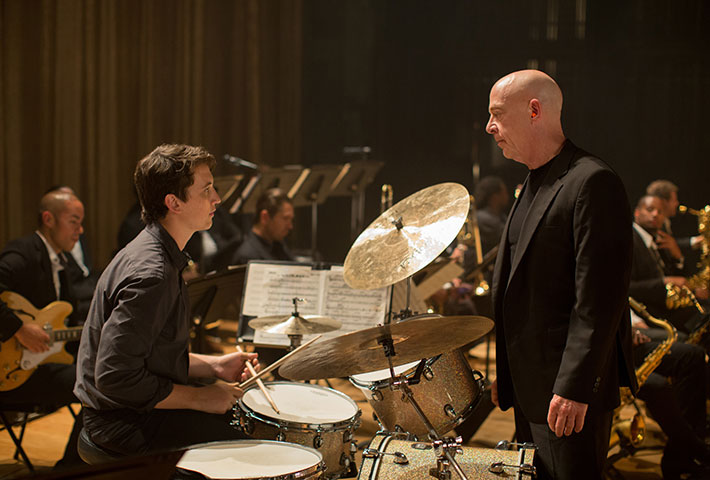

The obvious way to praise the editing in Whiplash is to call it fast. Tom Cross cuts drumsticks, cymbals, sheet music, tightening hands, Fletcher's signals, and Andrew's alarm into passages that seem to strike the viewer. The film won Cross the Academy Award for film editing, while its sound team also won for mixing.[4] Speed is plainly part of the achievement. It is not the organizing idea.
The sharper insight in BAFTA's 2015 Film Craft Sessions is that Cross treats a cut as a decision about power. A quick insert can make Andrew feel trapped inside a mechanism; a held face can let him take control of time. The useful question is therefore not whether a sequence cuts on the beat. It is who appears to own the beat before and after each cut—and what the audience is asked to feel while that ownership changes.[1]
The nine-minute video places Cross beside editors Barney Pilling and William Goldenberg, so Whiplash sits next to The Grand Budapest Hotel and The Imitation Game. Those comparisons matter. Pilling describes comedy built by timing bodies against precise camera moves; Goldenberg describes easing off a wartime plot's urgency so Benedict Cumberbatch's performance could breathe. Together, they reveal editing as calibrated attention rather than a universal appetite for velocity.[1]
Spoiler warning: this annotated viewing discusses the rehearsal scenes and the film's final performance.
0:30–1:38 — the collaboration begins before the footage
Cross first explains why he joined the Whiplash short that preceded the feature. The script attracted him, but the decisive encounter was with Damien Chazelle. Cross heard a director speaking through specific movies and through the language of editing, not merely describing a story he hoped somebody else would assemble. Their shared references became an early working grammar.[1]
That history complicates the fantasy of the editor as either invisible technician or rescuer summoned after production. Cross edited the financing short, learned Chazelle's taste, and entered the feature with a relationship already tested at small scale.[1] Chazelle and Cross later identified Raging Bull as the finale's major reference, a choice that named more than aggressive cutting. Scorsese and Thelma Schoonmaker's boxing sequences bind impacts to subjective flashes, faces, breath, and damaged duration. Whiplash borrows that permission to let a musical performance behave like bodily combat.[2]
This does not mean the film simply copies a sports-movie rhythm. Its central contest is stranger because conductor and drummer are making the same music while fighting over what the performance means. Cross has to preserve both simultaneity and opposition. Inserts of instruments prove that a performance is happening; reaction shots decide whether it currently belongs to Fletcher's discipline, Andrew's terror, or Andrew's defiance.
1:53–2:58 — a polished first cut can still be a sketch
At about 1:53, Cross moves from attraction to constraint. The feature shot for roughly 19 days. He cut while production continued and had an assembly about a week after shooting ended.[1][2] Under that schedule, knowing the footage was not a leisurely refinement. It was how the edit stayed alive while new material kept arriving.
Cross says contemporary rough cuts are expected to look polished, then offers the video's most useful correction: he still regards that first version as a sketch.[1] Polish and finality are different properties. A clean transition, synchronized music, and complete coverage can make an assembly presentable without proving that its emotional structure works. The director's return to the room changes the available questions. A cut that efficiently delivers information may be the very cut preventing a performance from gathering pressure.
That distinction is especially important for Whiplash because its surface can impersonate completion. Music supplies a grid. Chazelle storyboarded extensively and made an animatic for the finale.[2] It would have been possible to obey that preparation, hit every planned accent, and produce a sequence that felt finished. Chazelle later said an early version worked as a music video but not yet as the scene they needed. The repair was not more rhythmic accuracy. A new pass centered facial expressions so that the music carried a changing relationship.[2]
2:58–4:15 — knowing every shot creates permission to invent
The anecdote that follows sounds modest. Chazelle was certain he had filmed a shot; Cross, after briefly doubting himself, was certain the shot did not exist. His confidence came from having gone deeply enough into the material to know its negative space. Once the missing image was accepted as missing, the room could stop searching and build another solution from what it actually had.[1]
This is the editor's memory as a creative tool. Coverage is not a menu of interchangeable angles. Each take contains a distinct pressure: an eye-line lands differently, a hand enters early, a cymbal hides a face, a pause gives Fletcher command, a breath gives Andrew interiority. Knowing the footage means knowing which fragments can be made adjacent without flattening those differences.
It also explains why visible speed in Whiplash remains legible. The rehearsal passage that begins around 4:16 does not throw percussion images at the audience indiscriminately. Fletcher stops the band, questions Andrew, orders him to count, and converts a nearly microscopic timing dispute into psychological domination. Cross alternates command, response, bodily detail, and group space. The room contracts around Andrew because the edit keeps returning every musical fact to Fletcher's gaze.
The sequence is fast where panic needs fragmentation, but its cruelty depends on interruption. Music repeatedly starts and stops. A pause becomes threatening because the next cut may expose Andrew's uncertainty to the whole ensemble. Tempo is therefore not only the subject of the dialogue. It is the mechanism by which Fletcher controls when Andrew may act and when everyone else must watch him fail.
4:34–8:58 — two control cases for rhythm
The video's later editors make Cross's method easier to see. Around 4:34, Pilling explains that The Grand Budapest Hotel locates comedy not only in performances but in the timing of deliberate camera moves. A pan, stop, entrance, and hold can carry a joke to its endpoint. Retiming is not cosmetic; it determines when the viewer is allowed to recognize the gag.[1]
At about 6:24, Goldenberg describes nearly the opposite adjustment on The Imitation Game. His team initially emphasized codebreaking, war pressure, and the race against time. When that version shortchanged the personal story, they eased the pace and stayed with Cumberbatch. Fewer cuts could reveal more because duration gave the performance room to become the scene's event.[1]
These are not digressions from Whiplash. They disprove the idea that an editor has one signature speed. Pilling lets camera choreography deliver comic surprise; Goldenberg relinquishes urgency to recover character; Cross moves between fragmentation and held looks as authority changes hands. In each case, rhythm is the allocation of attention over time.
The finale: when the metronome loses jurisdiction
The film's last performance makes that allocation explicit. Chazelle's storyboards and animatic gave the sequence a formidable plan, and he described wanting an action scene before a music scene.[2] Yet the account of the early cut shows why a plan of impacts was insufficient. Andrew and Fletcher had to remain present inside the machinery. The sequence became coherent when their exchanged looks charted a new relation, not when every drum hit received an image.[2]
That relation is deliberately unstable. Andrew's solo can look like liberation, surrender to abuse, artistic transcendence, or some poisonous mixture of all three. The editing does not settle the ethical argument. Instead it makes the dangerous exhilaration intelligible. As Andrew seizes duration, Fletcher ceases to dictate every entrance and begins responding. Hands and instruments still matter, but faces now confirm that the hierarchy is being renegotiated in real time.
This is why the cut functions like a second drum kit. It does not merely duplicate the soundtrack's pulse. It plays another line against it: compressing time when Andrew is processed by Fletcher's system, stretching a glance when choice re-enters the scene, and arranging fragments so power can migrate without a speech. The audience feels the rhythm because the edit has first decided whose experience the rhythm serves.
Fast cutting is the film's most conspicuous technique. Cross's BAFTA discussion reveals the less conspicuous discipline beneath it: read the script, build a shared language with the director, learn the footage well enough to know what is absent, treat polish as provisional, and let performance overrule a perfect diagram.[1][2] Whiplash hits hard because its cuts keep changing function. They count, strike, accuse, withhold—and, in the final exchange, listen.
Sources
- BAFTA Guru, “The Editing of Whiplash & more | BAFTA Film Craft Sessions,” YouTube video, 2015.
- Michael Ordoña, “Whiplash's J.K. Simmons, Miles Teller and others dissect last scene,” Los Angeles Times, December 9, 2014.
- Sony Pictures Classics, “Whiplash” — official synopsis, credits, poster, and production-still gallery; still 6 is used as the article image.
- Academy of Motion Picture Arts and Sciences, “The 87th Academy Awards | 2015” — official winners and nominees, including Tom Cross for film editing and the Whiplash sound-mixing team.