Note: this essay discusses major plot turns and the ending.
Tod Browning's The Unknown is often remembered by its outrageous premise: Lon Chaney plays Alonzo, a circus knife thrower who performs as if he has no arms. That summary is accurate, but it makes the movie sound like a lurid story idea first and a film second. Its real shock is more technical. Browning and Chaney turn the human body into a special effect that keeps changing status: visible and hidden, vulnerable and threatening, performing and deceiving, a source of desire and a piece of evidence.
The American Film Institute's record fixes the industrial frame. The Unknown was an MGM silent feature released on June 4, 1927, directed by Browning, photographed by Merritt Gerstad, with Lon Chaney as Alonzo, Joan Crawford as Estrellita, and Norman Kerry as Malabar.[1] AFI also preserves the plot mechanism that makes the craft so cruel: Alonzo hides his arms, is identifiable by a doubled thumb, wins temporary safety by posing as an armless sideshow performer, and then chooses actual amputation after learning that the woman he desires recoils from men's hands.[1] The horror is not just that something extreme happens. It is that the film spends its whole running time teaching the viewer to watch hands, arms, shoulders, faces, and proximity as charged evidence.
A Performance Built From Subtraction
Chaney's reputation as a transformation artist usually points people toward makeup: The Hunchback of Notre Dame, The Phantom of the Opera, faces changed by wax, cotton, collodion, paint, and pain. The Unknown is different. The San Francisco Silent Film Festival notes that the role proved Chaney did not need heavy makeup to become unrecognizable as a screen presence; he described the work as making himself look armless for dramatic force rather than mere shock.[4] The craft challenge is therefore negative. Instead of adding a monstrous face, Chaney subtracts a visible part of the body from the performance.
That subtraction has to be sold in every shot. A performer pretending not to have arms cannot simply keep still. He has to eat, smoke, gesture, react, threaten, desire, and throw knives while the audience's eyes search for the absent limbs. Browning turns that search into suspense. Alonzo's torso is wrapped and costumed so the viewer reads his upper body as a sealed unit. His face, meanwhile, has to do too much: calculation, hunger, panic, tenderness, contempt. The face becomes expressive partly because the arms have been removed from the visible vocabulary.
The consolidated film record makes the composite nature of the illusion explicit: Chaney collaborated with real-life armless double Paul Desmuke, sometimes credited as Peter Dismuki, whose legs and feet supplied object manipulation in frame with Chaney's upper body and face.[3] That detail matters. It keeps the film from being reduced to a legend of solitary actorly sacrifice. Alonzo is a constructed screen body: Chaney's eyes and mouth, concealed shoulders, Browning's framing, Desmuke's foot work, and the circus props that make those feet legible as tools. The performance is not naturalism. It is a body assembled by cinema.
Feet Become Close-Up Technology
The knife-throwing act is the film's cleanest craft lesson. In ordinary screen grammar, hands carry intention. They point, grab, sign, strike, caress, and betray. The Unknown moves that grammar downward. Feet become hands, but not comfortably. They manipulate objects with enough precision to make the circus act plausible, yet the displacement keeps a faint unease in the frame. The viewer understands the feat and still cannot relax into it.
The same record foregrounds Alonzo as the carnival knife thrower who uses his feet to toss knives and fire a rifle at Nanon, while BFI's Browning guide identifies The Unknown as the best place to start with the director and describes Alonzo as a circus performer who appears armless while hiding his arms.[3][5] Those summaries point to a simple but powerful staging idea: Browning makes technique erotic before he makes it horrific. Nanon can stand near Alonzo because she believes he lacks the arms she fears. His bodily limitation, or rather his staged limitation, becomes the condition for intimacy.
That is why the feet are never merely a novelty. They are part of Alonzo's lie, but they are also part of his seduction. He has turned bodily difference into a professional identity, professional identity into emotional access, and emotional access into control. The act in the ring and the behavior outside the ring are continuous. The circus does not interrupt the plot; it teaches the plot how to move.
The Circus Is A Machine For Looking
Browning understood performance spaces as moral traps. In The Unknown, the circus is not just colorful background. It is an institution built around controlled staring. People pay to look at bodies under conditions that make looking feel permitted. Alonzo uses that permission. The audience thinks it is watching skill and spectacle. It is also watching a criminal disguise that works because the stage has licensed it.
AFI classifies the film under melodrama with a carnival/circus subgenre and subject headings that include amputation, circuses, disfiguration, phobias, revenge, and self-sacrifice.[1] Those catalog terms sound blunt, but together they show how compact the film's machine is. Every major element is bodily or theatrical. There is no large social panorama, no elaborate mystery architecture, no saving subplot to diffuse the pressure. BFI's guide likewise treats the film as Browning and Chaney's most concentrated collaboration, a story built from desire, bodily concealment, drastic surgery, and cruel reversal.[5] The narrowness is the point. The film behaves like a ring: once the viewer enters, everything important happens inside a circle of attention.
The staging makes Nanon's fear more than a plot device. Her aversion to men's hands turns touch into visible danger. Malabar's strength is therefore a problem before he does anything wrong; he is all arms, chest, and embrace. Alonzo seems safe because he appears to have removed the threatening sign. The terrible irony is that his apparent harmlessness is the most dangerous performance in the film.
Hands Become Evidence
The doubled thumb is one of Browning's sharpest details because it converts the hand into forensic identity. AFI's synopsis makes the mechanism plain: Alonzo poses as an armless performer to escape police attention, but his unusual thumb can reveal him.[1] In a weaker film, that might function only as a clue. Here it becomes a formal pressure point. The hidden arm is not just hidden ability. It is hidden guilt.
That double logic makes Alonzo's later choice more horrifying than a simple act of self-mutilation. He wants to remove both the evidence that can identify him and the bodily fact that prevents Nanon from accepting him. The operation is therefore criminal, erotic, and cinematic at once. It tries to solve a problem of visibility by changing the body itself. The fake absence that made the act possible becomes a real absence that arrives too late.
Browning's cruelty lies in timing. Alonzo does not amputate his arms into a stable fantasy. He does it into a changed scene. When he returns, Nanon has moved toward Malabar. The body he destroyed to become acceptable is no longer the body she needs. The film's melodrama is savage because it understands performance as something that expires. A role can work for one moment and ruin the next.
Faces Carry What Arms Cannot
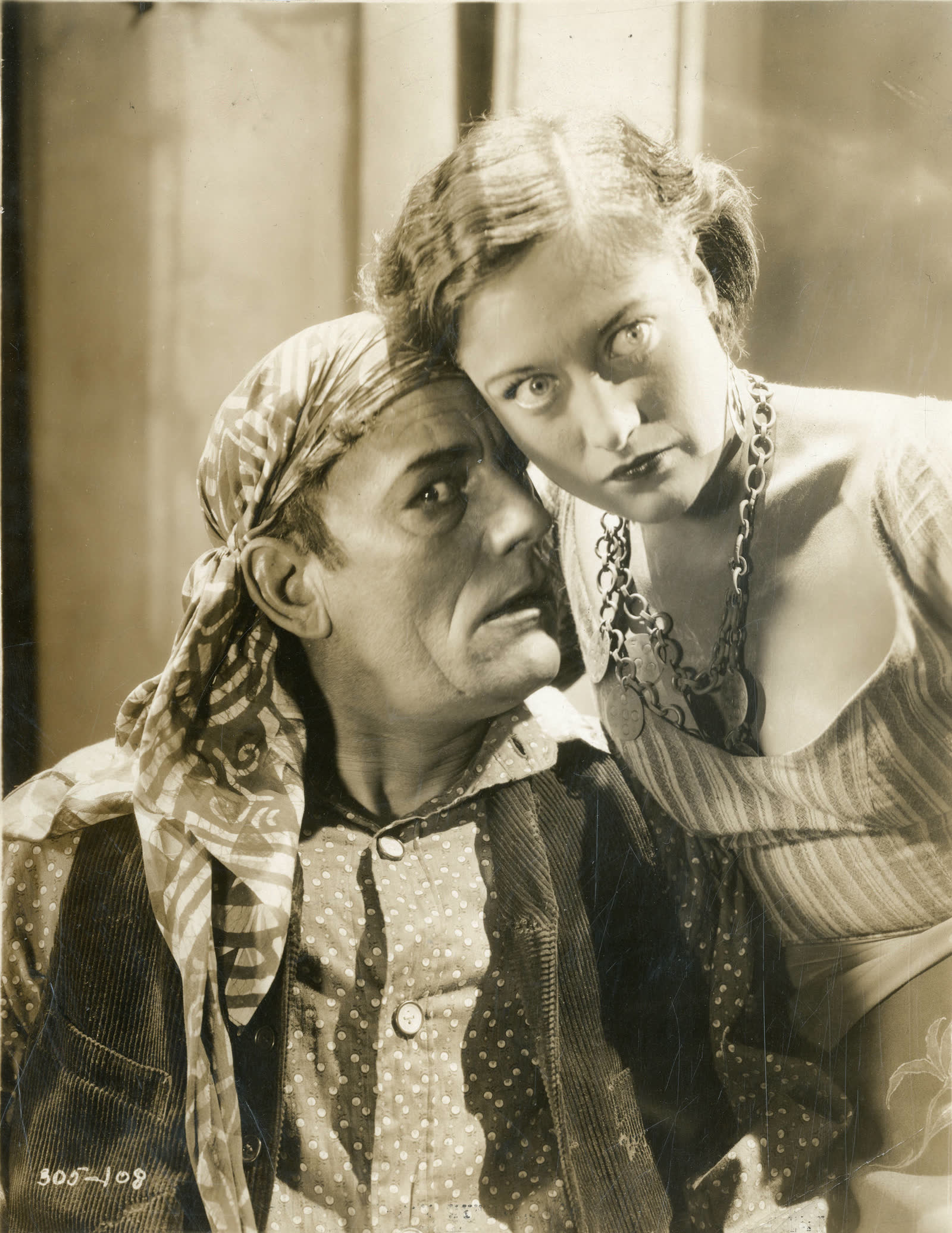
The still used for this article is useful because it does not show the famous foot work. It shows Chaney and Crawford in a tight relational frame: his face angled upward, hers leaning close, both caught in a charged pause.[6] That is the film's deeper craft. The absent arms make the faces louder.
Chaney's Alonzo often looks as if he is calculating faster than he can safely speak. The eyes lift, narrow, soften, or harden before the body can move. Crawford's Nanon, still early in her screen career, is not just an object of obsession; her flinches and lean-ins define the space that Alonzo tries to occupy. The San Francisco Silent Film Festival notes that Crawford later credited Chaney with teaching her film acting, and the point is visible in the still's pressure.[4] The scene depends on concentration rather than theatrical display. Two faces carry a whole system of touch that cannot yet happen.
The close face also keeps the film from becoming only a carnival oddity. Alonzo's deception is grotesque, but it is not abstract. Browning keeps placing it near human attention: Nanon's trust, Cojo's knowledge, Malabar's confidence, the audience's appetite. The body trick works because it is embedded in relationships. Horror enters through the distance between what people think they are seeing and what the frame knows they are not.
Restoration Adds A Second Kind Of Suspense
The film's modern force is also tied to survival. The National Film Preservation Foundation notes that The Unknown disappeared after its theatrical run and was thought lost for decades until a print surfaced in France.[2] George Eastman Museum's newer restoration added roughly ten minutes from a Czech export print held by the National Film Archive in Prague, bringing the running time close to the original release and using the original cutting continuity to create new English intertitles.[2] BFI's Browning guide supplies the broader preservation shadow: a fair share of Browning's silent-period filmography has vanished or survives only in damaged and abridged form.[5]
That history matters for a craft reading because The Unknown is a film about missing body parts that has itself reached viewers through missing and recovered material. The analogy should not be pushed too neatly; archival loss is not a metaphor the filmmakers designed. But restoration changes what the viewer can study. Extra shots, repaired continuity, and clearer access to the film's rhythms make Browning's bodily engineering easier to see as engineering rather than just pulp incident.
It also explains why the film can feel both ancient and newly abrasive. Silent cinema often reaches contemporary viewers through softened distance: old formats, old acting styles, familiar museum framing. The Unknown resists that distance because its central device is still physically legible. A hidden arm, a foot holding a cigarette, a knife thrown from below, a shoulder made suspicious by stillness, a face trying to replace a whole expressive body: these are not period references. They are immediate screen mechanics.
Why The Shock Still Cuts
What makes The Unknown endure is not simply that its plot is extreme. Extreme plots become quaint when the craft cannot keep them alive. Browning's film still cuts because every formal choice reinforces the same pressure: which body parts are visible, which are trusted, which are feared, and which are turned into performance.
Alonzo's false armlessness is a disguise, an act, a seduction strategy, a criminal shield, and a camera problem. Nanon's fear of hands is a psychological premise, but also a staging rule. Malabar's body is not just a rival's body; it is the opposite grammar of visible strength. Desmuke's doubling is not trivia; it is part of the film's composite body. The recovered restoration is not a bonus; it helps us see the shape of the machine.
The result is one of silent cinema's most unsettling craft objects. The Unknown does not merely show a man who will damage himself for desire. It shows cinema inventing a body that can lie better than speech, perform better than confession, and betray itself only when the frame asks us to look in the right place. The knives matter because they are thrown with feet. The hands matter because they are hidden. The face matters because, for most of the film, it has to carry everything the arms are not allowed to say.
Sources
- American Film Institute Catalog, "The Unknown (1927)" - film record, credits, release date, production details, synopsis, genre, and subject headings.
- National Film Preservation Foundation, "Reminder: Catch THE UNKNOWN on the big screen, September 30th!" September 25, 2023 - restoration note on the lost-film history, Czech export-print material, and George Eastman Museum restoration.
- Wikipedia, "The Unknown (1927 film)" - consolidated film record for plot, cast, production notes, Paul Desmuke/Peter Dismuki doubling, and restoration history.
- Scott Brogan, "The Unknown," San Francisco Silent Film Festival - program essay on Browning, Chaney, Crawford, performance context, and print source history.
- Martyn Conterio, "Where to begin with Tod Browning," BFI, July 12, 2018 - guide to Browning's horror cinema, the Browning-Chaney collaboration, The Unknown, and silent-film survival context.
- Wikimedia Commons, "File:The Unknown (SAYRE 14274).jpg" - 1927 still from the University of Washington J. Willis Sayre Collection used as the article image.