Note: this essay discusses the film's ending.
The Seventh Seal has almost too much symbolic capital. The chessboard on the beach, the white face of Death, the plague procession, and the hilltop dance have been reproduced so often that the film can look severe before it is watched. Janus describes it as a benchmark foreign import of America's 1950s art-house moment, while BFI calls it Bergman's much-imitated classic about a knight who buys time by playing chess with Death during a plague-ravaged Middle Ages.[1][2] Those summaries are right, but they can make the movie sound like a monument. Its real force is less monumental and more demanding: it asks whether doubt can become useful before time runs out.
Antonius Block returns from the Crusades wanting an answer. He wants proof that God is present, or proof that God is absent, or at least proof that the devil exists and therefore the supernatural order is not empty. But Bergman does not let the question remain safely intellectual. The knight asks it while pestilence moves through Sweden, while the Church stages fear as public theater, while bodies are punished in the name of certainty, and while ordinary people improvise food, jokes, desire, songs, and escape. The film's deepest question is not simply "Does God speak?" It is: what does a person do while heaven stays silent?
That is why the chess game is often misremembered when it is treated as the film's whole thesis. The game is not a philosophy seminar. It is a timer. Death gives Block a delay, not an explanation. Every move says that thought can buy a little space but cannot cancel the appointment. Turner Classic Movies notes the production's tight practical conditions, including producer Carl Anders Dymling backing the project on the condition that Bergman finish the shoot in thirty-five days.[5] That production fact rhymes with the drama. The film itself behaves like a limited schedule: each scene asks what can be done under a deadline that will not negotiate forever.
The origin story reinforces the point. Bergman's official production history traces The Seventh Seal back to Wood Painting, a play he wrote in 1953-1954 for actors at the Malmo Municipal Theatre, and to medieval art that had lodged in his imagination.[3] TCM likewise links the scenario to the church frescoes of Death that Bergman remembered from childhood and to the clout he had gained after Smiles of a Summer Night won at Cannes.[5] The film therefore begins from images of belief rather than from a tidy doctrine. Fresco, theater exercise, radio play, and film all pass through one another. Death is not an abstract proposition. He is a figure staged in front of people who need a way to picture what terrifies them.
That makes Block's hunger for proof both moving and dangerous. He is not foolish for wanting the silence to end. The film respects the ache behind his question. But when he looks toward the accused young woman and tries to use her terror as evidence of the devil, his search has already begun to deform. Suffering becomes a possible instrument for his metaphysical need. In that moment, doubt stops being honest inquiry and risks becoming consumption. The film is merciless about this. A person's pain cannot be redeemed by turning it into someone else's proof.
Jons, the squire, is the corrective, though not an easy one. He is not saved by a doctrine either. He has the roughness of a man who has seen crusading idealism rot into stupid violence and who no longer trusts grand speech. Senses of Cinema's Darragh O'Donoghue warns against reducing the film to Block's metaphysical quest alone, stressing that the film is also about the ways people structure, imagine, and stage death.[4] Jons belongs to that larger map. He mocks pious spectacle, notices predation, and acts when a vulnerable person is in front of him. His skepticism has weight because it keeps touching the ground.
The film's most unnerving public scenes show what happens when certainty takes over the ground. The flagellant procession is theatrical, but not in the harmless sense. It turns fear into choreography: bodies beating themselves, faces arranged for awe, religious panic given a route through the town. The execution of the accused woman works the same way. State, religion, crowd, and spectacle become one apparatus. O'Donoghue's reading of the film's artist figures and social rites is useful here because it keeps the film from becoming a private diary of one knight's anxiety.[4] Everyone is staging something in the presence of death. The question is whether the staging protects life or feeds on it.
Jof and Mia answer differently. They are performers, which means they also live by staging, but their art does not demand victims. Jof's visions can seem naive beside Block's anguish and Jons's hard jokes, yet the film does not treat him as a decorative innocent. He sees because he is not trying to dominate what he sees. Mia's gift is even less spectacular: milk, wild strawberries, a pause in the grass, a family rhythm briefly strong enough to interrupt the film's black weather. BFI notes the film's stark apocalyptic imagery, from storm birds to the final silhouetted dance, but the small meal matters because it refuses apocalypse as the only scale that counts.[2] For a few minutes, grace looks like hospitality.
That meal is the center of the film's ethics. Block does not receive the proof he wants, but he receives something better than an answer: a task. He has met people worth sparing. The later chess distraction matters because it is the first time his delay becomes mercy rather than self-extension. He knocks the pieces over, Death restores them, and the game continues, but the seconds have already changed ownership. Jof, Mia, and their child get a chance to leave. Block cannot defeat Death. He can only make Death look down long enough for someone else to move.
That is the film's least sentimental hope. It does not claim that a good deed solves the silence of God. It does not claim that innocence is safe. It does not even claim that Block becomes serene. When Death arrives for the gathered group, fear, prayer, defiance, and exhaustion remain unevenly distributed among them. The final dance is not a consoling image; it is too stark for that. But the dance is not the last moral fact. Somewhere outside the iconic silhouette, a family has been given distance.
Harvard Film Archive calls The Seventh Seal both an allegory of the search for meaning and a textbook in the craft of filmmaking.[6] The two descriptions belong together. The meaning does not hover above the craft. It is made by timing, blocking, faces, costumes, procession, intervals of silence, and the recurring decision to place grand questions beside ordinary gestures. The chessboard would be empty solemnity without the meal. Death would be a poster without the actors. The medieval setting would be pageantry without the pressure of practical choices.
This is why the film survives parody. The image of a knight playing chess with Death is easy to quote because it is simple. The film around it is harder to exhaust because it keeps refusing simplicity. Doubt is not enough. Certainty is worse when it becomes cruelty. Skepticism is strongest when it remains answerable to bodies. Art can terrify, exploit, comfort, or reveal, depending on what it asks from the people gathered around it. Faith, if the film permits the word at all, is not possession of an answer. It is the discipline of using borrowed time for someone other than oneself.
So The Seventh Seal is not only a film about silence. It is a film about conduct during silence. Block asks for God and hears no clear reply. The film asks what his hands can do before the reply comes, or never comes. In the end, the chess game matters because it is lost. The mercy matters because it is spent in time.
Sources
- Janus Films, "The Seventh Seal" film page - synopsis, release framing, formats, and art-house import context.
- BFI, "The Seventh Seal (1957)" - film page with credits, plague-allegory framing, Gunnar Fischer cinematography notes, and final imagery context.
- Ingmar Bergman Foundation, "The Seventh Seal" - official production page covering Wood Painting, production history, legacy, and medieval-art influences.
- Darragh O'Donoghue, "The Seventh Seal," Senses of Cinema, March 2009 - critical essay on death imagery, Jof, artist figures, and the film's staged social responses to mortality.
- Jay S. Steinberg, "The Seventh Seal (1957)," Turner Classic Movies, August 23, 2003 - production overview, plot framing, Cannes context, and thirty-five-day shoot note.
- Harvard Film Archive, "The Seventh Seal" screening page - institutional capsule on the film as allegory and filmmaking craft reference.
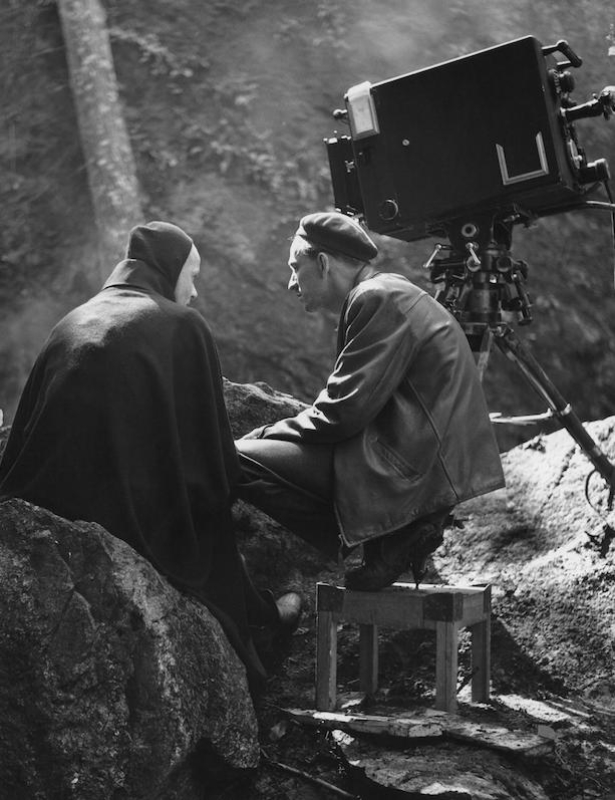
- Wikimedia Commons, "File:Bergman-Ekerot-1956.jpg" - Louis Huch / Svensk Filmindustri production photograph of Bergman and Bengt Ekerot used as the article image.