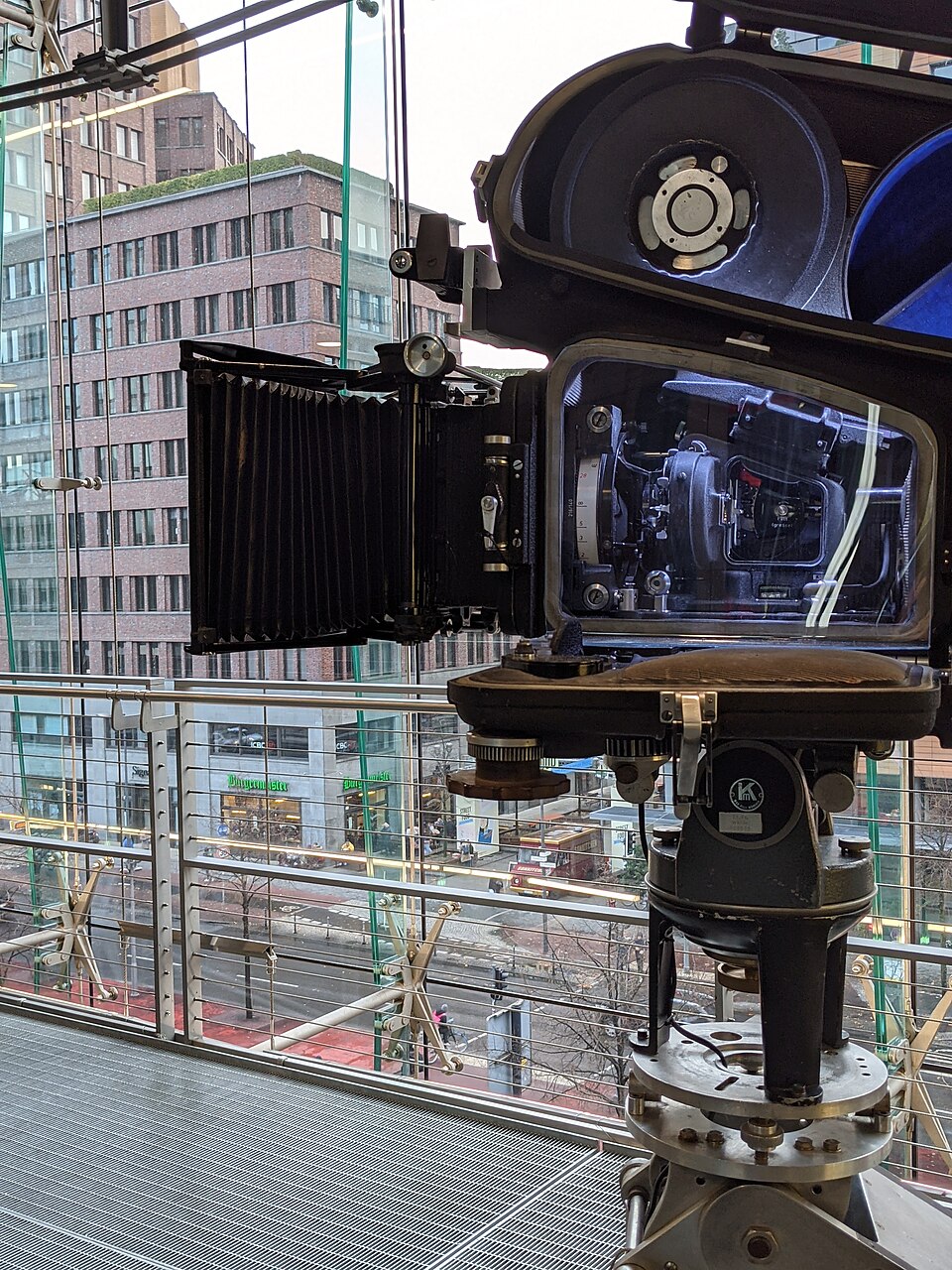
The Arriflex 35 matters because it changed where a 35 mm camera could make decisions. Heavy studio cameras had virtues: steadiness, silence when blimped, controlled operation, and a working culture built around precision. What the Arriflex added was a different production grammar. It let a camera operator carry 35 mm into cars, sidewalks, cramped rooms, documentary situations, and second-unit danger without giving up the ability to see through the taking lens.
That last phrase is the key. Handheld motion existed before the Arriflex, but handheld 35 mm with practical reflex viewing was a sharper industrial proposition. ARRI's own history says the ARRIFLEX 35 appeared as a prototype in 1936 and as a production-ready camera at the 1937 Leipzig Fair, weighing 13.5 pounds and giving the operator a parallax-free ground-glass image identical to the film frame.[1] The Science Museum Group puts the same breakthrough in institutional terms: ARRI introduced the first reflex mirror shutter in the Arriflex 35, an Erich Kaestner invention that later shaped professional motion-picture camera design broadly enough to be recognized by Scientific and Technical Academy Awards.[2]
The object in the cover image looks bulky because it is photographed inside a studio sound blimp, not stripped for handheld work.[7] That is useful rather than contradictory. The Arriflex story is not a fairy tale in which smallness solves everything. It is a story about the exact boundary between mobility, viewing, noise, and workflow.
The Viewfinder Changed The Operator's Job
The reflex shutter turned the operator's body into a more reliable measuring instrument. With parallax-prone viewing systems, framing could become an act of correction and compensation: the operator saw beside or above the lens and had to trust marks, habit, and mechanical alignment. With the Arriflex mirror reflex system, the operator could judge the recorded image through the lens itself, including focus and framing, while the camera remained compact enough for mobile use.[1][2]
That made handheld shooting less like a stunt and more like a repeatable craft. A camera can be light and still be blind. A camera can be accurate and still be too heavy to follow action. The Arriflex's importance was that it moved both constraints at once. The Museum of the Moving Image describes its Arriflex Type IIB/C as a German-developed handheld 35 mm camera with through-the-lens reflex viewing, exact framing during photography, and enough lightness and usability to attract independent filmmakers in the 1950s and 1960s.[3]
This is why the camera belongs in film technology history rather than equipment nostalgia. The tool changed the operator's timing. It let the person holding the camera react while still seeing the photographed field with technical confidence. The result was not merely "shaky camera." It was a new permission structure: the camera could notice in real time.
Compactness Had A Workflow Behind It
The later Arriflex 35 II line matters because portability only becomes production practice when loading, lenses, accessories, and repair habits can keep up. The Science Museum Group's Arriflex 2C record describes a 1960 ARRI camera using 35 mm film in 200-foot or 400-foot magazines, with a three-lens turret for quick lens changes and a viewfinder that could be closed to prevent stray light from reaching the film.[4] Those are not decorative details. They are the mechanics that let a small camera stay operational under pressure.
CinemaTechnic's technical profile of the Arriflex 35-II series makes the same point from the service-and-use side. The profile emphasizes the three-lens turret, compact film chamber, simple motor arrangement, magazine design, and fast threading as part of why the 35-II became so durable and practical.[5] A camera body is not just a box around film. It is a set of habits offered to the crew: how fast a magazine can be changed, how confidently a lens can be selected, how readily the camera can be moved, how often a minor problem stops the day.
This is where the Arriflex 35 differs from a purely romantic account of location shooting. Mobility did not come from abandoning discipline. It came from moving discipline into a smaller, more responsive package. The operator still needed focus, exposure, loading, support, and a working motor. The difference was that these tasks no longer automatically implied a studio-scale camera position.
Location Became A Financial And Stylistic Option
The Arriflex did not single-handedly invent New Wave cinema, documentary mobility, or low-budget independence. Film stocks, lenses, recorders, cars, labs, producers, unions, and taste all mattered. But the camera sat near a practical choke point: could a 35 mm production leave the usual controlled space and still return with usable images?
Norris Pope's Chronicle of a Camera, as summarized by the Academy Museum Store, traces the Arriflex 35 in North America from 1945 to 1972 and frames it as consequential because it widened production choices in theatrical filmmaking. The summary identifies three linked areas of change: location shooting, intensified visual style, and low-budget or independent production, with examples including Bullitt, The French Connection, and especially Easy Rider.[6] ARRI's own history makes a similar North American point, connecting captured wartime cameras, postwar import, Robert Flaherty's Louisiana Story, William A. Fraker's use of ARRIFLEXes on Bullitt, and Laszlo Kovacs's use of Vilmos Zsigmond's Arriflex 35 IIC on Easy Rider.[1]
Those examples matter because they show the camera as a business tool as much as an aesthetic one. Location shooting is expensive when every change of place drags a studio apparatus behind it. Independent production is fragile when every setup requires the scale of a larger company. A camera that could ride in a car, fit a cramped room, or move quickly through a street changed what kinds of schedules and scenes were feasible.
The Sound Problem Did Not Go Away
The Arriflex 35's strength also reveals its limit. The classic 35-II and 35 IIC cameras were not quiet sync-sound cameras in their bare form. CinemaTechnic is blunt about the practical boundary: a 35 IIC needs a blimp for sync-sound dialogue work, and without that containment it is better suited to MOS work, noisy environments, scratch tracks, second-unit shots, handheld coverage, and risky positions.[5]
That is why the cover photograph is so telling. The Blimp 300 wraps a mobile reflex camera in a large sound housing.[7] It makes visible the compromise: to silence the camera, you give back some of the freedom that made the camera attractive. In one configuration, the Arriflex is a handheld liberation machine. In another, it becomes part of a bulkier studio sound apparatus.
ARRI's later history shows the industry trying to solve that tension. The ARRIFLEX 35BL, launched in the early 1970s, was ARRI's first silent 35 mm production camera, designed around the need for a smaller self-blimped sync-sound machine and light enough to rest on the operator's shoulder.[1] In other words, the 35BL did not erase the earlier Arriflex legacy. It answered the next production question that the 35-II had made obvious: once 35 mm can move, how quietly can it move?
The Legacy Is Operational, Not Cosmetic
The easy mistake is to reduce the Arriflex 35 to a look: handheld roughness, car energy, street realism, a little more accident in the frame. The deeper legacy is operational. It changed the permissible distance between camera, operator, subject, and location. A director could imagine shots that did not begin with the question of whether a massive studio camera could be wedged into place. A cinematographer could intensify point of view without leaving 35 mm behind. A producer could see mobility as a budget and schedule strategy, not only an artistic indulgence.
That is also why the camera remains useful as a historical lens on modern filmmaking. Digital cameras have made the physical problem far smaller, and stabilizers, wireless video, autofocus systems, and lightweight rigs now multiply the options. But the underlying question is recognizably Arriflex-like: what changes in the movie when the camera can go where the scene is already alive?
The Arriflex 35 did not make cinema more truthful by itself. No camera does that. It made a certain kind of truth-seeking more practical: seeing through the lens while moving with 35 mm authority, accepting the limits of noise and sync, and forcing production culture to treat location as a working space rather than a special exception. That is a major technological event disguised as a small black camera.
Sources
- ARRI, "The History of ARRI in a Century of Cinema" - official company history covering the ARRIFLEX 35 prototype, 1937 launch, reflex viewing, postwar import, New Hollywood use, and ARRIFLEX 35BL.
- Science Museum Group, "Arri" - manufacturer record summarizing ARRI's 1917 founding, Kinarri 35, Arriflex 35 mirror-reflex introduction, awards recognition, and portable-camera role.
- Museum of the Moving Image, "Arriflex 35mm Camera, Type IIB/C, 1957" - gallery object label on handheld 35 mm through-the-lens reflex viewing and independent-filmmaker use.
- Science Museum Group, "Arriflex 2C 35mm cine camera" - object record for a 1960 Arriflex IIC, including 200/400-foot magazines, three-lens turret, and viewfinder light control.
- CinemaTechnic, "Camera Profiles - Arriflex 35-II Series" - technical profile covering the Arriflex 35-II design, magazines, motors, IIC model, sound limitations, and production use.
- Academy Museum Store, "Chronicle of a Camera" - product page for Norris Pope's Chronicle of a Camera: The Arriflex 35 in North America, 1945-1972, summarizing the book's account of location shooting, visual style, and independent production.
- Wikimedia Commons, "File:Filmmuseum Berlin - Arriflex 35 IIC with Blimp 300.jpg" - photographic source for the article image, a real Arriflex 35 IIC with Blimp 300 displayed at Filmmuseum Berlin.