Spoiler warning: this article discusses Harry Lime's entrance, the Ferris wheel scene, and the sewer chase ending.
When people remember The Third Man, they often remember three things first: the shadow in the doorway, the Ferris wheel speech, and the chase through the sewers.[1][3][4] That memory is accurate, but it can make the film sound like a string of famous set pieces in a very stylish thriller. Carol Reed's film is harsher and more exact than that. It does not merely decorate a Graham Greene intrigue with canted angles and zither music. It turns postwar Vienna into a machine for changing scale. A friend becomes a rumor, then a silhouette, then a face lit from below, then a man who can look at human beings as dots, and finally a hunted body reduced to noise in the tunnels beneath the city.[1][2][3]
That is why the film still feels so modern. Reed and cinematographer Robert Krasker make corruption visible not by overexplaining it but by controlling when a person becomes legible.[1][3] Harry Lime dominates the movie long before he fully appears, and once he does appear, the city keeps translating him into new forms: doorway light, carnival height, underground echo.[1][2][3] The result is a film in which moral collapse is experienced as a problem of perspective. Holly Martins does not simply discover that his old friend is rotten. He has to keep relearning how to see him. Occupied Vienna, scarred by war, divided by powers, full of rubble, black markets, and broken routes, becomes the instrument of that reeducation.[1][2][3]
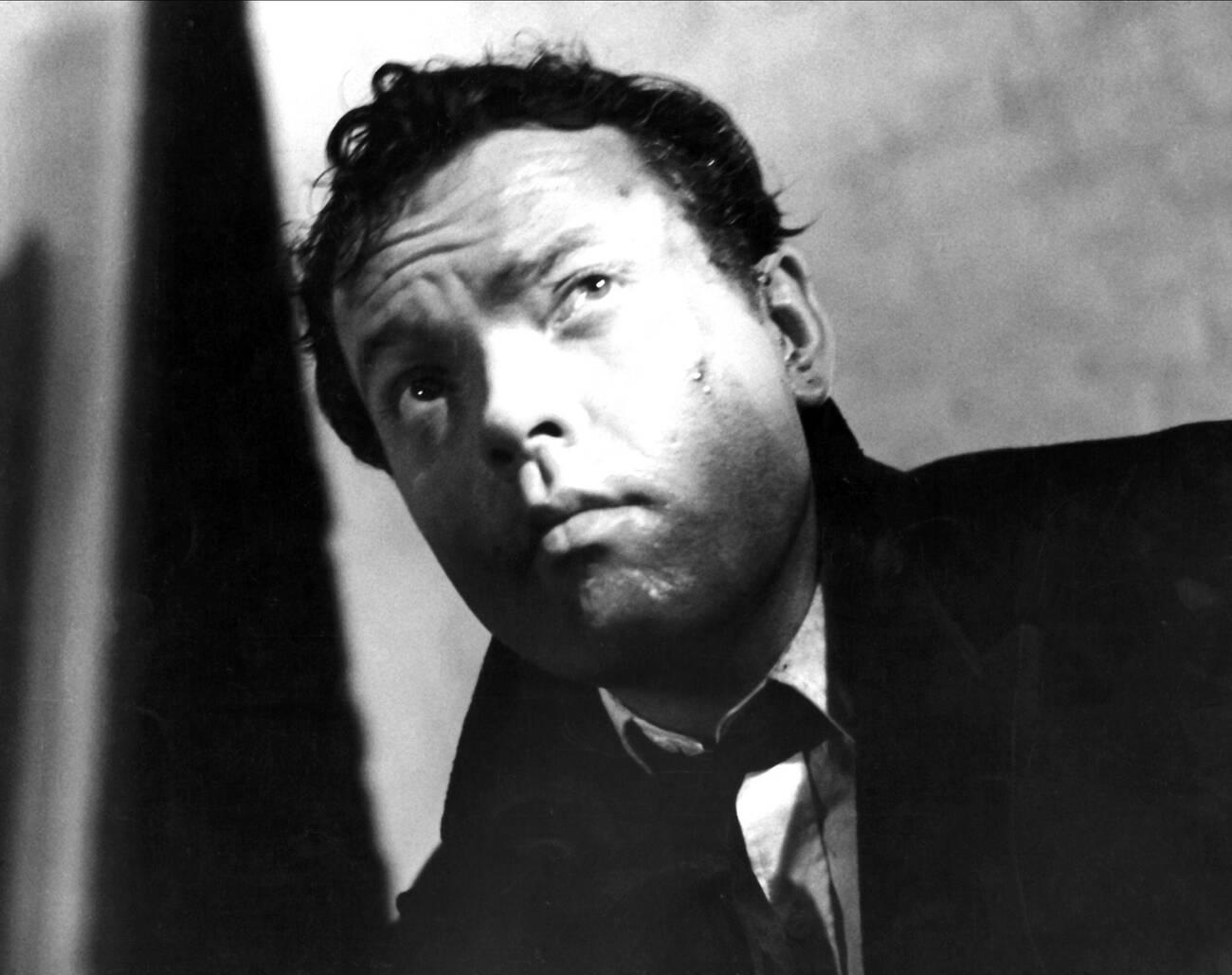
Image context: the lead image uses a real publicity still of Orson Welles as Harry Lime seen from below.[5] It fits this essay because Reed's film keeps making Lime arrive as a distortion in space before it grants him ordinary dramatic presence. Even at rest, the image makes him look half apparition, half angle of attack.
1. The doorway entrance works because light appears before character does
Harry Lime's entrance is famous enough to risk becoming a mere icon, yet it remains shocking because Reed structures it as a lesson in delayed recognition.[1][3] The film spends a long opening stretch filling Vienna with secondhand accounts of Lime: he is dead, or missing, or misunderstood, or entangled with the wrong people, or perhaps still the charming rogue Martins remembers. That narrative delay matters, but the scene would not have the same force without the visual design that completes it. A cat goes to the shoes first. A window opens. A light lands across the face. Only then does the absent friend become visible.[1][3]
Michael Wilmington's Criterion essay is especially good on the film's ruined Vienna as a near-nightmare environment, a real city made uncanny by off-angle framing and visual fracture.[1] The doorway scene condenses that whole strategy. Lime does not emerge into neutral space. He emerges from a street already prepared to turn identity into event. Reed lets the architecture collaborate with the deception. Martins has been asking for explanation; the city answers with illumination. Character arrives as a lighting effect.
That is why the moment stays richer than a simple plot twist.[1][4] It is not just that Lime turns out to be alive. It is that the film makes resurrection look inseparable from urban theatricality. Reed understands that charisma in noir is often an optical problem before it becomes a moral one. Martins sees his friend again and the shot seems, for a beat, to justify affection. Only later does the movie keep stripping that first thrill down. The doorway gives Lime back to Holly, but in a form already contaminated by performance.
2. The Ferris wheel scene turns friendship into altitude and people into arithmetic
If the doorway scene is about revelation, the Prater wheel scene is about distance.[1][3][4] By the time Martins and Lime rise above Vienna together, the movie has already made clear that their friendship survives mostly as inertia. Martins keeps wanting the old Harry back; Lime keeps speaking from a moral altitude that makes the old Harry impossible. The wheel gives that moral altitude literal shape. People on the ground shrink into moving specks, and Lime's notorious indifference to suffering stops sounding like a villain's flourish and starts sounding like the logic of height itself.[1][4]
BFI's writing on the film keeps returning to Vienna as both a devastated real place and a city of chosen details, where postwar damage, unstable loyalties, and brittle charm all coexist in the same frame.[3][4] The wheel scene is where that environment becomes an ethic. Lime does not need to shout his corruption. He only needs to look downward long enough for scale to do the work. Once human beings can be reduced to dots, casualty becomes countable, and countable things can be rationalized.
What hurts in the scene is not simply the cynicism of the speech. It is the way Reed stages Holly's listening.[1][3] Martins is trapped between intimacy and abstraction. He is physically close to Lime, enclosed in the same carriage, yet everything in the scene insists that the two men now inhabit different moral altitudes. The Ferris wheel does not just provide suspenseful height. It visualizes the point at which friendship becomes impossible because one friend has begun to perceive the world as arithmetic.
This is also where the movie's famous style proves it is not ornamental.[1][2] The tilted city, the circular machinery, and Anton Karas's zither all deny heroic steadiness. James Naremore's Criterion essay on listening to the film is useful here because it insists that the score never simply sweetens the action.[2] It makes Vienna sound jaunty, brittle, and faintly mocking. On the wheel, that sound keeps the scene from hardening into a solemn debate. The music reminds us that corruption can wear wit very easily.
3. In the sewers, the city finally stops turning Lime into myth and makes him sound mortal
The sewer chase is the film's most obvious climax, but it matters because it reverses the terms of the earlier scenes.[1][2][3] Harry Lime had entered as a magical return in a doorway and then looked down on the city from a carnival height. In the sewers he loses both glamour and altitude. He is forced below ground, into a space of drips, grates, echoes, and dead ends. The city that once helped stage his legend now breaks that legend apart into acoustics.
Reed's direction here is extraordinarily severe.[1][3] The chases in many thrillers clarify pursuit: the hunted man runs, the pursuers close in, and space becomes a map of narrowing options. In The Third Man, space becomes more confusing as the net tightens. Walls curve, tunnels fork, footsteps rebound, and Lime's body seems to disperse into sound before it can fully settle into a target. The effect is not just excitement. It is attrition. Myth is being ground down into breath and panic.
Naremore's emphasis on the film's sound world matters even more in these closing passages.[2] The zither has always made the city feel slyly unstable, but in the sewers Reed adds a different register: splashes, echoes, whistles, distant shouts, metallic resonance. Vienna ceases to be the picturesque ruin of a postwar postcard and becomes an underworld of exhausted reverberation. Martins is no longer chasing the dazzling friend of stories. He is chasing what those stories sound like once they have nowhere noble left to stand.
The final images complete the reduction.[1][3] Lime's fingers through the grate are often remembered as one last expressionist flourish, yet they are also brutally literal. The hand reaches upward, but it does not recover height or authority. The body that once seemed to control entrances and viewpoints can only scrape at the surface from below. The chase ends not with a grand confrontation of ideals but with a trapped limb, a shot fired, and a silence that drains the glamour from everything before it.[1][3]
That is why The Third Man lasts.[1][2][3][4] Reed does not present corruption as a stable identity trait that Holly finally uncovers. He presents it as a sequence of visual and acoustic transformations. Harry Lime begins as a story, becomes an image, argues from above, and dies in echo. The doorway light, the Ferris wheel, and the sewers belong to one continuous design: each scene changes the scale at which Holly can understand the man he thought he knew. By the time Anna walks past Holly in the last shot, the film has already finished its hardest work. Friendship has not been disproved in the abstract. It has been forced through a ruined city until only distance remains.[1][3]
Sources
- BFI, "The Third Man (1949)" film page.
- Nick James, "Location, location, location: Vienna and The Third Man," BFI.
- Adam Scovell, "The Third Man: in search of the Vienna locations, 75 years later," BFI.
- BFI, "The annotated shooting script for The Third Man, minus the 'cuckoo clock' speech."
- Wikimedia Commons, "File:Harry Lime from below.jpg" - publicity still used for the cover image.