Jacques Tati is still often filed under a soft category that makes him smaller than he is: gentle comic, whimsical nostalgist, lovable enemy of gadgets.[1][2] Those labels catch part of the surface and miss the force underneath. Tati was not simply lamenting modernization from a cozy distance. He was one of cinema's great analysts of coordination. His films keep asking what happens when design, speed, signage, etiquette, machinery, and public routine get just misaligned enough to make ordinary life absurd. A door opens too late, a chair squeaks too loudly, a traffic pattern keeps people circulating without arriving, a restaurant's polished surfaces begin to fail, and suddenly the whole social order has to be renegotiated in public.[1][2][3]
That is why his comedy feels so durable in 2026. Tati understood that modernity is lived less as ideology than as choreography.[2][3][6] People learn where to stand, how loudly to speak, which sounds to ignore, which routes to trust, how fast to walk, and what kind of face to wear inside office towers, suburban houses, train stations, and road systems. His films are funny because these instructions never quite hold. They are humane because he does not treat breakdown as proof that people are foolish. He treats it as proof that environments are always making demands on bodies, and that dignity often lies in the little improvisations by which people help one another through the mess.[1][3][6]
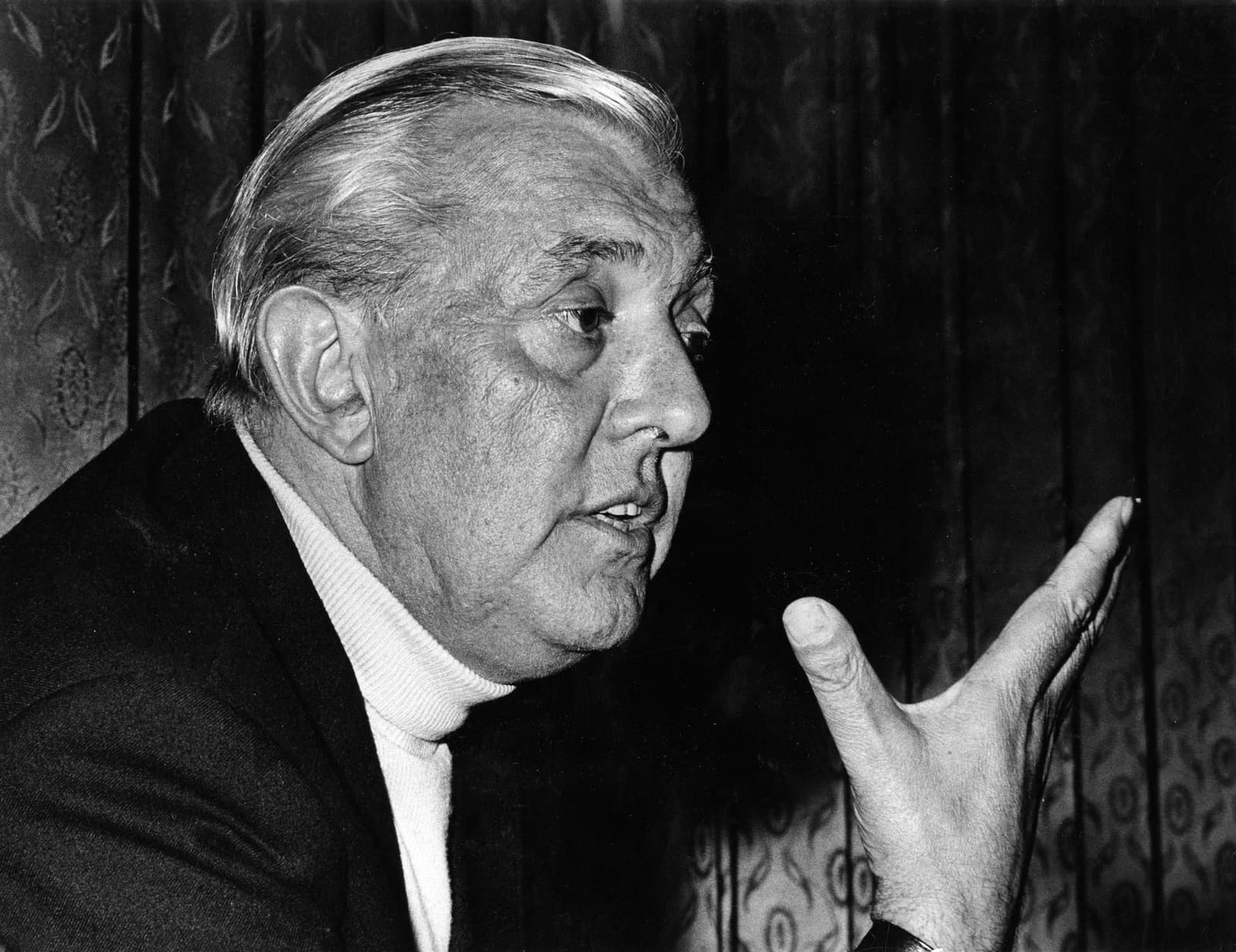
Image context: the lead image is a real press photograph of Tati in Helsinki in September 1969, where he was promoting Playtime.[7] It belongs here because a Tati profile needs a documented public image tied to circulation and exhibition, not a generic studio portrait. He appears as a tall, slightly off-center figure moving through a civic occasion, which is exactly how his films keep teaching us to notice people in space.
Tati's comedy begins with timing, not punch lines
The best broad overview in English may still be Jonathan Rosenbaum's Criterion essay on Tati's composing in sound and image, because it insists that his films are built from audiovisual timing rather than from dialogue or isolated jokes.[1] Sound in Tati is never mere accompaniment. Shoes click, glass hums, doors hiss, motors sputter, public-address systems flatten language into atmosphere, and the world acquires a comic rhythm before anyone "performs" a gag.[1] Jaime Christley's Senses of Cinema profile pushes the point further by treating Tati as an artist of entire environments rather than a maker of skits.[3] What matters is not only Monsieur Hulot or the village postman or the traffic engineer. What matters is the field they move through.
You can see this from the beginning. In Jour de fete, modern efficiency arrives in the French countryside as a promise that delivery can be quicker, smarter, more American.[2][3] Tati does not answer that promise with a speech. He answers it with bodily misfit: wobbling bicycles, uneven roads, overexcited acceleration, and the gap between imagined speed and actual rural terrain. The joke is not "technology bad." The joke is that systems imported as abstract prestige still have to pass through local bodies, habits, and material limits.[2]
That insight keeps returning. Tati loves schedules, uniforms, routes, and procedures because they reveal how much social life depends on fragile repetitions. When a repetition slips, embarrassment spreads through a room like weather. His characters are not heroic rebels who smash systems from outside. They are participants whose slight delays or misunderstandings expose how artificial the smooth surface always was.[1][2]
In Mon oncle, modern comfort becomes a performance nobody can inhabit naturally
If one film states Tati's middle-period method most clearly, it is Mon oncle.[2][4] Matt Zoller Seitz's Criterion essay on the film is especially good at noticing how the Arpel house turns design into ritualized misbehavior. The famous fish fountain, the manicured yard, the automated kitchen, the segmented paths across the garden, all of it looks like convenience, yet every object requires a performance of correctness.[4] Guests must enter the right way. Furniture dictates posture. Hospitality becomes an obstacle course.
Tati's great move is that he never shoots this world as a single tyrannical symbol.[2][4] He lets its absurdity emerge through repeated use. Hulot does not give us a philosophical critique of modern domestic architecture. He brushes against it, misreads it, detours around it, and exposes how much energy this "efficient" house consumes in order to keep up appearances. David Parkinson's BFI guide to Tati's modern world sees the same pattern across the work: machines and planned environments are less scary than faintly ridiculous, because they force human beings into overly scripted relations with one another.[2]
The contrast with the old neighborhood matters for the same reason. Tati is not idealizing poverty or prewar quaintness. He is distinguishing between spaces that tolerate improvisation and spaces that punish it.[2][4] In the older streets, movement bends and adjusts. In the Arpel house, movement is supposed to become obedient geometry. Comedy appears when the geometry fails.
In Playtime, the city becomes democratic because no single person can dominate the frame
Playtime is the decisive expansion of Tati's method.[1][5][6] Kent Jones's Criterion essay describes it as Tati's film about "everybody," and that phrase gets to the center of what makes it radical.[5] The movie does not ask us to follow one star through a chain of plot points. It asks us to scan an environment where attention is constantly redistributed across glass partitions, office corridors, airport waiting areas, trade-show booths, and the disastrous Royal Garden restaurant. Modernity here is not a theme added to comedy. It is the entire visual and sonic operating system.[5][6]
BFI's film page on Playtime captures the arc exactly: the office block first behaves like a prison of glass and steel, then the ruined restaurant turns malfunction into a shared liberation.[6] That second movement is crucial. Tati is not a prophet of total alienation. He is interested in the point where overdesigned space breaks down and people begin helping one another through the debris. A torn chair becomes manageable if everybody agrees to pretend. A broken doorway becomes a new kind of stage. A formal nightclub gradually mutates into a commons. Social grace is rebuilt from below, improvisationally, once top-down smoothness collapses.[5][6]
This is why Playtime has remained central to Tati's reputation while also threatening to flatten it.[3][5] It is easy to remember the film as one supreme satire of glass-box urbanism. That is true, but incomplete. Tati's deeper subject is the circulation of attention. He wants the viewer to wander, to catch a gag at the edge of the frame, to notice that one person's inconvenience is another person's cue. The city becomes comic because no one, not even Hulot, fully commands it.[1][5]
In Trafic and the late work, delay becomes a form of social knowledge
MoMA's retrospective description of Tati is helpful because it frames the six features as one coherent project rather than as a climb toward one masterpiece.[8] Seen that way, the late films are not afterthoughts. They extend his central problem. In Trafic, cars are not glamorous objects but moving compartments of impatience, aspiration, national style, and logistical absurdity.[2][8] Everyone is trying to get somewhere. Everyone is trapped in shared delay. The road does not express freedom; it organizes collective inconvenience.
That turns out to be one of Tati's most prophetic ideas. He understood that advanced systems do not remove friction. They redistribute it.[2][3][8] Airports create queues, roads create jams, office transparency creates confusion, domestic gadgets create maintenance theater, and leisure itself becomes scheduled performance. Yet Tati never abandons pleasure. He keeps finding tiny acts of rescue inside the friction: a glance, a pause, an accidental rhythm, a stranger briefly joining the same improvisation.
That is the final reason his films remain alive. They do not flatter the fantasy of perfect flow. They show that human fellowship often appears only after the flow has failed. Tati's cinema is full of glass lobbies, traffic loops, squeaky plastic, chrome surfaces, and public systems that overpromise control. What he keeps rescuing from all of that is a modest, comic ethics: people become more legible, and sometimes more generous, when the plan stops working. That is why his modernity still feels contemporary. He did not just film gadgets or old France or one funny walk. He filmed the unstable agreement by which strangers share a world.[1][2][3][5][6]
Sources
- Jonathan Rosenbaum, "Jacques Tati: Composing in Sound and Image," The Criterion Collection.
- David Parkinson, "A user's guide to the modern world... according to Jacques Tati," BFI.
- Jaime N. Christley, "Tati, Jacques," Senses of Cinema.
- Matt Zoller Seitz, "Mon oncle," The Criterion Collection.
- Kent Jones, "Playtime," The Criterion Collection.
- BFI, "Playtime (1967)" film page.
- Wikimedia Commons, "File:Jacques-Tati-1969-a.jpg" - photograph of Jacques Tati in Helsinki promoting Playtime.
- MoMA, "Jacques Tati" retrospective page.