Frank Perry's The Swimmer begins with a joke that does not know it is a confession. Ned Merrill, played by Burt Lancaster, looks across the bright pools of affluent Connecticut and decides that he can swim home through them. He names the route the Lucinda River, after his wife, as if private property can become a personal waterway by force of charm. The premise is absurd, but the film treats it with unnerving seriousness: one man, one summer day, one string of backyard pools, one home that keeps receding into myth.[1][2]
That is why the movie's power does not come from plot surprise. It comes from repetition with damage. Each pool looks like a variation on the same promise: money, leisure, cocktails, sun, neighbors who should remember the rules of belonging. Yet every stop changes the social temperature. Ned begins as a figure of athletic confidence, all shoulders and greeting-card optimism. By the end, the same body has become evidence against him. The route does not return him to domestic security. It turns suburbia into an obstacle course built from the things he once mistook for proof that his life was intact.
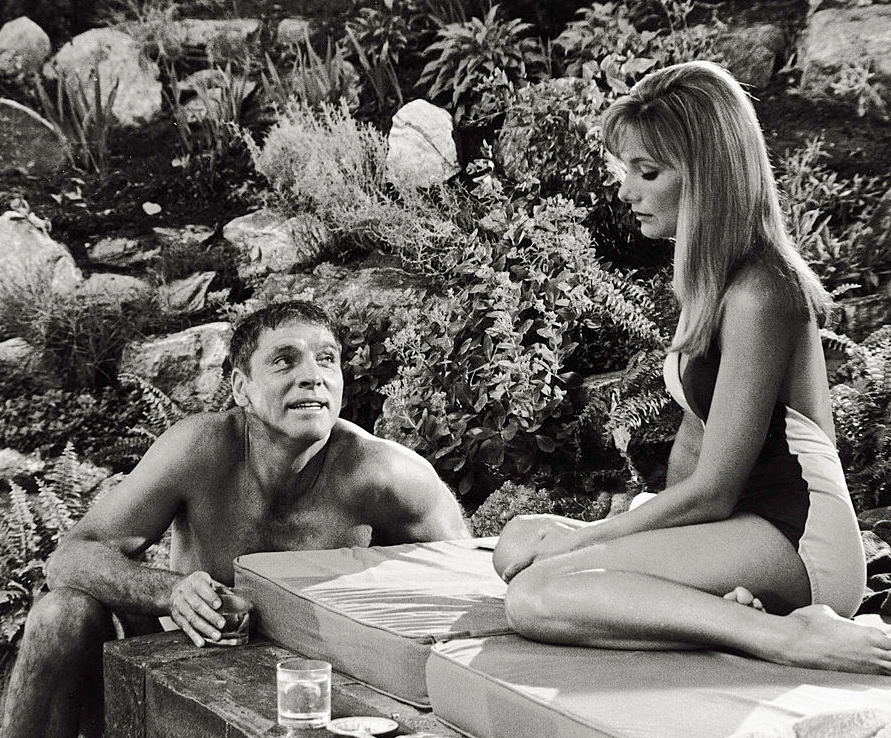
The film was released in 1968, but AFI's production record keeps the facts plain enough to show how strange the object already was: Frank Perry directed, Eleanor Perry adapted John Cheever's story, Burt Lancaster starred as Ned Merrill, and the location record places the film in Westport and Fairfield County, Connecticut.[1] Those details matter because The Swimmer is not an abstract fable staged against generic wealth. It is a geographically precise fantasy of upper-middle-class ease. Lawns connect. Houses sit close enough for rumor to travel. Pools are private, but the whole neighborhood behaves like one extended social machine.
Cheever's source story makes the machine even sharper. Susan Cheever's account of the story's origins describes a Westchester pool culture of elegant estates, mythic self-invention, local gossip, and the image of a prosperous man crossing the county from pool to pool.[4] The story began, by her telling, as something larger before Cheever cut it down into a concentrated ten-page allegory.[4] The film inherits that compression but adds something cinema can do with cruel efficiency: it makes Ned's self-deception visible on a body that keeps moving even after its story has failed.
That body is the film's essential instrument. Senses of Cinema is right to emphasize Lancaster's face and gestures as the route through the movie's loneliness, not just as star charisma or late-career athletic display.[3] Lancaster's casting creates the necessary contradiction. Ned has to look plausible as a heroic swimmer, a host's delight, a man who might stride out of a 1950s liquor advertisement and make everyone forgive him before dinner. But he also has to look increasingly wrong inside that image. The film needs the glamour because the glamour is the trap.
At first, Ned's fantasy seems almost contagious. He treats the linked pools as if they reveal a hidden civic order: one estate joins another, one guest right leads to the next, and a man known in the right houses can cross private land as if it were open country. That is the beautiful lie of the Lucinda River. It converts exclusion into adventure. Gates, hedges, patios, and cabanas become scenery for a self-mythologizing quest rather than evidence of class division. Ned can imagine the neighborhood as a river only because he assumes every pool is still available to him.
The movie then starts removing permissions. Acquaintances are not as delighted as he expects. Old intimacies curdle. The youthfulness he projects onto himself begins to seem not liberating but evasive. A child can briefly receive him as a figure of instruction; an old lover can receive him as a debt that has come walking back in wet trunks. Each encounter asks the same question in a different social key: what if Ned's remembered life is not merely out of date, but false?
Roger Ebert's 1968 review saw the film's unusual demand clearly. He summarized the premise as a man beginning in the freshness of a beautiful day and moving through a chain of backyard pools, but the review's real insight is that Lancaster must carry heroic plausibility for the fall to register.[2] If Ned were only a fool, the film would be a satire. If he were only a victim, it would be a tragedy with clean sympathies. The Swimmer is harder than either. It makes the audience watch a man whose confidence has social roots, moral costs, and genuine pathos.
That ambiguity is why the pools matter more than the house. A conventional version of this story would save revelation for the final destination: the locked door, the missing family, the evidence that Ned has been living after the end of his own life. Perry's film does not wait that long. The destination is already leaking backward through the route. Every pool is a smaller version of the lost house, because every pool is a claim that has stopped holding. Friendship, desire, paternal authority, neighborhood status, sexual charm, and masculine stamina all become shallow water he has to cross in public.
The public pool sequence makes the private fantasy collapse most bluntly. Ned's journey began in lush backyards where access could be softened by manners. A public facility works by rules, fees, bodies, hygiene, noise, and crowding. It refuses his private mythology. There, he is no longer a legendary figure crossing a named river; he is a wet, aging man required to submit to the same procedures as everyone else. The humiliation is not incidental. It exposes how much his earlier freedom depended on social recognition rather than on any true openness in the landscape.
The film's production history also shadows its form. Susan Cheever's 2025 account describes a troubled adaptation: the Perrys wanted a serious literary film, Lancaster prepared intensely, Columbia and Sam Spiegel became involved, Marvin Hamlisch replaced the imagined Miles Davis musical atmosphere, and the movie's making entered its own period of compromise and alteration.[4] AFI's credits and release data stabilize the official record, but the afterlife of the film has always included the sense of a work patched together under pressure.[1][4] That pressure may help explain its odd tone. The Swimmer feels at once literal and hallucinated, elegant and damaged, over-bright and already late.
The ending is devastating because the movie has spent the whole day teaching us how to read absence. By the time Ned reaches home, home has stopped being a place and become a verdict. The empty property does not simply reveal that he has lost his family and status. It reveals that he has been using motion to postpone knowledge. Swimming looked like progress because each new pool created another interval before recognition. The final door removes the interval.
That is the film's most durable idea. American suburbia often sells itself through surfaces that promise continuity: lawn, pool, marriage, children, cocktail hour, address. The Swimmer does not deny the seduction of those surfaces. It lets them glitter. Then it makes the viewer notice that a surface can reflect a life without holding it up. Ned Merrill's tragedy is not that the pools were fake. They were real. The neighbors were real. The water was real. What failed was the story that connected them into a home.
Sources
- American Film Institute Catalog, "The Swimmer (1968)" - release data, credits, cast, and Connecticut location records.
- Roger Ebert, "The Swimmer" review, July 2, 1968 - contemporary critical response to the film's premise and Lancaster's heroic plausibility.
- Senses of Cinema, "'I used to believe in things': On Frank and Eleanor Perry's The Swimmer (1968)" - close critical account of Lancaster's embodied performance and the film's loneliness.
- Susan Cheever, "Off the Deep End: Susan Cheever on the Story Behind 'The Swimmer'," Vogue, September 29, 2025 - account of John Cheever's story, its pool-world origins, and the film adaptation.
- Wikimedia Commons, "File:Burt Lancaster and Janice Rule 1968.jpg" - source page for the 1968 photographic still used with this article.