Oscar Micheaux is often introduced by a milestone, and the milestone is real: he was the first major Black feature filmmaker in the United States, a writer-producer-director who worked outside Hollywood from the late silent era into the sound years.[2][4] But the label can make him sound like a doorway that history passed through on the way to someone else. That misses the point. Micheaux's achievement was not simply that he got there first. It was that he treated independence as an entire production method.
He did not only direct films. He found stories, raised money, sold books, adapted his own material, negotiated with theater owners, handled distribution, argued with censors, and kept making work for Black audiences that mainstream cinema either caricatured or ignored.[2][3][4] In that sense, his authorship was not confined to mise-en-scene. It lived in the circuit: page to prospectus, stock sale to shoot, print to theater, controversy to the next project.
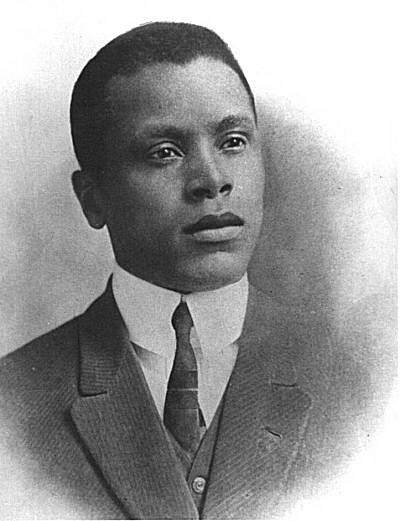
Before cinema, he learned the road
Micheaux's film career makes more sense if it is read through his earlier work as a self-publisher and salesman. Britannica traces the line from Pullman porter to South Dakota homesteader to author, noting that he turned his frontier experiences into self-published books, including The Homesteader.[4] The Encyclopedia of the Great Plains gives the crucial business detail: Micheaux controlled the production and distribution of his novels, then sold them door to door across the Midwest and South.[5]
That habit mattered. When Lincoln Motion Picture Company showed interest in adapting The Homesteader, Micheaux did not accept the usual position of author whose material would be handled by someone else. The deal collapsed because he wanted control over the filming itself.[3][5] He then formed his own film and book company, sold shares, and produced The Homesteader as his first feature.[3][5]
This is the first key to Micheaux's profile. He did not enter movies as someone waiting to be admitted into the studio system. He entered with a portable commercial logic already in hand. He knew how to locate an audience, speak to it directly, and move a product through channels that did not require white industry approval. The later films may look technically uneven beside studio productions, but the business grammar behind them was sophisticated: Micheaux understood that control over distribution could be as artistically important as control over the camera.
Race films were not a niche to him; they were a public
Micheaux's cinema grew inside the race-film world, a market built by and for Black audiences during segregation. The Library of Congress essay on Within Our Gates notes that by 1910 there were more than two hundred Black-owned movie theaters, rising toward seven hundred within a decade.[3] That network did not remove the obstacles facing Black filmmakers, but it created a public that could be addressed without pretending Hollywood's audience was the only audience.
The Smithsonian's National Museum of African American History and Culture describes Micheaux as the most successful Black independent filmmaker of the race-movie era, writing, directing, and producing approximately 40 films between 1919 and 1948 while working directly with theater owners to finance, distribute, and market them.[2] Britannica gives the same career in broader terms, emphasizing that he distributed by hand and used completed films to secure financing for the next one.[4]
That practical chain shaped the films. Micheaux could not afford the illusion that art floated above economics. The audience had to be found. The print had to travel. The next budget had to be raised. A film's political force therefore depended on its ability to survive as an object in circulation. He made cinema as someone who knew that a movie was not finished when the negative was assembled; it was finished when it reached rooms that Hollywood had treated as peripheral.
The films answered stereotypes by complicating the answer
Micheaux's work is sometimes framed as a response to racist representation, especially after The Birth of a Nation in 1915. That is true, but it can be too tidy. The NAACP summarizes his career as one that depicted contemporary Black life and complex characters while countering negative portrayals on screen.[7] The Smithsonian adds that he took on subjects that were taboo in commercial cinema: lynching, interracial sex, religious hypocrisy, color prejudice, and class division inside Black communities.[2]
That list is important because Micheaux did not answer stereotype with spotless uplift alone. He could be moralistic, blunt, melodramatic, and uneven. He could also be bracingly unwilling to flatter any side of the social order. Columbia's page for Oscar Micheaux and His Circle frames his silent-era work as controversial because it confronted lynching, miscegenation, peonage, white supremacy, passing, and corruption among Black clergy.[6] This is the difficult energy in Micheaux: he wanted Black life on screen, but he did not reduce Black life to a reassuring image campaign.
Within Our Gates makes that tension vivid. The Library of Congress essay describes how the film placed education, migration, philanthropy, sexual violence, and lynching inside a melodramatic structure, while also noting the censorship pressure that followed its 1920 release in cities including Chicago, Detroit, Shreveport, and Omaha.[3] The film's force comes from that unstable mixture. It is not polished into institutional respectability. It is trying to say too much because the official screen had said too little, and because some truths had to be smuggled through melodrama if they were to appear at all.
Roughness was part limit, part signature
There is no need to pretend Micheaux's films were technically seamless. Britannica is direct about the consequences of his low budgets: weak lighting, uneven editing, continuity problems, and poor sound show up across the work.[4] The Library of Congress essay similarly notes that Within Our Gates can seem awkward on an aesthetic level and that its budget constrained production values.[3]
But roughness is not the same as absence of form. Richard Brody's New Yorker essay argues that Micheaux's body of work developed themes and style across a long career, even though much of it survived poorly or not at all.[8] That distinction matters. Micheaux's style is not best understood as a studio style done with fewer resources. It is a pressure style: direct, argumentative, sometimes abrupt, often more interested in impact than polish.
The coming of sound intensified that bargain. Smithsonian identifies The Exile (1931) as the first Black-cast feature film with sound and links it back to Micheaux's autobiographical frontier material.[2] Brody reads the sound films as artistically audacious in their own way, using declamatory acting and musical performance to document Black entertainers seldom visible to mainstream Hollywood audiences.[8] Even when the recording was rough, the films could make room for voices, music, and public performance that the major studios mostly excluded.
That is why Micheaux cannot be filed away as only a historical pioneer. He is also a case study in what happens when a filmmaker builds a grammar from scarcity. The limitations are visible, but so is the will to turn available means into address: say it plainly, stage it forcefully, move to the next scene before the machinery gives out.
His real legacy is the system he exposed
Micheaux's surviving work also reveals how fragile early Black film history is. The San Francisco Silent Film Festival notes that of roughly twenty-two Micheaux silent features, only Body and Soul survives through an original English-language print, while Within Our Gates was long thought lost before a Spanish print was found and later reconstructed by the Library of Congress.[9] The Library of Congress catalog record for Within Our Gates records that reconstruction from a nitrate print of La Negra, with English intertitles translated back from Spanish and informed where possible by Micheaux's novels and Body and Soul.[10]
That afterlife matters. Micheaux built a production system because the dominant system did not exist for him. Later archivists had to rebuild parts of the record because the preservation system had also failed much of his cinema. The losses are not incidental. They are evidence of which films were treated as national memory and which films had to survive by accident, rediscovery, and repair.
So the strongest way to understand Micheaux is not simply as a lone genius outside Hollywood, though his drive was extraordinary. He was a filmmaker who made the whole infrastructure visible. Financing, censorship, segregated exhibition, print scarcity, race-specific publicity, Black press attention, and preservation gaps all belong to the story of his cinema.[2][3][4][9][10] In a studio profile, those forces might be background. In Micheaux, they are the foreground.
That is why his independence still feels contemporary. The question he kept answering was not only what a Black filmmaker could show. It was how a Black filmmaker could get the work made, shown, argued over, and remembered when the ordinary gates were closed. Micheaux's films may be uneven as objects, but his career is coherent as a method. He made independence visible as labor, risk, salesmanship, politics, and form.
Sources
- Wikimedia Commons, "File:Oscar Micheaux.jpg" - circa 1913 archival portrait file page and metadata.
- National Museum of African American History and Culture, "Oscar Micheaux, The Exile" - summary of Micheaux's race-film career, business methods, taboo subjects, and The Exile.
- Daniel Eagan, "Within Our Gates," Library of Congress National Film Registry essay - race-film market context, The Homesteader, financing, censorship, and Within Our Gates analysis.
- Encyclopaedia Britannica, "Oscar Micheaux" - biographical overview, independent distribution, sound-era survival, production limits, and filmography context.
- Encyclopedia of the Great Plains, "Micheaux, Oscar (1884-1951)" - homesteading, self-publishing, stock sales, and formation of the Micheaux Film and Book Company.
- Columbia University Seminars, "Oscar Micheaux and His Circle: African American Filmmaking and Race Cinema of the Silent Era" - scholarly framing of Micheaux, race cinema, and silent-era cultural networks.
- NAACP, "Oscar Micheaux" - civil-rights history overview of Micheaux as a major Black filmmaker countering negative screen portrayals.
- Richard Brody, "Oscar Micheaux, the First Black Auteur," The New Yorker, August 12, 2016 - critical account of Micheaux's surviving work, style, politics, and sound films.
- San Francisco Silent Film Festival, "Within Our Gates" - restoration notes, survival history, and screening details for Micheaux's 1920 film.
- Library of Congress, "Within our gates" catalog record - genre, subjects, National Film Registry status, and 1993 reconstruction notes.