Spoiler note: this essay discusses the doorman's demotion, humiliation, dreamlike collapse, and late epilogue in The Last Laugh.
F. W. Murnau's The Last Laugh looks, in outline, almost brutally simple: an aging hotel doorman loses the grand uniform that made him visible, is demoted to washroom attendant, and discovers that his neighbors valued the costume more than the man inside it. MoMA's collection note puts the emotional mechanism plainly: the porter's whole identity rests on his position and especially on the uniform that signals power and respectability to his lower-middle-class community.[1] The film's craft achievement is that it refuses to leave that idea as sociology. It turns status loss into camera movement, light, costume weight, architectural scale, and bodily collapse.
That is why the famous technical label, the "unchained camera," can sound too clean. It suggests liberation, as if the movie's main event were simply that Karl Freund's cinematography escaped the tripod. The better reading is harsher: the camera is freed so that humiliation can become mobile. It descends, glides, sways, presses through public rooms, and slips into subjective distortion because the doorman's world is no longer stable enough to be observed from a polite distance.[2][3][4]
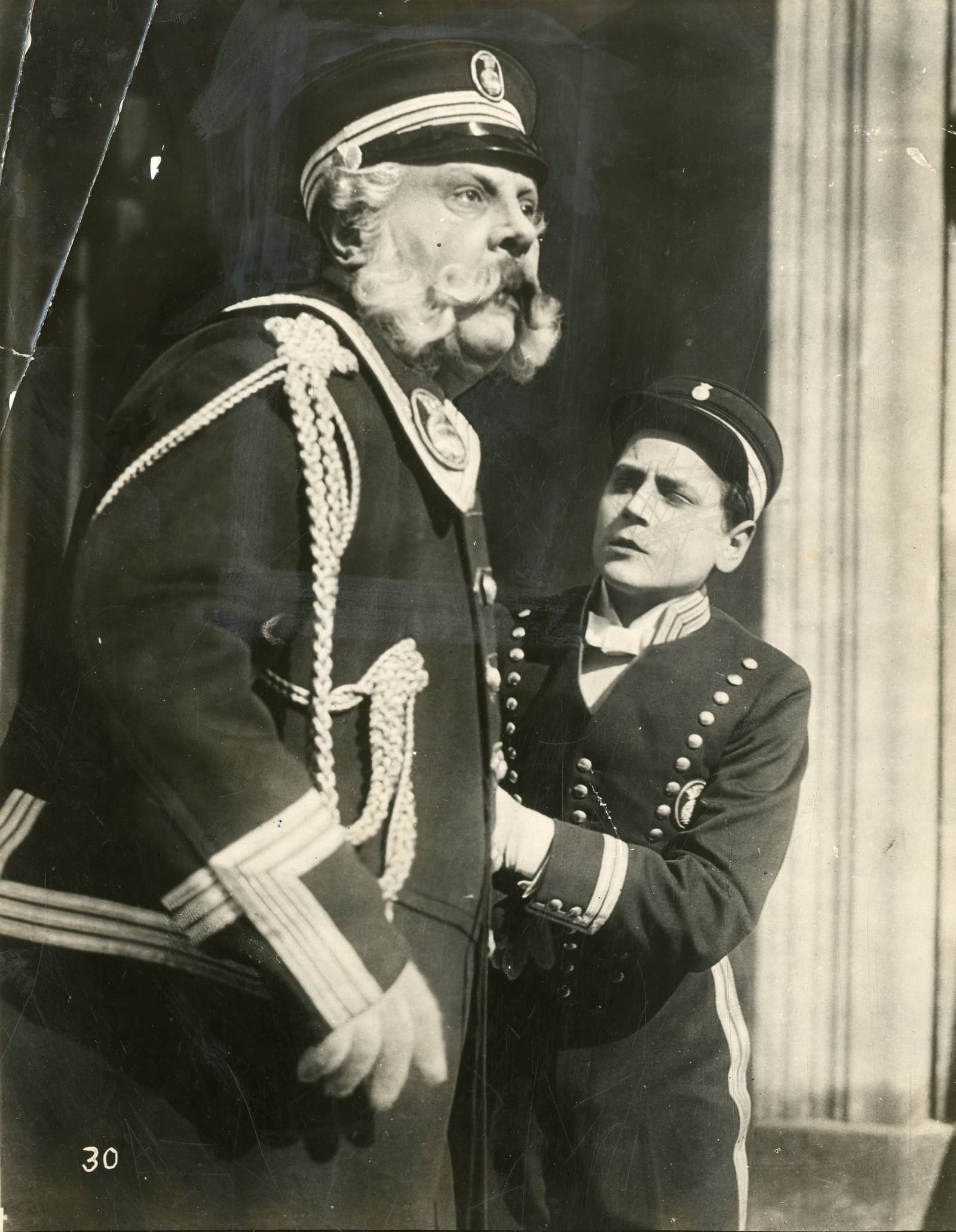
The Uniform Is A Moving Set
The doorman's coat is oversized in every sense. It carries buttons, braid, posture, ritual, and permission. In front of the Atlantic Hotel, it lets him stand between the building and the street as if he were part of the architecture. At home, it lets his tenement neighbors borrow some of the hotel's glamour by association. San Francisco Silent Film Festival's essay is sharp on this point: the doorman's authority comes less from character than from position, represented by the button-heavy overcoat that gives his community reflected pride.[2]
Murnau and Freund make that borrowed authority visible by making the lobby move around him. The hotel is not just a workplace. It is a machine that manufactures hierarchy through doors, elevators, polished floors, revolving traffic, luggage, uniforms, and gaze. When the doorman is still installed at the entrance, his body belongs to that machine. His gestures appear ceremonial, almost liturgical: greet, lift, salute, turn, shine. He is a laborer, but the costume lets the labor read as command.
The tragedy begins when the same system stops needing him in that role. The manager's decision is administrative, but the film stages it as a stripping. MoMA describes the loss of the uniform as the film's most brutal moment, comparable to tearing away skin.[1] That metaphor fits because the coat has become the doorman's public body. Once it is removed, he is not merely unemployed or reassigned. He is unreadable to the people whose admiration depended on the sign.
Camera Movement Turns Psychology Into Weather
The film's reputation rests heavily on its mobile camera, and rightly so. Senses of Cinema links Der Letzte Mann to the "unchained camera," a style of free, energetic movement and unusual angles that creates a subjective point of view.[3] MoMA adds one of the key production examples: in the opening, the camera descends in the hotel's glass elevator and then moves through the lobby on a bicycle.[1] Those facts matter because they reveal how physically solved the film's psychology is. Feeling is not added after the shot. Feeling is engineered into the shot's route.
The opening descent is more than a flourish. It teaches the viewer to read the hotel vertically and socially. The elevator comes down through glass, the lobby opens, staff and guests circulate, and the doorman appears as a node in a bigger system of display. The movement gives the building prestige before the plot has explained why prestige matters. We understand the doorman's pride because the camera has already taught us how impressive the world around him feels.
After the demotion, movement changes register. The camera can become woozy, heavy, or intrusive. Cineaste's review describes the camera as making the spaces it crosses into an interiorized landscape of the doorman's psyche while keeping the film's satire intact.[4] That balance is crucial. The technique is subjective, but the movie is not trapped inside private feeling. It keeps returning humiliation to public space. Shame happens in hallways, courtyards, streets, stairwells, and the watchful geometry of neighbors.
Almost No Intertitles Means No Escape Hatch
The film's near-absence of intertitles is not a silent-era novelty for its own sake. It is a moral constraint. If dialogue cards kept explaining the doorman's feelings, the viewer could retreat into literary sympathy: he is sad, he is proud, he is wronged. Murnau, Mayer, and Freund choose a stricter path. They make the viewer infer status from posture, lighting, movement, and arrangement.
San Francisco Silent Film Festival emphasizes Carl Mayer's role in imagining camera movement as a way to convey vertigo as people confront their environment.[2] That idea explains why the film feels so modern. The doorman's problem is not merely that he has an emotion. It is that his environment has changed its grammar. The same courtyard that once reflected his grandeur now reflects his exposure. The same route home becomes a corridor of detection. The same neighbors who admired him now become instruments of social measurement.
This is where The Last Laugh differs from a simple melodrama about an old worker betrayed by management. Its deepest subject is legibility. Who gets to look important? Who gets believed when his exterior changes? Who can survive when the signs that organized his identity are taken away? The film answers those questions with images before it answers them with events.
The Body Carries What The Camera Reveals
Emil Jannings's performance can look enormous by modern standards, but the scale is part of the design. The doorman is a man who has trained his body to be seen. His chest, stride, chin, and arm movements are all public architecture. When the uniform disappears, that architecture buckles. Jannings does not merely show sadness; he shows a body losing the role that taught it how to occupy space.
That is why the demotion to washroom attendant is so precise. It is not simply lower status. It is spatial reversal. The doorman moves from threshold to interior, from public greeting to hidden service, from the hotel's grand exterior face to its most humiliating back function. The job forces him into a room where bodies are managed without ceremony. The film's cruelty lies in how exact that relocation is. It does not only take away income or title. It changes which part of the building his body is allowed to represent.
The watchman who covers him later offers one of the film's few gestures of plain kindness, but even that kindness cannot restore the lost sign system. A coat can warm him; it cannot make the neighborhood read him as powerful again. Murnau's camera understands the difference. It can grant intimacy, but it cannot pretend that social vision has become merciful.
The Epilogue Is Not A Mistake So Much As A Trap
The late epilogue, in which the broken doorman unexpectedly becomes rich, has often been treated as a tacked-on happy ending. Cineaste notes the common claim that producers forced a happier resolution, but it also argues that the epilogue is cunningly poised between warmth and satire.[4] That second reading is the more useful one because the ending does not erase what came before. It exposes the absurdity of a world in which status can be restored only by a fairy-tale transfer of wealth.
The epilogue is funny because it is too much. The former doorman, now wealthy, eats grandly and dispenses largesse. But the film's form has already taught us that spectacle is not innocence. We have seen how quickly admiration follows costume, position, and money. The new ending therefore becomes an experiment: if society humiliated him when he lacked the correct signs, will it adore him once the signs return in richer form?
The answer is bitterly comic. The film gives him the last laugh, but it does not make the social world kinder. It makes the social world legible. Money can repair his public outline because that outline was never rooted in moral knowledge. The neighbors did not understand him before, abandon understanding during his fall, and recover it at the end. They read symbols, and the symbols change.
Why The Technique Still Cuts
The lasting power of The Last Laugh is that every famous craft element serves the same pressure system. The mobile camera is not decoration. The missing intertitles are not asceticism. The hotel set is not merely impressive. The uniform is not a prop. Together they make social rank feel like something a body must wear, carry, perform, and survive losing.[1][2][3]
That is why the film's influence is larger than the usual history-of-camera-movement summary. Freund's camera matters because it turns technique into social sensation. It shows how architecture can flatter a worker one day and swallow him the next. It shows how a costume can become a borrowed soul. It shows how public respect, once revealed as costume-deep, can become more terrifying than open cruelty.
Nearly a century later, the doorman's fall still feels raw because Murnau does not ask whether status is superficial. He assumes it is, then asks why superficial signs hurt so deeply when they are removed. The Last Laugh answers by making the camera feel the removal. It lets the image descend, sway, expose, and bend until the uniform coming off is not just something we see. It is something the whole film seems to undergo.
Sources
- MoMA, "Der Letzte Mann (The Last Laugh). 1924" - collection page with synopsis, uniform analysis, camera movement, and expressionist technique notes.
- Michael Fox, "The Last Laugh," San Francisco Silent Film Festival - essay and screening note on Carl Mayer, Karl Freund, the uniform, near-absence of title cards, and production details.
- Darragh O'Donoghue, "Der Letzte Mann (The Last Laugh)," Senses of Cinema - critical overview of the film's realistic/expressionist design and unchained-camera style.
- Andrew Schenker, "The Last Laugh (Web Exclusive)," Cineaste - review discussing the unfettered camera, subjective space, satire, and epilogue.
- Wikimedia Commons, "File:The Last Laugh (SAYRE 14726).jpg" - 1925 publicity still from the University of Washington J. Willis Sayre Collection, source for the article image.