Discusses the journey and the final reunion in the 1999 film.
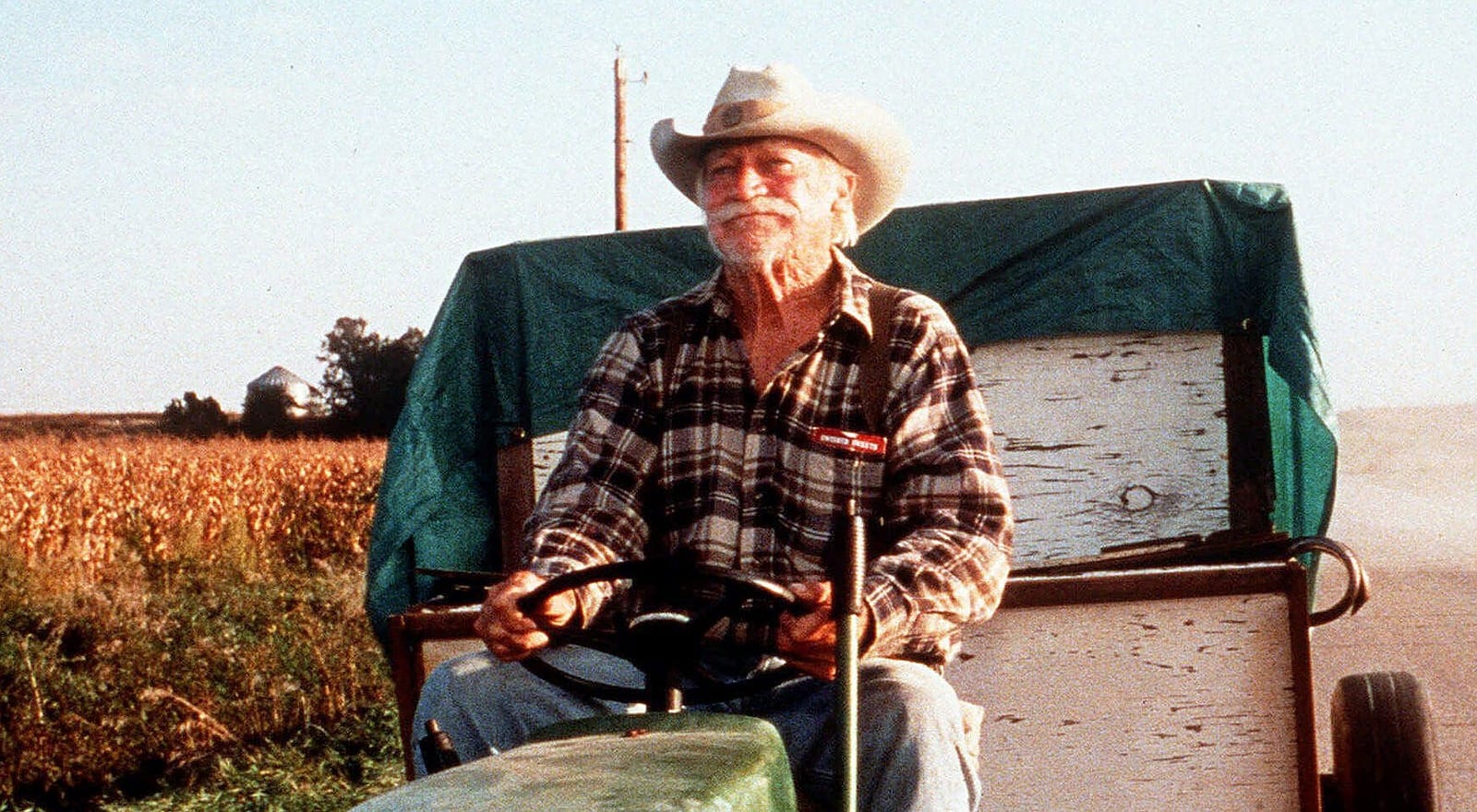
A riding mower is an awkward vehicle for an urgent visit. Alvin Straight's brother has suffered a stroke; Alvin's poor eyesight prevents him from driving a car, and even walking requires two canes. He sets out from Iowa toward Wisconsin on a John Deere, carrying a determination his machinery can express only very slowly. That mismatch supplies David Lynch's The Straight Story with an unusually exact filmmaking problem: how do you let an audience feel the effort of a journey without making every mile feel the same?[1]
Richard Farnsworth plays Alvin, with Sissy Spacek as his daughter Rose; Mary Sweeney and John Roach wrote the screenplay.[1] The film's modest scale invites close attention to its construction. Movement, noise, and hesitation keep changing the meaning of the time we spend beside this man. A delay can be funny, frightening, or intimate, depending on where the camera stands and what we hear.
A camera that can travel faster than its subject
An early crane shot makes the difference in speed visible. The camera begins close behind the mower, rises to show the highway ahead, waits, then descends. Alvin has advanced only a little. Camera operator Gordon Hayman used a truck-mounted Shotmaker crane; cinematographer Freddie Francis described how its movement helped articulate the journey's pace.[2]
The joke depends on returning. While the camera looks outward, we are briefly allowed the freedom of a much faster traveler. Coming back to the mower makes us measure what Alvin has actually accomplished. The landscape has opened; his situation remains stubbornly small. The shot gives distance a human denominator.
Francis also explained that, whatever the lighting mood, he protected the visibility of the actors' eyes.[2] We can survey the country and still need to come close enough to read the person crossing it. Scale keeps changing without making him disappear.
The road becomes dangerous through the ears
For the passage in which large trucks surround Alvin, re-recording mixer John Neff recorded idling and accelerating semis at California's Castaic Truck Stop. He described using those strained engine sounds in the film's 5.1 mix, including its subwoofer, to give the larger vehicles their threatening presence.[3]
That distinction matters. The scene's force does not depend on microphones simply preserving whatever happened beside the camera. The mix makes us experience the disparity between vehicles. Alvin's exposed seat leaves him within a world of engines whose power is wildly disproportionate to his own.
The effect also changes what slowness means. A leisurely pace can be a pleasure when there is room to choose it. Surrounded by heavy traffic, it becomes an inability to get clear. My reading is that the soundtrack briefly turns the mower from a declaration of independence into a measure of vulnerability. The same machine supports both feelings; the surrounding noise changes our judgment.
Leave the second call in
In Michael Sragow's 1999 interview with Lynch, the interviewer notes that the published screenplay includes incidents absent from the finished movie, among them a police stop. Lynch describes a process in which scenes change value as the film takes shape: material expected to be essential can go, while an inconspicuous fragment can become indispensable.[4]
Sragow offers a particularly revealing example at the reunion. Alvin calls his brother's name twice, although the script contains only one call. The second sounds worried. Lynch, in turn, singles out Farnsworth's sharp intake of breath near the ending as something that moved him in the editing room.[4]
A repeated name adds almost no information. It adds time in which confidence can become fear. The audience has already understood where Alvin wants to go; now it has to wait with him to discover whether arrival will be enough. That is an editing choice with an emotional consequence: preserve a small variation in delivery, and the destination remains uncertain for another moment.
In a separate contemporary interview, Lynch emphasized the effort involved in Alvin's chosen way of traveling. The journey's reason gave it power; its difficulty mattered to making amends.[5] That observation helps connect the mower to the voice on the porch. Both are forms of reaching toward someone, neither backed by any guarantee of a reply.
The film trains our attention accordingly. First, we notice how little ground a mower covers. Then we hear how much road other machines can occupy. Finally, a voice needs to cross only the distance to a house, and that small distance feels immense. By then the scale of a journey has become something we can recognize without consulting a map.
Sources
- Walt Disney Studios, “The Straight Story” — official synopsis and cast and screenplay credits.
- American Cinematographer, “Straight Shooting on The Straight Story” (November 1, 1999) — Francis and Hayman on camera movement and lighting; source of the film image.
- Matt Fagerholm, “John Neff on ‘The Straight Story,’ ‘Mulholland Dr.’ and ‘Inland Empire’,” Indie Outlook (May 2, 2022) — first-person account of the truck recordings and surround mix.
- Michael Sragow, “‘I want a dream when I go to a film’,” Salon (October 28, 1999) — interview with Lynch on editing and the final reunion.
- Bob Graham, “David Lynch Plays It ‘Straight’,” San Francisco Chronicle, via SFGATE (October 17, 1999) — Lynch on the journey's effort and purpose.