Spoilers throughout, including the final shot.
Mac finishes a call to his boss, steps out of the telephone box, and notices a baby in a pram. He asks whose it is. The people nearby look uncertain. Production historian Jonathan Melville traces the moment to Peter Riegert, who spotted the baby during filming and suggested the question; the other actors had no scripted answer.[2] A corporate errand has wandered into a conversation nobody knows how to finish.
That small interruption belongs at the heart of Local Hero. Bill Forsyth's 1983 comedy sends Mac, a Houston oil executive played by Riegert, to acquire the Scottish village of Ferness for a refinery. His employer, Felix Happer, is played by Burt Lancaster.[1] Mac arrives with a purpose clear enough to fit into a telephone report. The village keeps supplying things that fall outside it.
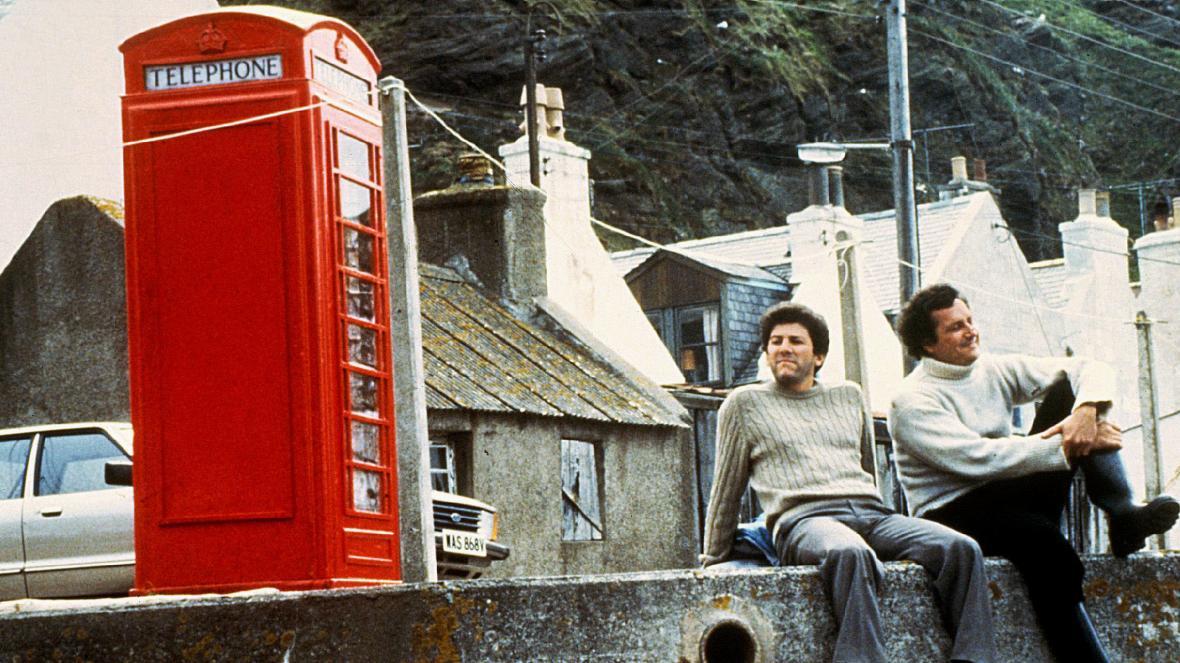
Business within earshot
The baby joke takes only a detour from Mac's work, yet that detour changes the scene's scale. He has been speaking to the man who can buy the place; now he cannot identify one of its smallest inhabitants. Riegert's question lets curiosity interrupt competence. A village is beginning to acquire particular people where his assignment supplied a purchasable site.[2]
Jonathan Murray's Criterion essay identifies the telephone as a recurring contrast between Houston and Ferness: plentiful devices accompany strained relationships in the city, while the Scottish public phone brings communication into a shared physical setting.[3] The booth offers Mac a little enclosure, but its door opens directly onto other people's lives. Finishing a call cannot mean finishing with the world around him.
The residents have their own plans
Forsyth complicates this attraction by giving the villagers an appetite for the very transaction Mac increasingly dislikes. Gordon Urquhart, the hotelier played by Denis Lawson, helps organize a community keen to sell. Their apparent reluctance is bargaining, not proof that they are too innocent to understand money.[3]
That distinction protects them from becoming accessories to Mac's holiday revelation. He can find their home restorative while they find a large payment attractive. Enjoying a place does not settle what its inhabitants should do with it.
At the ceilidh, Mac drunkenly proposes swapping lives with Gordon: the hotel for the American job and possessions. Melville places that offer amid Gordon's efforts to settle the village's price.[2] The bargain has become personal. Mac wants what he imagines Gordon already has, just as Gordon sees possibilities in what Mac can offer. Neither desire cancels the other.
A place assembled for the camera
Ferness itself is a construction. Criterion producer Kate Elmore records that the beach material was filmed around Morar on Scotland's west coast and the village scenes in Pennan, far away on the northern coast. A full-size cardboard church facade helped join the locations into a plausible whole.[4]
The geography matters to the film's invitation. We experience a harbour, a beach, and a settlement as neighbouring parts of one habitable world. Their continuity is an achievement of filmmaking. Mac's wish to stay depends on a place the production has made us able to imagine together.
The phone box gives that expansive landscape a modest point of return. Someone can cross the frame, enter it, and speak to another continent. A large distance becomes briefly manageable through one small door.
Who gets to decide the happy ending?
The film's political difficulty survives its charm. In his contemporary Sight and Sound review, Nick Roddick objected that Happer's eventual change of heart leaves the oil company's underlying power intact. A powerful man's sympathy can alter a plan without changing who possesses the authority to make it.[5]
This objection is useful because affection can make the resolution seem more complete than it is. Ben, the beachcomber played by Fulton Mackay, obstructs the proposed development; Happer's intervention changes its direction.[5] The preservation of a view does not by itself tell us whether everyone living within that view has gained the future they wanted.
Mac's departure belongs to this unfinished business. His growing attachment has not made him the village's owner, its representative, or a permanent resident. The story can move him deeply without granting him the right to determine its outcome.
The ring that leaves room
Back in Houston, Mac has photographs and shells. The film eventually cuts to Ferness, where the red phone rings.[5] We are invited to hear a call from Mac; no reunion arrives to complete that invitation.
Forsyth's account of the ending makes its uncertainty especially revealing. Speaking to Jonathan Murray in an interview published in 2015, he recalled that the American preview version ended with Mac on his Houston balcony. Warner Bros. wanted something happier and offered to finance a reshoot. Forsyth instead proposed reusing existing village footage and adding the ringing telephone.[6]
He remained unsure whether the alteration offered hope or made the loneliness worse: a telephone number could be the extent of Mac's remaining connection. The compromise satisfied a request for reassurance while preserving the distance between wanting to return and actually returning.[6]
The booth has changed its emotional direction. Earlier, it allowed business to reach into Ferness. Now it lets longing travel back toward it. The village remains visible, the connection remains possible, and the film stops before anybody picks up.
Sources
- The Criterion Collection, Local Hero — official edition page; release year, premise, director, cast, and credits.
- Jonathan Melville, “Local Hero,” Books from Scotland, November 2022 — production research on the improvised baby question, the ceilidh, and the ending.
- Jonathan Murray, “Local Hero: Our Man in Ferness,” The Criterion Collection, September 24, 2019 — the villagers' bargaining, telephone motif, and competing ideas of home.
- Kate Elmore, “10 Things I Learned: Local Hero,” The Criterion Collection, October 2, 2019 — filming geography and constructed scenery.
- Nick Roddick, Local Hero review, Sight and Sound, Spring 1983; republished by BFI — contemporary criticism of Happer's power and the film's resolution; source of the photographic film still reproduced above.
- Jonathan Murray, “Cornflakes versus Conflict: An Interview with Bill Forsyth,” Journal of British Cinema and Television 12.2 (2015), pp. 245–264 — accepted manuscript, especially PDF pages 10–11 on the revised ending.